Buying property in Phuket can still make sense in 2026, but buyers need to be more selective than during the strongest post-pandemic recovery years.
The main risks are no longer simply about whether Phuket property prices will rise or fall. Foreign buyers need to assess legal structure, competing supply, developer quality, rental legality, maintenance costs and future resale liquidity at the level of the individual property.
A strong location does not automatically make a strong investment, and an attractive brochure does not remove legal, construction or resale risk.
JFTB Real Estate Phuket has advised international property buyers since 2013. This guide examines the main Phuket real estate risks in 2026 from a buyer’s perspective and explains what should be checked before committing capital.
Phuket Real Estate Risks in 2026: Quick Answer
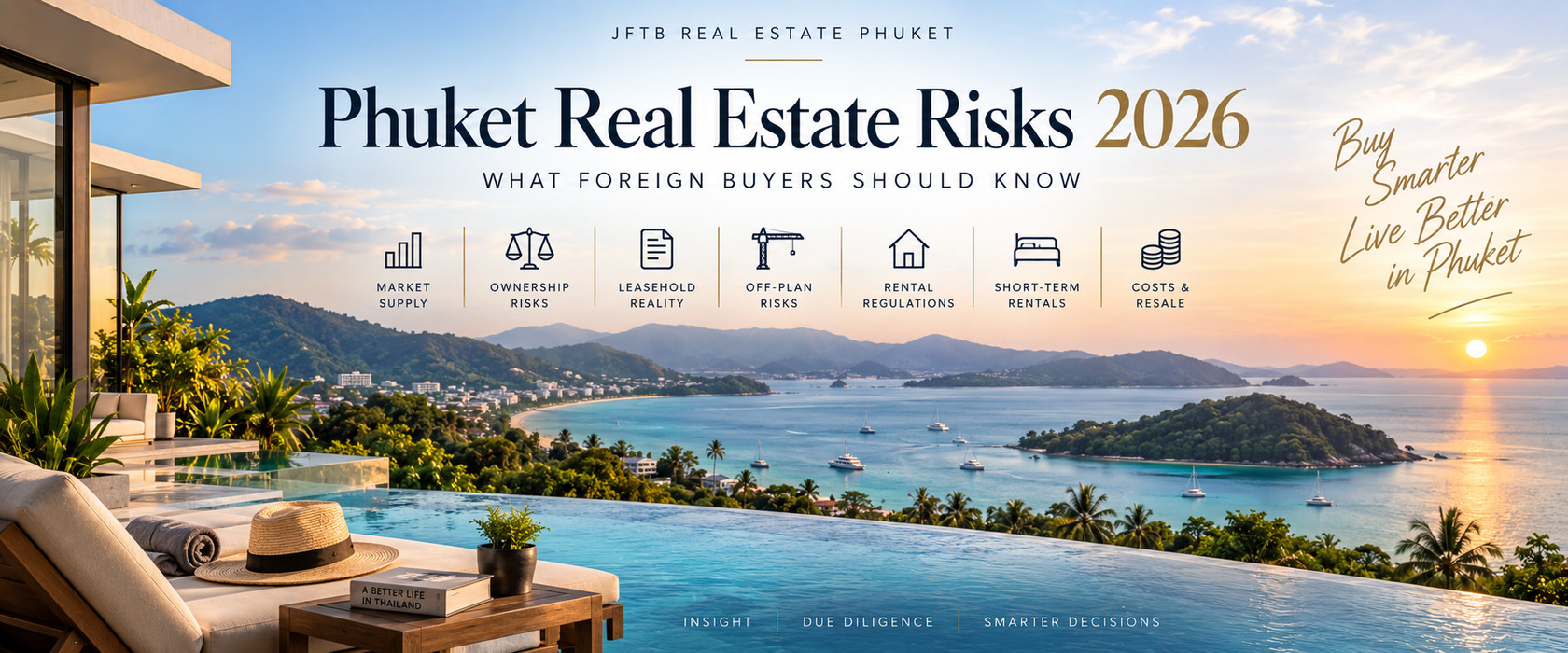
The seven main risks foreign buyers should consider are:
- Oversupply and weak resale liquidity
- Inappropriate or risky ownership structures
- Misunderstanding 30-year leasehold rights
- Off-plan developer and completion risk
- Residential rental regulation
- Short-term rental legality
- Underestimating maintenance, operating costs and exit risk
There is no single “Phuket property risk”.
A foreign-freehold condominium in Patong, a luxury villa in Bang Tao, an off-plan development in Rawai and a leasehold property in Kamala can all have completely different risk profiles.
The stronger approach is to verify the legal structure independently, compare the property with real competing supply and test the investment case without relying on aggressive rental or appreciation assumptions.
1. Phuket Property Supply: The Real Risk Is Buying the Wrong Asset
Phuket is not one uniform property market.
Bang Tao, Cherng Talay, Layan, Kamala, Patong, Rawai, Nai Harn, Kata, Karon, Mai Khao and Phuket Town serve different buyer profiles, rental markets and price segments.
A project can perform well while another development only a few kilometres away struggles to achieve either rentals or resales.
The important issue in 2026 is therefore not a simplistic island-wide “property crash” narrative.
The more relevant risk is competition.
Significant condominium and villa supply has entered Phuket in recent years, while further projects are under construction or planned in several high-growth areas.
That gives buyers more choice, but it also means future sellers may face considerably more competition.
What Buyers Should Check
Before purchasing, compare:
- Existing units for sale in the same project
- Competing developments within the same micro-market
- Properties scheduled for completion nearby
- Developer pricing versus resale pricing
- Actual resale transactions where available
- Rental competition
- Property differentiation
- Likely future buyer profile
The key question is not simply:
“Is Phuket property going up?”
It is:
“Why would a future buyer choose this particular property instead of the alternatives available at that time?”
Among the most important Phuket Real Estate Risks 2026, increasing competition affects both future pricing and resale liquidity.
Resale Liquidity Matters
Resale liquidity is one of the most underestimated Phuket real estate risks.
A villa may be impressive but appeal to a relatively narrow buyer pool.
A condominium may have a strong location but compete with hundreds of similar units.
A property can therefore increase in theoretical value while still being difficult to sell at the price an owner expects.
Location selection must also be assessed at micro-market level. Buyers comparing Bang Tao, Kamala, Rawai, Kata, Karon, Patong or other parts of the island should also read JFTB’s Where to Buy Property in Phuket in 2026 guide.
For broader market context, see the Phuket Property Market 2026 analysis.
2. Foreign Ownership and Nominee Structures
Ownership structure remains one of the central Phuket Real Estate Risks 2026 for international buyers.
Foreign buyers need to understand exactly what they will legally own.
Thailand provides a relatively clear direct ownership route for qualifying foreign-freehold condominium units within the applicable foreign ownership quota.
Official Thai government guidance confirms that foreign ownership in a condominium cannot exceed 49% of the total unit area of the condominium. See the Thai government guidance on foreign property ownership.
Villa and land transactions require more analysis because foreign land ownership is generally restricted.
Depending on the property, buyers may encounter:
- Leasehold land
- Separate building ownership
- Thai company ownership
- Usufruct rights
- Superficies
- Existing corporate structures
- Estate ownership arrangements
The existence of a structure does not mean it is appropriate for every buyer.
Increased Scrutiny of Nominee Arrangements
Thai authorities have continued to scrutinise nominee structures and corporate arrangements used to circumvent restrictions on foreign land ownership.
Foreign buyers should therefore be particularly cautious when a proposed transaction relies on Thai shareholders who have no genuine economic participation or business role.
A Thai company should never be treated as a casual workaround allowing a foreign purchaser to control land.
Nominee arrangements can create substantial legal, financial and tax exposure.
What to Ask Before Buying Through a Company
Before using or acquiring a company structure, verify:
- Who the shareholders are
- Whether they are genuine shareholders
- Company history
- Accounting records
- Tax compliance
- Existing liabilities
- Directors
- Contracts
- Beneficial ownership
- The genuine business purpose of the company
Buying shares in a company is not the same transaction as buying a property directly.
The purchaser may acquire the company’s liabilities as well as its assets.
Foreign buyers who need a broader explanation of condominium ownership, villas, land restrictions and legal structures should read JFTB’s Buying Property in Thailand as a Foreigner guide.
Independent Legal Advice
The lawyer reviewing a transaction should ideally be independent from:
- The developer
- The seller
- The listing agent
- The company being acquired
The important question is not whether a structure is commonly used.
It is whether it is lawful, properly documented and appropriate for the specific transaction.
3. Leasehold Property: Do Not Treat 30+30+30 as 90 Years
Leasehold is frequently used in Phuket villa transactions.
A properly registered lease can provide a legitimate right of use, but buyers need to distinguish clearly between the registered lease term and promises concerning future renewals.
Thai law generally limits a registered lease of immovable property to a maximum initial term of 30 years.
A future lease may potentially be entered into later, but that does not mean a buyer automatically receives a registered 60-year or 90-year property right at the beginning.
Leasehold misunderstanding therefore remains one of the most important Phuket Real Estate Risks 2026 for foreign villa buyers.
The 30+30+30 Problem
Marketing materials sometimes describe a property as:
30 + 30 + 30 years
This can create the impression of a guaranteed 90-year property right.
Buyers should not value the property on that assumption.
The correct analysis is:
- What is registered today?
- Who owns the land?
- What does the contract actually promise?
- What happens at the end of the registered term?
- What happens if the land is sold?
- What happens if the landowner dies?
- What happens if the land becomes encumbered?
- Can the lease be transferred?
- Can the rights pass to heirs?
- What legal protection applies to future renewal promises?
Thai court decisions concerning pre-agreed renewal structures have reinforced the need to distinguish a valid registered 30-year lease from arrangements intended to create the effect of a much longer guaranteed right.
The practical message for buyers is simple:
Do not pay for 90 years of security if only 30 years are presently registered.
For a detailed explanation, read JFTB’s Thailand 30+30+30 Lease Explained: Why It Is Not a Secure Property Right.
4. Off-Plan Property: Developer Risk Matters More Than the Rendering
Developer reliability is another major component of Phuket Real Estate Risks 2026, particularly in projects purchased before completion.
Off-plan property remains an important part of Phuket’s real estate market.
Buying before completion can offer advantages including:
- Early-stage pricing
- Greater choice of units
- Staged payment schedules
- Modern design
- Developer incentives
- Potential price appreciation during construction
But off-plan purchases also expose buyers to risks that completed properties do not.
The most important question is not whether the rendering looks attractive.
It is whether the developer can legally, financially and technically deliver what is being sold.
Off-Plan Due Diligence Checklist
Before committing to an off-plan property, buyers should investigate:
- Land title
- Developer rights over the site
- Building permits
- Planning restrictions
- Environmental approvals where applicable
- Developer track record
- Previous completed projects
- Corporate structure
- Construction financing
- Project timeline
- Payment schedule
- Delay provisions
- Refund rights
- Termination clauses
- Specifications
- Common-area plans
- Management arrangements
- Sinking fund
- Common-area fees
- Assignment or resale rights before completion
Where possible, major payments should correspond to meaningful construction milestones rather than simply calendar dates.
A developer may have an impressive showroom, international branding and sophisticated marketing while still presenting legal, financing or completion risks.
Guaranteed Returns Do Not Remove Development Risk
A guaranteed rental return can make an off-plan purchase appear safer.
It does not remove construction or developer risk.
Buyers should ask:
- Who legally guarantees the return?
- Is it the developer or another company?
- Does that entity have sufficient financial strength?
- Is the guarantee secured?
- Is the guaranteed income effectively included in a higher selling price?
- Who pays operating expenses?
- What happens if completion is delayed?
- What happens when the guarantee expires?
A guaranteed return is only as reliable as the entity required to pay it.
Rental projections should therefore be treated as one part of the investment analysis, not as proof that the underlying property is a good purchase.
5. Residential Rental Rules and Landlord Risk
Residential rental regulation should therefore be included when assessing Phuket Real Estate Risks 2026 for investment properties.
Rental income is not purely a market question.
It is also an operational and legal question.
Updated residential contract-control requirements took effect in Thailand in September 2025 for qualifying rental businesses, including business operators renting multiple residential units.
Depending on the landlord and rental structure, regulated issues can include:
- Security deposits
- Advance rent
- Utility charges
- Contract wording
- Tenant rights
- Termination provisions
- Business-operator obligations
The exact application depends on the owner, number of units and rental structure.
An individual investor should therefore not assume that a lease template copied from another property automatically complies with current requirements.
For the detailed rules, including the definition of qualifying business landlords, deposits, advance payments and contract requirements, see JFTB’s Thailand Rental Law 2025 guide.
The Investment Lesson
Before purchasing a rental property, understand:
- Who will manage the tenancy
- What lease will be used
- Who collects and holds deposits
- Who pays utilities
- What management fees apply
- How maintenance is handled
- What happens if the tenant defaults
- What rules apply to the landlord
- How long vacancies are likely to last
- Whether the projected rent is gross or net of operating expenses
A property producing attractive theoretical rent can become a poor investment if vacancy, administration, management fees and maintenance are underestimated.
6. Short-Term Rentals: Airbnb Visibility Does Not Equal Legality
Short-term rental income is frequently used to market Phuket investment property.
This is an area where buyers need particular caution.
The fact that a condominium or villa appears on Airbnb, Booking.com or another accommodation platform does not automatically mean that operating short-term stays from that property is legally permitted.
Short stays can involve:
- Hotel licensing
- Condominium regulations
- Estate rules
- Building regulations
- Local enforcement
- Management restrictions
Condominium Risk
Some condominium buyers assume they can purchase a unit and immediately operate daily or weekly rentals.
That assumption should be checked before purchase.
Even where short-term rentals are already occurring in the same building, buyers should verify:
- Whether the activity is legally licensed
- What the condominium regulations allow
- Whether management permits or prohibits short stays
- Whether the building has the necessary operating structure
- Whether enforcement practices could change
- Whether projected rental income depends on daily rentals
Existing activity is not proof of legal compliance.
Short-term rental regulation is another of the Phuket Real Estate Risks 2026 that should be checked before projected rental income is accepted.
Never Buy Based Only on a Short-Term Rental Projection
If the entire investment return depends on nightly holiday rentals, the legal basis for that activity should be confirmed before buying.
A useful stress test is:
Would this property still make sense if I could only rent it long term?
If the answer is no, the investment may carry significantly more regulatory risk than the marketing presentation suggests.
This guide examines the main Phuket Real Estate Risks 2026 foreign buyers should understand before committing capital.
7. Maintenance, Operating Costs and Exit Risk
Maintenance and operating expenses are among the less visible Phuket Real Estate Risks 2026, especially for larger villas.
Legal structure and market pricing receive a lot of attention, but operating costs can quietly destroy investment performance.
This is particularly relevant for Phuket villas.
Common Villa Costs
Owners may need to budget for:
- Pool maintenance
- Landscaping
- Air-conditioning
- Electricity
- Water
- Pest control
- Security
- Staff
- Property management
- Roof maintenance
- Waterproofing
- Pumps
- Drainage
- Furniture replacement
- Corrosion
- Insurance
Tropical weather, humidity, heavy rain and salt air can increase maintenance requirements.
A large luxury villa can therefore generate impressive gross rental income while producing a much weaker net return.
Condominium Costs
Condominium investors should review:
- Common-area fees
- Sinking fund
- Building management
- Future major repairs
- Reserve funds
- Lift maintenance
- Swimming pool maintenance
- Building insurance
- Historical fee increases
- Possible extraordinary assessments
A poorly managed condominium can deteriorate physically and lose resale appeal even if the individual unit remains in good condition.
Management quality therefore affects both operating cost and long-term asset value.
Always Model the Exit Before Buying
Resale liquidity is a critical part of Phuket Real Estate Risks 2026 because investment performance ultimately depends on future buyer demand.
Buying is only half of an investment strategy.
Eventually, another buyer must want the property.
Before purchasing, ask:
- Who is the likely future buyer?
- Can another foreign buyer own the property directly?
- Will competing new projects offer better facilities?
- Is the design likely to age well?
- Are maintenance costs reasonable?
- Is the ownership structure easy to understand?
- Is there genuine scarcity?
- How many similar properties are already listed?
- How easy will the property be to explain and finance at resale?
- What would make a buyer choose this asset five or ten years from now?
A property can perform well operationally but still be a weak investment if the eventual resale market is too narrow.
Phuket Property Due Diligence Checklist
Before making a major commitment, foreign buyers should review at least the following areas.
Legal
- Registered owner
- Land or condominium title
- Encumbrances
- Foreign ownership quota where applicable
- Lease terms
- Company structure
- Legal access
- Building permits
- Contractual rights and obligations
Financial
- Purchase price versus comparable properties
- Transaction costs
- Taxes
- Common fees
- Sinking fund
- Management costs
- Maintenance budget
- Rental assumptions
- Vacancy assumptions
- Net rather than gross return
Physical
- Construction quality
- Waterproofing
- Drainage
- Air-conditioning
- Electrical systems
- Plumbing
- Pool systems
- Structural condition
- Signs of humidity or corrosion
Market
- Current competing listings
- Future supply
- Rental competition
- Buyer demand
- Resale liquidity
- Property differentiation
- Likely future buyer profile
Developer
For off-plan property:
- Track record
- Previous projects
- Permits
- Financing
- Construction progress
- Contractual protections
- Completion obligations
- Delay history where relevant
Due diligence should answer two different questions:
Can I legally buy this property?
And:
Should I buy this particular property at this price?
The second question is often the one buyers underestimate.
How to Reduce Phuket Real Estate Risk
Managing Phuket Real Estate Risks 2026 starts with identifying problems before signing a reservation agreement or committing substantial capital.
Risk cannot be eliminated completely, but it can be reduced substantially.
A disciplined buying process should normally include:
- Choose the property before choosing the ownership structure.
- Compare real competing inventory.
- Use an independent lawyer.
- Verify title, access and ownership rights.
- Inspect completed properties physically.
- Investigate the developer for off-plan purchases.
- Stress-test rental projections.
- Calculate net rather than gross returns.
- Understand operating and maintenance costs.
- Define the likely future resale buyer before purchasing.
A good property should still make sense after optimistic assumptions are removed.
For investors evaluating the overall opportunity rather than a single transaction, JFTB’s Phuket property investment guide examines investment strategy, ownership, locations, returns and property selection in greater depth.
Is Phuket Real Estate Too Risky in 2026?
No.
But buyers need to be more selective.
Phuket remains one of Southeast Asia’s established international resort and lifestyle property markets.
Strong assets can still offer compelling lifestyle and investment value.
The mistake is assuming that Phuket’s overall popularity will protect every individual property.
It will not.
A well-priced condominium with clean foreign freehold ownership, strong management and genuine buyer demand can have a very different risk profile from a visually impressive property with complicated ownership and unrealistic rental assumptions.
Likewise, an exceptional villa with a clear legal structure, genuine scarcity and a credible future buyer pool may remain desirable even in a more competitive market.
The objective is not to avoid every form of risk.
It is to understand which risks are justified by the asset and expected return — and which risks should simply be avoided.
Understanding the Phuket Real Estate Risks 2026 before signing a reservation or purchase agreement can prevent much more expensive problems later.
Buying Property in Phuket with JFTB
JFTB Real Estate Phuket has advised international property buyers since 2013.
Our role is not simply to present available properties.
We help buyers compare opportunities, challenge pricing and projected returns, identify potential ownership or resale issues and coordinate independent legal due diligence before a transaction moves forward.
For foreign buyers, many of the most expensive property mistakes are made before the contract is signed.
Independent analysis at the beginning of the process can therefore be considerably more valuable than trying to solve a structural problem after the purchase.
FAQ — Phuket Real Estate Risks 2026
Is Buying Property in Phuket Safe?
It can be, provided that the property, title, ownership structure, contracts and physical condition are independently reviewed before purchase. The level of risk varies considerably between individual properties.
Can Foreigners Own Property in Phuket?
Foreigners may directly own qualifying condominium units within the applicable foreign ownership quota. Villas and land require different legal structures and additional analysis because foreign land ownership is generally restricted.
Are Thai Company Structures Safe for Foreign Buyers?
A legitimate company can own property, but companies should not be used as nominal arrangements to circumvent foreign ownership restrictions. Both corporate and property due diligence are necessary.
Is 30+30+30 Leasehold Guaranteed?
No buyer should automatically treat a 30+30+30 marketing structure as a guaranteed 90-year registered property right. The registered lease term and contractual renewal provisions must be analysed separately.
Is Off-Plan Property Risky in Phuket?
Off-plan property carries developer, construction, permitting and completion risks that completed properties do not. Developer due diligence and contract review are therefore particularly important.
Can I Rent My Phuket Property on Airbnb?
Not automatically. Short-term rental activity can be affected by hotel licensing requirements, condominium rules, estate regulations, building requirements and local enforcement. The legal and operational basis of the rental strategy should be verified before purchase.
Is Phuket Oversupplied?
Competition differs significantly between Phuket micro-markets, property types and price ranges. Buyers should analyse existing and future supply at project and neighbourhood level rather than relying on broad island-wide claims.
What Is the Biggest Risk When Buying Phuket Property?
This is why assessing Phuket Real Estate Risks 2026 requires looking at the property, ownership structure, rental model and future resale together.
For many foreign buyers, the biggest risk is not one individual legal rule or market forecast. It is purchasing the wrong property at the wrong price under a structure that restricts rental, resale or future flexibility.