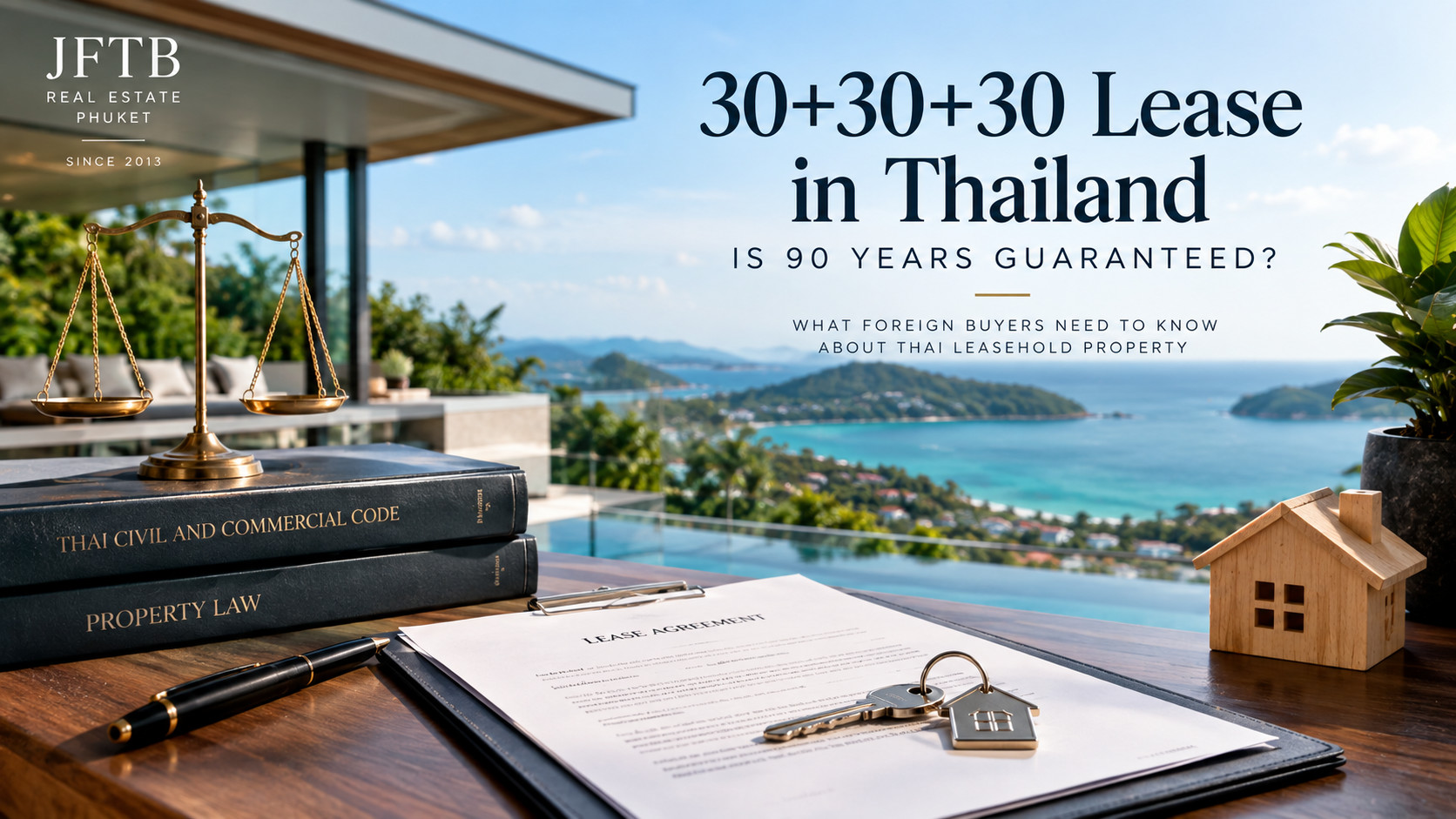
A 30+30+30 lease Thailand structure does not give a foreign property buyer a registered 90-year ownership right.
For an ordinary residential property lease, Thai law limits each lease term to a maximum of 30 years. A further lease may be agreed after the original term expires, but promises made today about years 31 to 90 should not be valued as though those additional 60 years were already registered at the Land Office.
This distinction is particularly important for foreign buyers considering villas and other properties where the underlying land cannot normally be owned directly in their personal name.
A property marketed as a “30+30+30 lease” may sound like a 90-year acquisition. Legally and commercially, the buyer needs to look much more carefully at what is actually being registered today.
What Does a 30+30+30 Lease Thailand Structure Mean?
In property marketing, 30+30+30 usually refers to:
- an initial lease of 30 years
- a promised second period of 30 years
- a promised third period of 30 years
That produces an advertised total of 90 years.
In practice, the term 30+30+30 lease Thailand is often used in property marketing to describe this type of arrangement, even though the buyer is not receiving one registered 90-year lease.
But the three periods do not provide the same legal security.
The first properly registered 30-year lease is fundamentally different from contractual promises concerning additional periods that may begin 30 or 60 years in the future.
For buyers comparing freehold and leasehold property in Thailand, this distinction is fundamental. A buyer should not value a 30+30+30 structure as though a continuous 90-year lease had already been registered.
The Legal Basis: Sections 538 and 540
Two provisions of Thailand’s Civil and Commercial Code are particularly important.
Under Section 538, a lease of immovable property must have written evidence signed by the liable party to be enforceable. Where the lease exceeds three years, it must be made in writing and registered with the competent authority to be enforceable beyond three years.
Under Section 540, the duration of a lease of immovable property cannot exceed 30 years. If a longer period is agreed, the term is reduced to 30 years. The law permits a lease to be renewed, but each renewed term cannot exceed 30 years.
The relevant provisions can be reviewed in the English translation of the Thai Civil and Commercial Code Sections 537–571.
The practical consequence is straightforward:
30 years registered today is not the same thing as 90 years secured today.
A properly registered 30-year lease gives the lessee enforceable rights for the registered term. A promise concerning what may happen when that term expires is legally and commercially different.
Supreme Court Decision No. 4655/2566
The legal risk surrounding the 30+30+30 lease Thailand structure became particularly important following Thai Supreme Court Decision No. 4655/2566.
The case concerned land and a house in Phuket.
The parties entered into an initial 30-year lease in 1990. On the same date, they also entered into arrangements intended to provide two additional 30-year periods after the initial term expired.
The transaction had therefore been structured from the outset to create the economic effect of a 90-year arrangement.
When the original 30-year term ended, the landowner sought to recover the property. The lessee relied on the agreements concerning the additional periods.
The Supreme Court held that the pre-arranged renewal structure was inconsistent with the 30-year limitation under Section 540. The initial lease term was treated separately from the additional periods that had been agreed in advance.
The decision is analysed in detail by Addleshaw Goddard and the case text and summary are also available under Supreme Court Decision 4655/2566.
For a foreign property buyer, the conclusion is important:
A pre-arranged 30+30+30 structure should not be treated as a guaranteed registered 90-year lease.
Does This Mean Every Lease Renewal Is Invalid?
No.
Section 540 itself contemplates renewal. The important distinction is between a future lease entered into when the relevant time arrives and a structure designed from the beginning to create, in substance, a lease exceeding the statutory 30-year limit.
The exact wording, timing, parties and circumstances matter.
What buyers should not do is assume that the words “renewable for another 30+30 years” provide the same legal security as the first registered lease.
For practical purposes, a buyer evaluating a 30+30+30 lease in Thailand should separate:
the rights registered today
from
the promises concerning future rights
That distinction should influence both the legal review and the price the buyer is prepared to pay.
The First 30 Years and the Next 60 Years Are Not Equivalent
Consider a simplified, illustrative example.
Villa A
Registered lease term: 30 years
Price: THB 20 million
Villa B
Advertised structure: 30+30+30
Price: THB 25 million
The seller of Villa B argues that the higher price is justified because the buyer effectively receives 90 years.
That conclusion should not be accepted without analysis.
The security attached to the first registered term is different from the security attached to future promised periods.
The difference can affect:
- valuation
- negotiation
- resale value
- inheritance planning
- financing
- transferability
- exit strategy
The issue is therefore not simply legal.
It is also financial.
This is why a 30+30+30 lease Thailand property should be valued according to the rights actually secured, not simply according to the total number of years advertised.
At JFTB, we still see Phuket properties marketed using 30+30+30 language. When analysing these properties for buyers, the relevant question is not the number of years shown in the brochure but the rights that can actually be registered, transferred and relied upon.
Registration Matters
Registration is a critical part of any long-term lease analysis.
For leases exceeding three years, Section 538 makes registration particularly important. An informal agreement or an unregistered long-term arrangement does not provide the same enforceability as a correctly documented and registered lease.
Before committing substantial capital, buyers should confirm exactly what will appear at the Land Office.
This should form part of a wider property due diligence review in Thailand covering the title, registered encumbrances, ownership, contracts and transaction structure.
A brochure may say:
90-year lease
A contract may say:
30+30+30
A developer may say:
renewable twice
The buyer should ask a simpler question:
What exactly will be registered at the Land Office on completion?
For an ordinary residential transaction, this will generally be the initial lease term of up to 30 years, not a single 90-year registered lease.
What Happens if the Land Is Sold?
This issue becomes particularly important over a 30-year period.
A registered lease can continue to have effect when ownership of the leased property changes, but contractual promises relating to future renewals must be analysed separately.
Section 569 of the Civil and Commercial Code is relevant to the effect of a transfer of ownership on an existing lease. The central distinction remains between the current lease and additional personal or contractual obligations that may have been agreed between the original parties.
A buyer should therefore establish:
- who currently owns the land
- whether the land is mortgaged or otherwise encumbered
- whether the lease can be assigned
- what happens if the landowner sells
- what happens if the landowner dies
- whether renewal obligations purport to bind successors
- who would actually have authority to grant a future lease
Thirty years is a long time. Owners, companies, heirs, lenders and circumstances can all change.
Land Ownership and Building Ownership Are Different Questions
For villa transactions, the legal position may involve separate rights relating to:
- the land
- the building constructed on the land
Foreign individuals are generally restricted from owning Thai land directly in their personal name. This is why foreign buyers should understand the broader rules on foreign land ownership in Thailand before comparing ownership structures.
Depending on the transaction, ownership or rights over the building may be structured separately from the underlying land.
The correct questions are therefore not simply:
Is this villa freehold or leasehold?
They are:
- Who owns the land?
- Who owns the building?
- What rights are registered?
- Who holds those rights?
- For how long?
- Can they be transferred?
- What happens when the lease expires?
Can a Superficies Strengthen a Villa Structure?
In some transactions, independent legal counsel may consider a registered right of superficies in addition to the land lease.
A superficies can help establish rights concerning a building situated on land owned by another person.
It does not make the foreign buyer the owner of the land, and it should not be presented as a universal solution.
Its value depends on factors including:
- how it is registered
- its duration
- transferability
- succession
- its relationship with the lease
- ownership of the building
These rights should be reviewed together rather than as isolated documents.
Should a Buyer Pay in Advance for Years 31 to 90?
This deserves particular caution.
Where a buyer is asked to pay today for periods that may only begin decades later, the buyer needs to establish precisely what legal right is being obtained in return for that payment.
Prepaying consideration does not by itself convert future promised lease periods into a presently registered 90-year right.
This point was particularly relevant in Supreme Court Decision 4655/2566, where the overall structure and pre-arranged future periods were central to the dispute.
Before paying substantial amounts for future lease periods, the complete structure should be reviewed by independent Thai legal counsel.
Can a Developer Guarantee a 30+30+30 Renewal?
The word guarantee should be treated carefully.
A developer, project company or landowner can make contractual commitments, but contractual language does not automatically create a registered 90-year lease.
A buyer should investigate:
- who owns the land
- who is making the renewal promise
- whether that party will still control the land decades later
- whether successors would be bound
- what happens if the company closes
- what happens if the land is transferred
- whether the land is mortgaged
- what legal security supports the promise
- whether the proposed arrangement complies with Thai law
A promise is only as useful as its legal enforceability and the ability of the responsible party to perform it when the time comes.
Resale Value Is a Major Issue
The remaining registered lease term can have a direct effect on resale.
Suppose a buyer acquires a villa under a registered 30-year lease and decides to sell 12 years later.
Eighteen years remain.
A future purchaser may ask:
- Can the existing lease be assigned?
- Can the buyer obtain a fresh 30-year lease?
- Who has authority to grant it?
- What will a new lease cost?
- What rights exist over the villa itself?
- What happens to the promised renewals?
These questions can reduce the number of potential purchasers and affect the price they are willing to pay.
A buyer should therefore consider resale liquidity before purchasing, not only when it is time to sell.
This is one reason lease structure should be analysed alongside the wider process of buying property in Thailand.
Already Own a 30+30+30 Lease Thailand Property?
Existing owners should also review their position.
If you bought a villa or another property marketed as a 30+30+30 lease in Thailand, separate the registered rights you currently hold from the future renewal promises contained in the original contracts.
Important points include:
- the remaining registered lease term
- the current identity of the landowner
- assignment rights
- rights over the building
- any registered superficies
- the wording of renewal provisions
- what happens following a sale or inheritance of the land
This becomes especially important when preparing the property for resale.
The asking price should reflect the rights that can realistically be transferred or granted to the next buyer rather than simply repeating the original “90-year” marketing proposition.
30+30+30 Lease Thailand: Buyer Checklist
Before buying a property marketed under a 30+30+30 structure, verify:
- the exact lease term being registered
- Land Office registration
- the legal owner of the land
- ownership or rights over the building
- title deed and registered encumbrances
- assignment rights
- inheritance provisions
- subletting rights
- renewal wording
- future rent or consideration
- what happens if the land is sold
- what happens if the landowner dies
- mortgages and other registered rights
- any superficies or related rights
- payments requested for future lease periods
- what happens at the end of the registered lease
- likely resale value as the remaining lease term declines
The title deed, lease agreement, sale agreement and related contracts should be analysed together.
Reading only one document can give an incomplete picture.
Are Longer Leases Ever Possible in Thailand?
There are limited statutory regimes outside the ordinary residential lease rules.
For example, the Immovable Property Lease for Commercial and Industrial Purposes Act B.E. 2542 (1999) provides for longer lease periods in qualifying commercial and industrial circumstances, subject to specific statutory conditions.
This special regime should not be confused with an ordinary residential villa lease.
A foreign buyer acquiring a private villa should therefore not assume that rules applicable to qualifying commercial or industrial investments can be used to create an ordinary residential 50-year or 90-year lease.
Is Leasehold Always a Bad Structure?
No.
A properly structured and appropriately priced leasehold property can make sense for some buyers.
The questions are whether:
- the registered term is clear
- the price properly reflects leasehold rather than freehold
- the lease can be assigned
- rights over the building are clear
- the structure can be understood by a future buyer
- the remaining lease period supports the expected resale strategy
- future renewals are presented realistically
The problem is not leasehold itself.
The problem is paying a price based on 90 years of assumed security when the rights actually being acquired are materially different.
Frequently Asked Questions
Is a 30+30+30 Lease Thailand Structure Legal?
A 30+30+30 lease Thailand structure can include a valid initial lease of up to 30 years when properly structured and registered. However, pre-arranged additional 30-year periods should not be treated as a guaranteed registered 90-year lease. Supreme Court Decision 4655/2566 is particularly important when considering structures designed from the outset to create successive 30-year terms.
Can I register a 90-year residential lease in Thailand?
An ordinary residential property lease cannot simply be registered today as one continuous 90-year lease. Section 540 limits each ordinary lease term of immovable property to 30 years.
Is every renewal clause invalid?
No. Renewal itself is contemplated by Section 540. But a future renewal is not equivalent to possessing that additional registered lease term today, and pre-arranged structures intended to circumvent the 30-year limit require particular caution.
Is the first 30-year lease still valid?
A properly executed and registered initial 30-year lease can remain valid even where arrangements intended to secure additional periods are ineffective. The exact transaction and documents should be reviewed individually.
Can a lease be renewed after 30 years?
Thai law permits renewal, with each renewed term subject to the statutory maximum. That is different from having the second or third term already secured and registered when the initial lease is signed.
Can foreigners acquire villas through leasehold structures?
Yes. Leasehold structures are commonly used where a foreign buyer cannot own the underlying land directly. The land lease, building rights, registration, transfer provisions and eventual resale position should all be reviewed separately.
Does 30+30+30 mean I own the property for 90 years?
No. A 30+30+30 lease in Thailand should not be interpreted as 90 years of direct ownership or as one presently registered 90-year property right.
JFTB Buyer Rule
When reviewing a leasehold property in Thailand, do not ask only:
“How many years does the brochure advertise?”
Ask:
“How many years are legally registered today, what happens when those years expire, and what am I actually paying for?”
That question can materially change the valuation and negotiation of the property.
Final Perspective
A 30+30+30 lease Thailand structure should not be valued as a guaranteed 90-year property right.
For an ordinary residential lease, Thai law limits each lease term to a maximum of 30 years. Supreme Court Decision 4655/2566 has reinforced the importance of distinguishing a valid initial lease from future periods arranged in advance to produce the economic effect of a much longer lease.
That does not make every leasehold property unsuitable.
It means buyers should distinguish clearly between rights registered today and promises concerning tomorrow.
Before paying a substantial deposit on a leasehold villa or another land-linked property in Phuket, the title, registered lease term, ownership of the building, renewal provisions, transfer rights and eventual resale strategy should be reviewed together.
If you are considering a property offered under a 30+30+30 or renewable lease structure, JFTB can help you assess the commercial terms before you commit and coordinate independent legal due diligence where required.