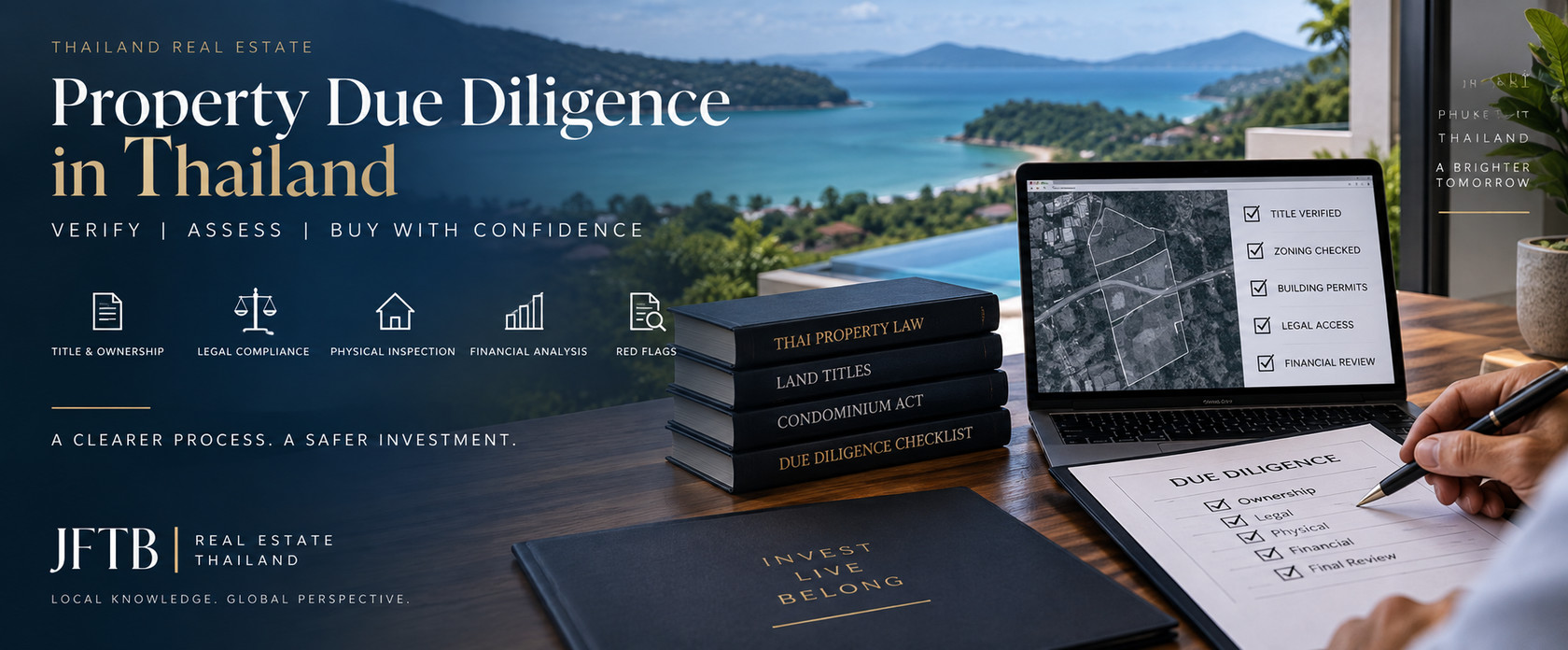
Buying property in Thailand should never begin with the question:
“Do I like this property?”
The first serious question is:
“Can I safely acquire the rights I think I am buying?”
That is the purpose of property due diligence in Thailand.
For a foreign buyer, due diligence is not simply a lawyer checking a title deed. A proper review should examine the legal ownership structure, the property itself, the seller, registered rights, access, permits, construction, condominium management, contractual obligations and the commercial assumptions behind the purchase.
A condominium, villa, land plot and off-plan development therefore require different investigations.
The objective is not to eliminate every theoretical risk.
It is to identify material risks before they become the buyer’s problem.
This guide explains the due diligence process international buyers should understand before purchasing property in Phuket, Bangkok or elsewhere in Thailand.
What Is Property Due Diligence in Thailand?
Property due diligence is the investigation carried out before a buyer becomes legally and financially committed to a real-estate transaction.
It should answer three different questions.
1. Legal Due Diligence
Can the seller legally transfer what is being sold, and can the buyer legally acquire it?
This includes ownership, title, encumbrances, contracts, foreign ownership rules, permits and registered rights.
2. Technical Due Diligence
Does the physical property correspond with the legal documents, plans and representations?
This may include structural condition, boundaries, drainage, construction quality, building permits, access and utilities.
3. Commercial Due Diligence
Does the transaction still make financial sense after the facts are verified?
This includes comparable property values, management costs, rental assumptions, competing supply and future resale liquidity.
Strong property due diligence in Thailand combines all three.
A legally transferable property can still be technically defective.
A technically excellent property can still be overpriced.
And an attractive investment can still be legally unsuitable for a foreign purchaser.
Due Diligence Should Happen Before the Buyer Loses Leverage
The best time to identify a problem is before signing an unconditional Sale and Purchase Agreement or transferring a substantial non-refundable payment.
Good property due diligence in Thailand should be completed while the buyer still has the contractual ability to withdraw or renegotiate.
In practice, some transactions begin with a reservation deposit.
If a deposit is required before full due diligence is completed, the buyer should understand:
- whether the deposit is refundable
- under what conditions
- the due diligence period
- what happens if the title, ownership or permits are defective
- what happens if foreign ownership cannot be registered
- what happens if the seller cannot complete
A buyer who discovers a problem while still protected by the contract has options.
A buyer who discovers the same problem after transferring the full purchase price has a dispute.
That difference is fundamental.
Step 1: Confirm Exactly What You Are Buying
Before investigating the property, define the asset.
This sounds obvious, but many transactions become confused because several different legal interests are bundled together under the word “property”.
You may actually be buying:
- a foreign-freehold condominium
- a Thai-freehold condominium
- a leasehold condominium
- a villa building
- a lease of land
- a house and registered land lease
- shares in a Thai company
- vacant land
- an off-plan contractual right
- a commercial building
- a hotel or operating business
These are not interchangeable.
The legal due diligence required for each structure is different.
For an overview of the ownership framework, see JFTB’s Buying Property in Thailand as a Foreigner.
Step 2: Verify the Seller
Verifying the seller is a fundamental part of property due diligence in Thailand because ownership alone does not always establish authority to complete the transaction.
A buyer should establish that the person or company selling the property actually has the legal authority to do so.
For an individual seller, checks may include:
- identity
- ownership
- marital status where legally relevant
- authority to sign
- powers of attorney
- inheritance documentation where applicable
For a corporate seller, the review becomes broader.
Relevant documents may include:
- company affidavit
- shareholder information
- directors
- signing authority
- company objectives
- corporate resolutions
- current legal status
If the person signing the contract does not have authority to bind the owner, the quality of the property is irrelevant.
Step 3: Verify the Title at the Land Office
A formal title search is therefore one of the core elements of property due diligence in Thailand.
A photocopy supplied by a seller or agent should not be treated as final proof.
A proper title search should verify the official Land Office record.
Depending on the property, this can establish:
- current registered owner
- title type
- land area
- previous registered transactions
- mortgages
- registered leases
- usufructs
- servitudes
- superficies
- other registered rights or encumbrances
The back of a Thai land title can be as important as the front.
A clean-looking property can still be subject to a registered mortgage or third-party right.
The buyer’s lawyer should therefore confirm the current registry position rather than relying on an old copy.
LandsMaps Is Useful — but It Is Not Due Diligence
Thailand’s Department of Lands provides the official LandsMaps service, which can be useful as a preliminary tool.
It can help locate a parcel and compare its basic mapped position, shape and area with the property being marketed.
But an online map is not a substitute for a formal Land Office investigation.
It does not replace verification of:
- ownership
- mortgages
- registered rights
- current encumbrances
- document authenticity
For property due diligence in Thailand, LandsMaps is a useful first filter — not the final legal check.
Step 4: Understand the Land Title
Not all Thai land documents provide the same rights.
For most conventional property transactions, the strongest land title is the Chanote, formally known as Nor Sor 4 Jor.
Other land documents exist, including Nor Sor 3 Gor and Nor Sor 3, which involve different levels of survey precision and legal rights.
A foreign buyer should never assume that every document described casually as a “title deed” provides full freehold ownership.
The lawyer should establish:
- exact document type
- rights attached to it
- boundary status
- whether transfer or lease can be registered
- whether further survey is advisable
For high-value villa and land transactions, title quality should influence both risk and valuation.
Step 5: Check the Physical Boundaries
For land and villa purchases, property due diligence in Thailand should confirm that the physical site corresponds with the registered parcel.
The legal parcel and the land shown during a viewing must correspond.
This is particularly important for:
- large plots
- hillside land
- old properties
- irregular boundaries
- beachfront property
- land with neighbouring construction
Potential problems include:
- fences outside the legal boundary
- neighbouring encroachment
- buildings crossing boundaries
- access roads outside the title
- advertised land area differing from the deed
For material land acquisitions, a formal survey or boundary verification may be justified.
Never assume that the wall surrounding a property is necessarily the legal boundary.
Step 6: Verify Legal Access
Legal access is particularly important in property due diligence in Thailand because physical road access alone may provide no registered right of passage.
One of the most important land checks is also one of the most frequently underestimated:
How does the property legally connect to a public road?
Physical access and legal access are not the same thing.
A road may physically reach the property but cross privately owned land.
The buyer should establish whether access is:
- public
- included within the title
- protected by a registered servitude
- dependent on an informal agreement
This is especially important in Phuket hillside developments and older villa areas.
A property without secure legal access can become difficult to develop, finance or resell.
Excellent sea views do not solve defective access.
Step 7: Check Mortgages and Other Encumbrances
A title search should identify registered rights affecting the property.
These may include:
- mortgages
- leases
- usufructs
- servitudes
- superficies
- court-related registrations
- other registered interests
A mortgage does not necessarily prevent a sale.
It does mean that the discharge and transfer procedure must be properly coordinated.
Never assume that a seller will “take care of it later”.
The mechanism for clearing material encumbrances should be established before completion.
Condominium Due Diligence
For condominium buyers, property due diligence in Thailand extends beyond the individual unit to the legal and financial condition of the building.
Condominium purchases require a different checklist from villas and land.
Foreign buyers should not stop after inspecting the unit and checking the title.
The building itself is part of the investment.
Step 8: Confirm Foreign Freehold Eligibility
Foreign nationals can own qualifying condominium units in Thailand under foreign freehold, subject to the statutory foreign ownership limit within the registered condominium.
Foreign ownership is limited to 49% of the aggregate floor area of all units in the condominium.
The calculation concerns area, not simply the number of apartments.
A buyer therefore needs confirmation that the unit can legally be transferred into foreign ownership.
This should be established before significant non-refundable funds are committed.
For the condo-specific framework, see JFTB’s Buying a Condo in Phuket as a Foreigner.
Step 9: Verify the Source-of-Funds Procedure
A foreign buyer purchasing a condominium under foreign freehold generally needs appropriate banking evidence showing that the purchase funds satisfy the requirements for registration.
The payment structure should therefore be planned before transferring money.
The buyer should confirm with the lawyer and receiving bank:
- originating account
- beneficiary
- currency
- transfer description
- required bank documentation
- amount required for transfer registration
Do not improvise the payment trail at the end of the transaction.
A perfectly good condominium can become impossible to register as intended if the financial documentation has been handled incorrectly.
Step 10: Investigate the Condominium Juristic Person
This building-level review is an essential part of property due diligence in Thailand for resale condominium purchases.
Buying a condominium means acquiring both a private unit and an interest in a managed building.
The condition of the juristic person can therefore materially affect the investment.
Due diligence should consider where available:
- common-area fee
- sinking fund
- unpaid fees
- major planned expenditure
- management quality
- building maintenance
- insurance
- financial position
- meeting minutes
- disputes
- litigation
- building rules
A beautiful apartment in a financially unhealthy building can become an expensive problem.
Check the Debt-Free Position
Before transfer, outstanding common-area liabilities attached to the unit need to be understood and dealt with.
The transaction should clearly establish who is responsible for:
- unpaid common fees
- special assessments
- utility balances
- other outstanding building charges
Do not rely only on the seller saying that everything has been paid.
Documentary confirmation matters.
Read the Condominium Regulations
Investors should also read the actual building regulations.
Important restrictions can affect:
- pets
- renovations
- parking
- business activity
- rental use
- short-term accommodation
- use of common areas
This is particularly important if rental income forms part of the investment case.
A buyer should not purchase first and discover the operational restrictions later.
Villa Due Diligence Is More Complex
Villa transactions are one of the areas where property due diligence in Thailand becomes particularly important because land and building rights may be separated.
A villa transaction can involve several legal components simultaneously.
The buyer may be acquiring rights relating to:
- land
- building
- lease
- company
- common infrastructure
- estate management
Do not treat “villa ownership” as one legal concept.
The due diligence needs to identify exactly which party owns each component and how those rights connect.
Step 11: Verify Building Ownership
Land ownership and building ownership can be separate issues.
A foreign buyer acquiring a villa through a lease structure needs the lawyer to establish what rights exist over the building itself.
Relevant evidence may include:
- construction documents
- permits
- sale documentation
- registration records
- contractual ownership provisions
The objective is to avoid paying for a building without having a clearly defensible legal position over it.
Step 12: Verify the Building Permit
Property due diligence in Thailand should therefore compare the existing building with the permits and approved plans where relevant.
For an existing villa or house, confirm that the building was legally authorised.
The lawyer and technical adviser should investigate the relevant approvals and determine whether the physical building broadly corresponds with what was permitted.
Potential issues include:
- extensions added later
- extra floors
- enlarged terraces
- relocated pools
- converted structures
- unapproved guest houses
A building that exists physically is not automatically a building that was legally approved in its present form.
Step 13: Check Zoning and Development Restrictions
Zoning becomes particularly important when buying:
- vacant land
- redevelopment property
- hillside land
- coastal property
- large estates
The buyer should establish whether the intended project can legally be built.
Issues can include:
- building height
- setbacks
- slope
- environmental regulations
- road width
- density
- permitted use
Do not buy development land based solely on what an architect’s marketing sketch suggests could fit on the plot.
Verify the legal development envelope first.
Step 14: Conduct Technical Due Diligence
Legal due diligence will not tell you whether the roof leaks.
For higher-value houses and villas, an independent technical inspection can examine issues such as:
- structure
- cracking
- waterproofing
- roof
- pool
- plumbing
- electrical systems
- air-conditioning
- drainage
- retaining walls
- moisture
- termite damage
- wastewater systems
Phuket’s tropical climate makes water management particularly important.
A property that looks perfect during the dry season can behave very differently during heavy rain.
Technical inspection is therefore an important part of property due diligence in Thailand, especially for hillside villas and older buildings.
Step 15: Check Drainage and Flood Exposure
Drainage deserves its own investigation.
Look beyond the property itself.
Consider:
- road elevation
- neighbouring land
- water channels
- retaining walls
- slope runoff
- previous flood marks
- drainage outlets
Visit after heavy rain where possible.
The seller may have renovated the interior.
Water follows the land.
Leasehold Due Diligence
Leasehold transactions require particularly careful analysis because marketing language can create unrealistic expectations.
Under Section 540 of Thailand’s Civil and Commercial Code, an ordinary lease of immovable property cannot exceed 30 years. When that period expires, a new lease may be entered into, but the new term cannot itself exceed 30 years.
That does not mean that a promise made today for future extensions should automatically be treated as the legal equivalent of a presently registered 60- or 90-year property right.
This distinction has become particularly important following Thai Supreme Court Decision No. 4655/2566 (2023).
In that case, the parties entered into an initial 30-year lease together with promises for two additional 30-year periods. The arrangements for the future periods were made from the outset, and the additional rent was effectively agreed and paid in advance.
The Supreme Court decision found that the structure demonstrated an intention to circumvent the statutory 30-year limitation under Section 540. The promises relating to the two additional 30-year periods were therefore void.
The significance of the decision needs to be stated carefully.
It does not mean that parties can never enter into a new lease after an existing lease expires.
Section 540 itself recognises that a new lease may be entered into after expiry, for another period not exceeding 30 years.
What Decision No. 4655/2566 demonstrates is the risk of treating a pre-arranged 30+30+30 structure created from the outset as though it already provides a guaranteed registered 90-year property right.
For foreign buyers, that distinction is critical.
For leasehold buyers, property due diligence in Thailand must distinguish between the registered lease term and contractual promises concerning possible future renewals.
Step 16: Analyse the Actual Registered Lease
The buyer should understand:
- initial registered term
- start date
- remaining term
- lessor
- lessee
- transfer or assignment rights
- inheritance provisions
- sale provisions
- termination clauses
- rent obligations
- renewal wording
A property advertised as “30+30+30” should never be valued as though the buyer already holds a guaranteed 90-year registered property right.
Supreme Court Decision No. 4655/2566 provides an important warning against structures designed from the outset to circumvent Thailand’s statutory 30-year lease limit.
The legal substance matters more than the marketing shorthand.
Step 17: Check Who Owns the Land Under a Lease
A lease is only as secure as the legal relationship with the landowner and the registered rights.
The buyer should establish:
- who owns the land
- whether the lessor has authority
- whether the land is mortgaged
- whether prior leases exist
- whether the lease is properly registered
- what happens if the land is sold
- what rights can be transferred or inherited
A lease contract should never be reviewed independently of the underlying title.
Company-Held Property
Some Thai properties, particularly villas, are sold through companies.
This can require significantly more due diligence than a straightforward asset purchase.
The buyer must first establish what is actually being proposed.
Is the buyer purchasing:
- property from a company
or
- shares in the company that owns the property?
Those are completely different transactions.
Step 18: Buying Shares Means Buying the Company’s History
When shares are acquired, the buyer may inherit exposure to the company’s previous activities.
Corporate due diligence can therefore include:
- shareholders
- directors
- share capital
- financial statements
- debts
- taxes
- contracts
- litigation
- mortgages
- employee liabilities
- business activity
- historic transactions
Buying a company because it happens to own a villa is not equivalent to buying a clean piece of real estate.
Nominee Structures Are a Red Flag
A Thai company should not be used merely as a paper mechanism to circumvent restrictions on foreign land ownership.
A structure does not become legitimate simply because the share register shows a nominal Thai majority.
The legal and commercial substance of:
- funding
- shareholders
- control
- business activity
- decision-making
matters.
A foreign buyer considering a company-held property should obtain independent Thai legal and tax advice before assuming that the existing structure can safely be continued.
Off-Plan Due Diligence
Buying off-plan changes the nature of the risk.
With a completed property, the buyer can inspect the asset.
With off-plan property, the buyer is purchasing a contractual promise that an asset will exist later.
Due diligence must therefore investigate the developer as well as the land and project.
Step 19: Investigate the Developer
Relevant checks can include:
- corporate registration
- directors
- shareholders
- capital
- completed projects
- delivery history
- litigation
- financial position where available
- reputation with previous buyers
A beautiful showroom is not evidence of financial capacity.
Step 20: Confirm the Project Controls the Land
The developer should be able to demonstrate the legal basis on which the project is being built.
The investigation should establish:
- land ownership
- title
- mortgages
- financing
- encumbrances
- development rights
If the land is mortgaged, that does not automatically make the project unsafe.
It does mean the buyer and lawyer need to understand how the unit or relevant rights will ultimately be released and transferred.
Step 21: Check Approvals Before Trusting the Renderings
Depending on the development, relevant investigations may include:
- building permit
- planning approval
- environmental approvals where applicable
- condominium registration strategy
- hotel or commercial approvals where relevant
Marketing illustrations are not regulatory documents.
A pool, rooftop facility, additional building or sea-view orientation shown in marketing material should not automatically be assumed to be legally approved.
Step 22: Review the Sale and Purchase Agreement
The contract should reflect the transaction that the buyer believes they are entering.
Important issues can include:
- precise property identification
- purchase price
- payment schedule
- completion date
- specifications
- ownership structure
- transfer obligations
- taxes and fees
- default
- delay
- remedies
- assignment
- cancellation
- refund rights
The contract should also address material findings from due diligence.
Due diligence that discovers a problem but leaves the contract unchanged has not completed the job.
Commercial Due Diligence
Commercial property due diligence in Thailand asks whether the verified asset still justifies its purchase price and investment assumptions.
Legal clearance does not tell you whether you are paying the right price.
Commercial due diligence asks a separate question:
Would this still be a sensible acquisition if every legal document were perfect?
Step 23: Check Comparable Property
Compare the property with actual competing stock.
Relevant comparisons should consider:
- same micro-location
- same property type
- ownership
- age
- condition
- size
- view
- land
- facilities
- developer or estate
Do not compare a foreign-freehold condo with a Thai-quota unit without adjustment.
Do not compare a sea-view villa with an inland villa because they share the same postcode.
And do not use Phuket-wide averages to value a specific property.
Step 24: Test the Rental Assumptions
If the investment case depends on rental income, test it.
Ask for evidence where available.
Analyse:
- realistic monthly or nightly rent
- occupancy
- seasonality
- management fees
- commissions
- utilities
- maintenance
- common fees
- repairs
- furnishing replacement
- taxes
Gross yield is not net return.
And advertised holiday rates are not proof of annual income.
For investment methodology, see JFTB’s Phuket Property Investment 2026 guide.
Step 25: Check Whether the Intended Rental Use Is Legal
A property can be legally owned and still be unsuitable for the rental strategy being promoted.
Short-term accommodation in Thailand can engage hotel, condominium and other regulatory requirements.
Do not accept:
“Everyone in the building does Airbnb.”
as legal due diligence.
The investor needs to know whether the intended use is legally and contractually permitted.
Step 26: Think About Resale Before Buying
One of the best due diligence questions is:
Who will buy this property from me later?
Possible future buyers may include:
- Thai owner-occupiers
- foreign condo buyers
- international lifestyle buyers
- investors
- developers
- hotel operators
If the answer is extremely narrow, the price should reflect that risk.
Liquidity is part of due diligence.
A complete property due diligence in Thailand process should therefore connect legal verification, physical inspection and commercial analysis rather than treating them as separate exercises.
The JFTB Three-Layer Due Diligence Test
Before recommending that a buyer proceeds, JFTB views a property through three independent layers.
Layer 1 — Legal
Can the buyer safely acquire the intended legal rights?
Layer 2 — Physical
Does the actual property match the title, permits, condition and representations?
Layer 3 — Commercial
Does the purchase still make sense at the agreed price and for the intended use?
A property needs to survive all three layers.
Passing only one or two is not enough.
Common Due Diligence Red Flags
Effective property due diligence in Thailand should identify red flags early enough for the buyer to investigate, renegotiate or walk away.
Warning signs include:
- pressure to pay immediately
- refusal to provide the title
- seller name differing from registered owner without explanation
- unclear access
- unregistered road
- major discrepancy in land area
- unexplained mortgage
- missing building permit
- foreign quota not confirmed
- guaranteed rental return without underlying economics
- “30+30+30” marketed as guaranteed 90-year ownership
- nominee company structure
- developer unable to establish its rights over the land
- construction inconsistent with plans
- rental strategy dependent on questionable short-term use
One red flag does not always kill a transaction.
It does require an explanation.
Several unexplained red flags usually indicate that the buyer should slow down.
Who Should Conduct Property Due Diligence?
Legal due diligence should be handled by a qualified, independent Thai lawyer acting for the buyer.
“Independent” matters.
The developer’s lawyer represents the developer.
The seller’s lawyer represents the seller.
The estate agent is not a substitute for legal counsel.
Independent professional advice is central to property due diligence in Thailand because the buyer needs advisers whose interests are not aligned with the seller or developer.
JFTB’s role as a buyer adviser is to identify commercial and transaction risks, coordinate documentation and help ensure the right questions are asked.
The final legal opinion should come from the buyer’s lawyer.
Technical inspection should similarly be carried out by an appropriately qualified independent professional when the property justifies it.
When Should You Walk Away?
Due diligence does not exist to force every transaction to completion.
Sometimes its purpose is to tell the buyer not to buy.
A buyer should be prepared to reconsider the transaction when a material problem cannot be satisfactorily resolved.
One of the most valuable outcomes of property due diligence in Thailand is knowing when a transaction should not proceed.
Examples can include:
- defective ownership
- unacceptable title
- no secure access
- major unauthorised construction
- ownership structure unsuitable for the buyer
- developer unable to establish legal project rights
- contract refusing to protect the buyer against known risks
Losing a reservation can be painful.
Buying a defective asset can be vastly more expensive.
Frequently Asked Questions
What is property due diligence in Thailand?
It is the legal, technical and commercial investigation carried out before buying property to verify ownership, title, registered rights, permits, physical condition, ownership structure and investment assumptions.
Do I need a lawyer to buy property in Thailand?
Using an independent Thai lawyer is strongly advisable for foreign buyers, particularly where land, villas, leasehold, company structures or off-plan projects are involved.
What should be checked on a Thai title deed?
The review should establish the title type, registered owner, land area, ownership history where relevant and registered encumbrances such as mortgages, leases, servitudes or other rights.
Is a Chanote safe to buy?
A Chanote is Thailand’s strongest conventional land title, but the existence of a Chanote does not eliminate the need to check ownership, encumbrances, boundaries, access, zoning and development legality.
Can I check a Thai land title online?
The Department of Lands LandsMaps system is useful for preliminary parcel identification, but it does not replace a formal Land Office title search.
What should I check before buying a condominium in Thailand?
Important checks include title, seller, foreign quota, banking documentation, outstanding common fees, condominium management, regulations, building condition and the Sale and Purchase Agreement.
What should I check before buying a villa in Phuket?
In addition to title and ownership structure, check building ownership, permits, legal road access, boundaries, drainage, structure, utilities, estate management and any lease or company arrangement.
Is a 30+30+30 lease guaranteed for 90 years?
No. A pre-arranged 30+30+30 structure should not be treated as a guaranteed registered 90-year property right. Thai Supreme Court Decision No. 4655/2566 provides a significant warning against arrangements structured from the outset to circumvent the statutory 30-year lease limit.
Can a lease be renewed after 30 years?
Section 540 permits parties to enter into a new lease after the initial lease expires, provided the new term does not exceed 30 years. That is different from assuming today that future extensions already constitute a guaranteed long-term registered right.
Is it safe to buy property through a Thai company?
It depends entirely on the company and transaction. Buying shares can expose the buyer to corporate liabilities, and nominee structures intended to circumvent foreign ownership restrictions create serious legal risk.
Should I inspect an off-plan developer?
Yes. Off-plan due diligence should examine the developer, land, financing, permits, project approvals, contract and delivery history before substantial payments are made.
Does due diligence guarantee that a property investment will make money?
No. Due diligence reduces identifiable legal, technical and commercial risks. It cannot guarantee future price appreciation, rental occupancy or investment returns.
Can an estate agent perform the legal due diligence?
An experienced agent can identify issues and coordinate the process, but legal due diligence and legal opinions should be provided by an independent qualified Thai lawyer acting for the buyer.
Property Due Diligence with JFTB
The purpose of property due diligence in Thailand is not to make property buying complicated.
It is to separate facts from assumptions before money is committed.
For international buyers, the strongest transactions usually have five characteristics:
clear ownership, clear title, legal use, sound physical condition and a rational purchase price.
Everything else is secondary.
A beautiful property with defective access is a problem.
A high-yield property with an illegal rental model is a problem.
A luxury villa without a clear ownership structure is a problem.
And a legally perfect property purchased far above its realistic resale value can still be a poor investment.
JFTB Real Estate assists international buyers with property sourcing, negotiation, comparative market analysis and coordination of independent legal and technical due diligence in Phuket and selected Thailand markets.
For foreign buyers, property due diligence in Thailand is ultimately about reducing uncertainty before legal and financial commitments become difficult to reverse.
understand exactly what you are buying before you buy it.
The objective is straightforward: