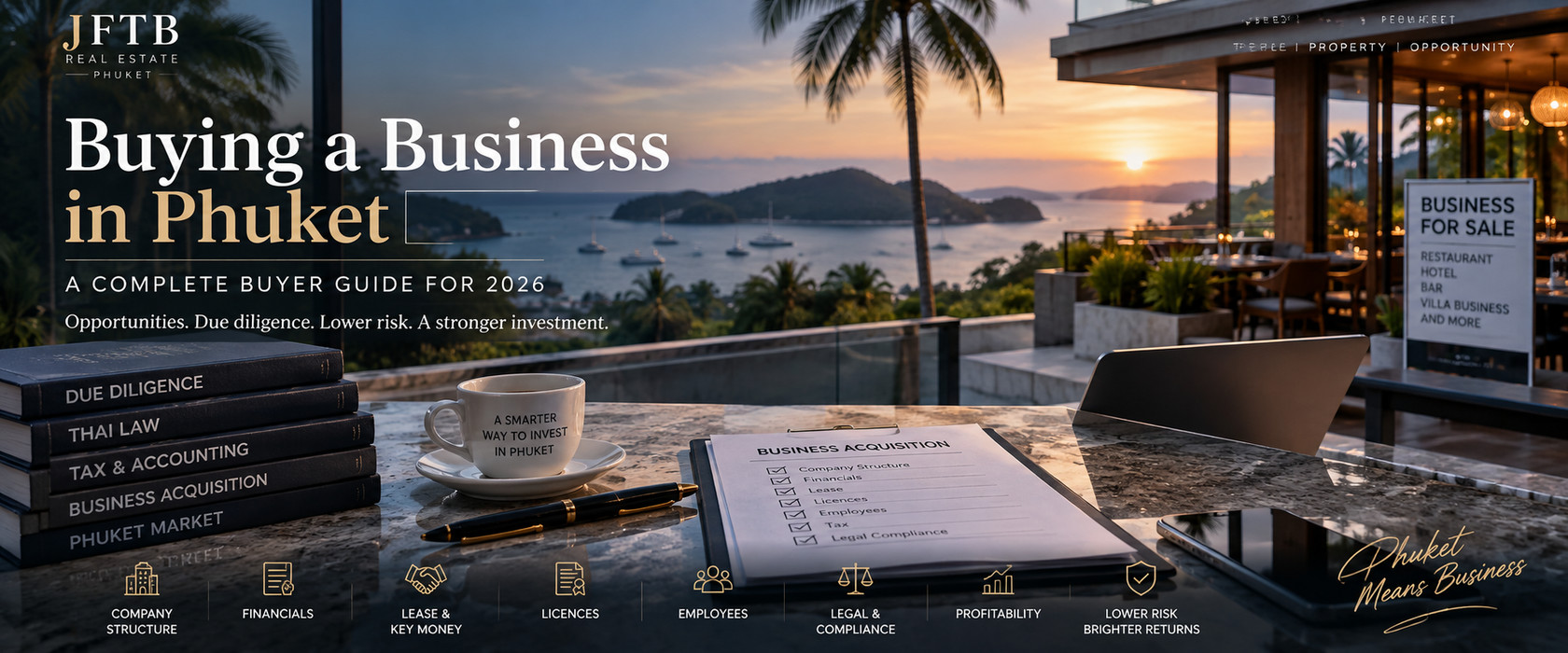
Buying an existing business in Phuket can provide immediate access to a location, customers, staff, equipment and an operating structure. It can also expose the buyer to liabilities, weak leases, questionable company structures or financial figures that do not survive proper verification.
For foreign investors, buying a business in Phuket therefore requires more than agreeing on a price with the seller. The legal structure, ownership, commercial lease, licences, accounts, tax position and actual profitability should all be understood before money changes hands.
JFTB Real Estate Phuket works with buyers and sellers of selected hotels, restaurants, commercial properties and investment opportunities across Phuket. This guide explains the main points foreign buyers should examine before acquiring a business in Thailand.
Buying a Business in Phuket: What Are You Actually Buying?
The first question is not how much the business costs.
It is what exactly is included in the transaction.
A Phuket business opportunity may involve:
- Shares in an existing Thai company
- Business assets and equipment
- A commercial lease
- Key money or a lease-entry payment
- Furniture, fixtures and inventory
- Intellectual property or branding
- Existing employees
- Customer databases or booking systems
- Operating licences
- Contracts with suppliers or customers
- A hotel, restaurant or commercial property
- Goodwill attached to the existing operation
These elements should never be treated as interchangeable.
A buyer acquiring shares in a company may be taking control of the existing legal entity together with its history and potential liabilities. A buyer acquiring only selected business assets may have a very different risk profile.
The proposed transaction structure should therefore be reviewed with a qualified lawyer and accountant before signing a binding agreement or paying a substantial deposit.
Share Purchase or Asset Purchase?
When buying a business in Phuket, one of the first structural decisions is whether the transaction involves shares in an existing company, selected business assets, or a combination of both.
Many business acquisitions can broadly be structured as either a share purchase or an asset purchase.
Buying Shares in an Existing Company
In a share transaction, the buyer acquires shares in the company that operates the business.
The company itself continues to exist.
That can be convenient because contracts, employees, accounts and operational relationships may already sit within the same legal entity. However, the company’s historical obligations and liabilities also require careful investigation.
Before acquiring shares, buyers should examine areas including:
- Current shareholders and directors
- Registered company objectives
- Paid-up capital
- Company financial statements
- Outstanding taxes
- Loans and shareholder loans
- Existing contracts
- Employee obligations
- Litigation or disputes
- Business licences
- Lease obligations
- Guarantees
- Other potential liabilities
Corporate records filed with Thailand’s Department of Business Development are an important part of this investigation, but they should not be treated as a substitute for full legal and financial due diligence.
Buying the Business Assets
An asset transaction may involve purchasing selected equipment, furniture, inventory, brand assets, customer relationships or other operating assets without acquiring the existing company itself.
This can sometimes separate the buyer from parts of the seller’s corporate history, but it creates other questions.
The buyer must establish which contracts can continue, whether the premises can still be occupied, which licences are required and whether employees, suppliers or operating agreements must be transferred, renewed or replaced.
Do not assume that buying the furniture, brand and customer database automatically gives the buyer the right to continue operating from the same premises.
Foreign Ownership Rules Matter
Foreign ownership rules are a critical consideration when buying a business in Phuket, because the permitted structure depends not only on the company but also on the activity being conducted.
Foreign investors must examine the business activity as well as the company structure.
Thailand’s Foreign Business Act restricts foreign participation in certain categories of business. Depending on the activity and ownership structure, a foreign-controlled business may require permission before conducting a restricted activity.
The Thai Board of Investment explains that businesses falling within restricted categories may require a Foreign Business License, while qualifying BOI-promoted businesses may instead obtain a Foreign Business Certificate.
This is why a statement such as “the business is already under a Thai company” is not sufficient due diligence.
The relevant questions include:
- Who genuinely owns the company?
- Who funded the shares?
- Who controls the business?
- What activity does the company actually conduct?
- Is that activity permitted under the existing structure?
- Does the proposed acquisition change the legal position?
- Will additional approvals be required after the transaction?
Foreign buyers should never assume that an existing structure used by the seller can simply be transferred unchanged.
For an official overview, see the Thai Board of Investment guidance on establishing and operating businesses in Thailand.
Be Extremely Careful with Nominee Structures
Using Thai shareholders purely as nominees to circumvent restrictions on foreign ownership or foreign business activity is not a legitimate shortcut.
This issue has become particularly important in 2026.
Under Central Partnership and Company Registration Office Order No. 2/2569, effective 1 August 2026, Thailand’s Department of Business Development strengthened the documentation required in relevant company registrations involving foreign participation or foreign authorised signatories.
For certain new company registrations, including structures where foreign shareholders hold less than 50% of registered capital or where a foreign national is an authorised signatory despite there being no foreign shareholder, applicants must provide additional evidence concerning the source and payment of capital.
This includes an investment explanation and, in applicable cases, bank statements covering the three months before payment from Thai shareholders’ accounts showing withdrawals or transfers corresponding to their subscribed capital.
Evidence must also show receipt of the investment funds into the account used to receive the company’s share capital.
The rules also extend scrutiny to certain amendments made after incorporation, including changes that can affect shareholders, directors or authorised signatories.
The purpose is clear: authorities want greater evidence that Thai shareholders genuinely funded their investments rather than merely lending their names to a foreign-controlled structure.
The Department of Business Development described the measure as part of a wider effort to close registration loopholes and combat nominee arrangements.
Phuket is not an abstract example.
In 2026, the Department of Special Investigation continued enforcement involving alleged nominee company structures used in Phuket real estate and villa businesses. In May 2026, the DSI reported proceedings involving a network accused of using Thai nominees in companies connected with real estate in Phuket and Samui.
A buyer should therefore be cautious when a transaction is presented as:
“Just take over the company.”
“Keep the existing Thai shareholders.”
“This is how everyone does it.”
“No lawyer is necessary.”
The fact that a company has operated for several years does not prove that its structure is compliant or appropriate for a new foreign owner.
Any proposed share acquisition should be independently reviewed to establish who genuinely funded and controls the company and whether the structure complies with the Foreign Business Act and other applicable Thai law.
The Commercial Lease Can Be More Important Than the Business
When buying a business in Phuket that operates from leased premises, the commercial lease can be as important as the business itself.
For restaurants, bars, shops, hotels and many other Phuket businesses, the premises may be leased rather than owned.
In those cases, the value of the business can depend heavily on the lease.
Before paying key money or buying the operation, verify:
- Who owns the property
- Who is named as tenant
- Remaining lease term
- Renewal options
- Monthly rent
- Rent escalation clauses
- Security deposit
- Transfer or assignment conditions
- Restrictions on business activity
- Renovation obligations
- Early termination provisions
- Whether landlord consent is required for the proposed transaction
A profitable restaurant with only a short lease remaining may have a very different value from the same operation with secure long-term occupancy.
Never value the business independently from the lease supporting it.
Understand Key Money
Key money is another issue foreign investors frequently encounter when buying a business in Phuket, particularly for restaurants, bars, hotels and retail premises.
Commercial opportunities in Phuket are sometimes advertised with key money or a takeover payment in addition to monthly rent.
That payment should not automatically be treated as the value of the business.
Ask exactly what the amount represents.
It may include:
- Existing fit-out
- Furniture and equipment
- Brand value
- Remaining lease rights
- Inventory
- Customer base
- Security deposits
- Historical investment by the seller
- Goodwill
A seller may have invested heavily in a business, but historical expenditure does not necessarily equal current market value.
The relevant question is what economic value the buyer receives today.
If an owner spent THB 10 million fitting out a restaurant several years ago, that does not automatically mean the fit-out is still worth THB 10 million to the next operator.
Verify Revenue, Not Just Claimed Profit
One of the most common mistakes when buying a business in Phuket is accepting a seller’s profitability figures without examining the underlying evidence.
Statements such as:
“Net profit is THB 300,000 per month.”
“ROI is 20%.”
“High season pays for the whole year.”
should be treated as claims until supported by documentation.
Depending on the business, useful evidence may include:
- Filed financial statements
- Management accounts
- Bank statements
- Tax filings
- VAT records
- Point-of-sale records
- Booking platform statements
- Rental or customer contracts
- Payroll
- Supplier invoices
- Utility bills
- Occupancy data
- Historical monthly revenue
The buyer should also separate revenue, gross profit, operating profit and net profit.
They are not the same thing.
A business with high turnover can still produce little economic return after rent, payroll, utilities, online platform commissions, maintenance, tax and replacement costs.
Look at the Business Month by Month
Seasonality should be examined carefully when buying a business in Phuket, especially when revenue depends heavily on tourism.
Annual averages can hide important weaknesses in Phuket.
Tourism-related businesses may experience substantial seasonal differences.
Instead of examining only one annual revenue figure, review monthly performance wherever reliable records are available.
Compare:
- High season
- Shoulder months
- Low season
- Fixed monthly expenses
- Staffing levels
- Marketing costs
- Rent
- Maintenance
- Utilities
- Booking and platform commissions
This analysis also helps determine the working capital required after acquisition.
A buyer who uses the entire investment budget to purchase the business can discover too late that additional cash is required to fund operations through weaker months.
Check Every Important Licence
Licences and operating approvals should be independently verified before buying a business in Phuket, particularly for regulated activities such as hotels, restaurants and bars.
Hotels, restaurants, bars and other regulated businesses may require specific licences, registrations or approvals.
The exact requirements depend on the activity and property.
Before completing the transaction, establish:
- Which licences the business currently holds
- Which legal entity holds them
- Whether they remain valid
- Whether the premises comply with their permitted use
- Whether a change of ownership or operating entity affects them
- What additional applications or approvals may be required
Never assume that a seller saying “all licences included” settles the issue.
A licence associated with the seller, a particular company or a specific operating structure may not necessarily function in exactly the same way after an acquisition.
The buyer’s lawyer should verify the documentation and, where necessary, confirm the position with the relevant authority.
Hotels Require Additional Due Diligence
Buying a hotel business is significantly more complex than buying furniture and taking over guest bookings.
A hotel acquisition may require investigation of:
- Land and building ownership
- Hotel operating licence
- Building permits
- Number of legally approved rooms
- Commercial lease, where applicable
- Fire and safety compliance
- Employee obligations
- Booking platform accounts
- Existing reservations
- Customer deposits
- Management contracts
- Tax records
- Operating history
- Outstanding renovation requirements
A property being marketed online as a hotel does not by itself establish that every aspect of the operation is legally authorised.
The operating documentation should be independently verified.
The same principle applies to smaller guest accommodation businesses. The number of rooms advertised online or physically operating should not automatically be assumed to equal the number legally approved for hotel use.
Employees and Existing Obligations
Employee liabilities should also be reviewed carefully when buying a business in Phuket, especially when the acquisition involves taking over an existing operating company rather than purchasing selected assets only.
Employees are another area buyers sometimes underestimate.
Before acquiring an operating company, determine:
- Number of employees
- Employment contracts
- Salaries
- Social security status
- Accrued employee entitlements
- Management agreements
- Work permits held by foreign staff
- Existing employment disputes
- Outstanding obligations
If the transaction involves acquiring the company rather than only selected assets, historical employment liabilities may be relevant to the acquisition.
Foreign buyers intending to work personally in the business should also examine their own immigration and work authorisation position.
Owning shares in a Thai company and having permission to work for that company are separate legal issues.
Tax and Accounting Due Diligence
A buyer should involve an accountant before completing a business acquisition.
Depending on the structure, the review may include:
- Filed financial statements
- Corporate income tax
- VAT position
- Withholding taxes
- Payroll obligations
- Social security
- Outstanding tax assessments
- Shareholder loans
- Director loans
- Unrecorded liabilities
- Related-party transactions
Thailand’s Revenue Department requires Thai companies and other qualifying juristic entities to comply with corporate income tax filing obligations.
For official tax information, see the Thai Revenue Department guidance on Corporate Income Tax.
A clean-looking set of accounts does not eliminate the need to compare accounting records with bank activity and the actual operation of the business.
How Should You Value a Phuket Business?
Valuation is one of the most difficult parts of buying a business in Phuket, because asking price, historical investment and sustainable economic value can be very different numbers.
There is no single valuation formula suitable for every business.
Depending on the opportunity, value may come from:
- Sustainable earnings
- Assets
- Location
- Remaining lease term
- Brand
- Licences
- Customer base
- Property ownership
- Development potential
- Replacement cost
A buyer should be particularly careful when most of the asking price is described simply as goodwill.
Goodwill is valuable only if the business can continue generating economic benefits after the seller leaves.
Ask what would happen if:
- The current owner stopped working tomorrow
- A key manager left
- The rent increased
- Tourist demand weakened
- A licence could not be renewed
- The lease was not extended
- The business lost its main booking or sales channel
The more a business depends personally on the seller, the less transferable its apparent value may be.
Compare Asking Price with Sustainable Earnings
A seller’s asking price and the economic value of the business are two different things.
For example, an owner may value the business based on:
- Money originally invested
- Renovation costs
- Emotional attachment
- Expected future profits
- A previous offer
- The amount needed to recover personal investment
None of those factors automatically establishes market value for the buyer.
The buyer should instead focus on the future economic benefit that can reasonably be supported by evidence.
If a business is offered for THB 15 million but produces only a modest sustainable return after rent, salaries, maintenance and tax, the buyer must decide whether the location, assets, lease rights or future potential justify the difference.
Do Not Pay a Deposit Too Early
Buyers can lose significant negotiating leverage by paying a large deposit before important information has been verified.
Before making a substantial non-refundable payment, the buyer should understand:
- What is being purchased
- Agreed purchase price
- Due diligence conditions
- Deposit refund conditions
- Completion timetable
- Required seller documents
- Landlord approvals where applicable
- Licence conditions
- What happens if due diligence identifies a serious problem
A properly structured offer or reservation agreement can allow the parties to move forward while preserving the buyer’s ability to investigate the opportunity.
Legal documentation should be prepared or reviewed by a qualified professional representing the buyer.
Business Due Diligence Checklist
Before completing an acquisition, a buyer should normally understand at least the following areas.
Corporate
- Company registration
- Directors
- Shareholders
- Shareholder register
- Company objectives
- Share capital
- Authorised signatories
Financial
- Revenue
- Profitability
- Bank statements
- Financial accounts
- Taxes
- Debt
- Working capital
- Shareholder loans
Commercial
- Lease
- Contracts
- Suppliers
- Employees
- Customer concentration
- Competition
- Booking or sales channels
Operational
- Equipment
- Inventory
- Maintenance requirements
- Business systems
- Licences
- Insurance
Legal
- Litigation
- Ownership restrictions
- Foreign business rules
- Lease rights
- Regulatory approvals
- Existing contractual obligations
The objective of due diligence is not merely to confirm what the seller has already told you. It is to identify information that could materially change the value, risk or structure of the proposed acquisition.
For a broader review of legal and ownership checks before completing a transaction, read our Property Due Diligence in Thailand guide.
Red Flags When Buying a Business in Phuket
Investigate much further when you encounter situations such as:
- No reliable financial records
- Claimed cash revenue that cannot be verified
- Seller refuses access to company documents
- Very short lease with no secured renewal
- Unclear property ownership
- Missing or uncertain licences
- Unexplained company debts
- Pressure to pay immediately
- Unclear Thai shareholder arrangements
- Seller insists no lawyer is required
- Profit figures change during negotiations
- Key money cannot be clearly explained
- Asking price based only on what the seller originally invested
- Landlord has not approved the proposed transfer
- Company ownership is described as a simple way around foreign ownership restrictions
One red flag does not always make a transaction impossible.
Several unresolved red flags together can substantially increase the risk.
A Safer Process for Buying a Business in Phuket
A disciplined process reduces avoidable risk when buying a business in Phuket and helps prevent the buyer from committing capital before the essential facts have been verified.
A disciplined acquisition normally follows a clear sequence.
1. Identify the Opportunity
Understand the business model, asking price, location, lease and basic transaction structure.
2. Request Supporting Information
Ask for relevant company, financial, lease, asset and licence documentation.
3. Assess the Economics
Determine whether the claimed revenue, profit and asking price make commercial sense before spending significant time and money on the transaction.
4. Make a Conditional Offer
Where appropriate, negotiate subject to satisfactory legal, financial and operational due diligence.
5. Conduct Independent Due Diligence
Use qualified lawyers and accountants rather than relying exclusively on information supplied by the seller or selling agent.
6. Confirm the Acquisition Structure
Determine exactly whether shares, assets, lease rights, property or a combination of these are being transferred.
7. Finalise the Agreements
Document the purchase price, assets, liabilities, warranties, completion requirements and payment conditions.
8. Complete Only After the Conditions Are Satisfied
Do not confuse signing an agreement with completing due diligence.
Buying a Business in Phuket with JFTB
JFTB Real Estate Phuket works with selected commercial properties, hotels and business opportunities across the island.
Our role is to help buyers understand the opportunity, obtain relevant property and commercial information, negotiate with sellers and coordinate the transaction alongside the buyer’s independent legal and accounting advisers.
We do not treat a seller’s asking price, projected return or claimed profitability as automatically verified.
For foreign investors, the priority should be to establish exactly what is being purchased, how the business is structured, what rights are actually transferable and whether the underlying numbers support the investment case.
If you are considering buying a business in Phuket, contact JFTB Real Estate with your preferred business type, location and investment budget.
We can then identify suitable opportunities and help you evaluate the next steps before you commit capital.