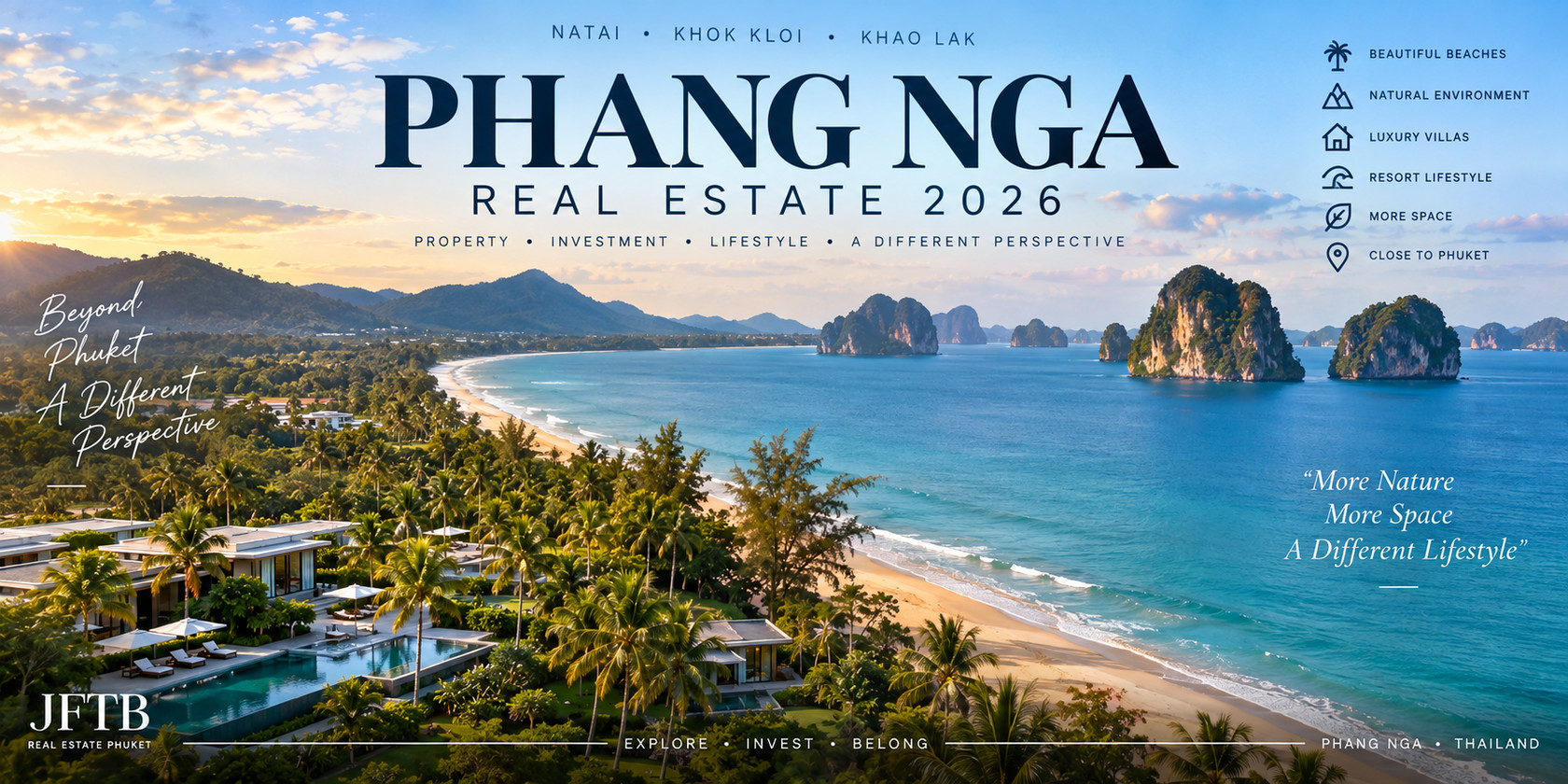
Phang Nga offers one of the most interesting property alternatives to Phuket, but it should not be described as simply “the next Phuket”.
The province has a much smaller residential market, lower development density and a very different buyer profile.
At the southern end, Natai Beach and Khok Kloi sit just beyond Phuket and combine luxury beachfront villas, large land plots and access to Phuket International Airport. Farther north, Khao Lak operates as an established resort destination with hotels, villas, smaller residential communities and a stronger long-stay tourism identity.
That makes Phang Nga real estate a market of contrasts.
A beachfront villa at Natai, an inland house in Khok Kloi and a property near Khao Lak may all be located in Phang Nga, but their pricing, rental demand and future buyer pools are completely different.
For investors and lifestyle buyers, the opportunity lies in understanding those differences rather than assuming that lower density automatically means better value.
Where Is Phang Nga?
Phang Nga Province lies immediately north and east of Phuket on Thailand’s Andaman coast.
Phuket and the mainland are connected across the northern end of the island, making southern Phang Nga particularly relevant to buyers who want access to Phuket without necessarily living on the island itself.
The Tourism Authority of Thailand describes Phang Nga as a province of mountains, forests, national parks, islands and extensive Andaman coastline. Khao Lak is specifically identified as one of its major mainland tourism areas, with a long coastal environment containing both luxury and budget hotels. (Tourism Authority of Thailand – Phang Nga)
For property purposes, however, Phang Nga is far too large to analyse as one market.
The two areas most relevant to international residential buyers are:
- Natai Beach / Khok Kloi
- Khao Lak and the surrounding Takua Pa coast
Their relationship with Phuket is very different.
Natai Beach and Khok Kloi
Natai Beach sits in Khok Kloi, Takua Thung District, immediately north of Phuket.
For international buyers, Phang Nga real estate around Natai represents the province’s clearest alternative to premium northern Phuket property.
This is the part of Phang Nga real estate that most directly competes with northern Phuket.
The market combines ordinary local housing inland with a completely different coastal segment containing high-end resorts, private pool villas and substantial beachfront estates.
That contrast is important.
A house in central Khok Kloi and a six-bedroom beachfront villa at Natai may be only a short distance apart geographically while belonging to entirely different markets.
Current property inventory illustrates this unusually wide range, from modest local houses to beachfront residences priced well above THB 100 million.
For buyers, the word “Natai” therefore needs to be treated as a micro-location rather than a generic Phang Nga label.
Why Natai Appeals to Phuket Buyers
Natai’s strategic advantage is straightforward.
It offers a quieter mainland coastline while remaining relatively close to northern Phuket and Phuket International Airport.
For buyers who use the airport frequently or spend most of their Phuket time around Mai Khao, Nai Yang or northern Thalang, crossing into Phang Nga can be realistic.
That relationship becomes less practical for someone whose daily life revolves around Patong, Chalong, Rawai or Phuket Town.
This is why Phang Nga real estate should not be compared with Phuket only through purchase price.
Daily movement matters.
A Natai property can provide exceptional space and privacy while still being inconvenient for a buyer who needs to cross much of Phuket several times per week.
The appeal of Phang Nga real estate in this southern corridor therefore depends heavily on how often the buyer needs to access Phuket.
Buyers considering both sides of the provincial boundary should also compare JFTB’s Mai Khao Phuket Real Estate Guide and Thalang Phuket Real Estate Guide.
Natai Beachfront Villas
Beachfront villas are the most distinctive international property segment around Natai.
The current market includes established developments and individual residences offering:
- direct beach frontage
- large plots
- private pools
- substantial bedroom counts
- high levels of privacy
- resort-style management in selected projects
Current listings near Natai demonstrate how premium this niche can become, with several completed beachfront residences marketed above THB 100 million and some substantially higher.
That places genuine Natai beachfront property into competition not with ordinary Phang Nga housing, but with premium villa markets in Phuket.
The correct comparison might therefore include Layan, Bang Tao, Surin or Phuket’s other high-end coastal villa locations rather than inland Phang Nga.
Beachfront Does Not Automatically Mean Better Investment
Natai’s low-density coastline is visually compelling, but buyers still need to separate lifestyle appeal from investment fundamentals.
A large beachfront villa can have very high acquisition and operating costs.
Typical expenses may include:
- staff
- gardens
- swimming pools
- preventive maintenance
- air-conditioning systems
- beachfront weather exposure
- security
- property management
- periodic refurbishment
Large villas also require a smaller pool of future buyers.
A THB 150 million beachfront residence does not need thousands of potential buyers, but it does need enough credible buyers when the owner eventually wants to exit.
This is where Phang Nga real estate differs materially from Phuket’s deeper residential market.
Khok Kloi Beyond the Beach
Khok Kloi itself should not be confused with Natai’s premium beachfront strip.
Move inland and the market changes rapidly.
Buyers can encounter houses, smaller villas, local residential communities and larger land plots at prices far below the beachfront market.
This can appeal to people looking for:
- more land
- local residential living
- proximity to northern Phuket
- lower acquisition cost
- future development potential
But inland value depends heavily on exact location and access.
A property that is inexpensive because it sits several kilometres from the beach and away from major services should not be marketed as equivalent to Natai beachfront property.
The discount exists for a reason.
Khao Lak Is a Different Market
Within Phang Nga real estate, Khao Lak should therefore be analysed as an independent resort and residential market rather than an extension of Phuket.
Khao Lak should be treated separately from Natai.
The Tourism Authority of Thailand describes the Khao Lak coast as a long stretch of beaches extending through an established tourism landscape of resorts, natural surroundings and water activities.
Unlike Natai, whose premium property narrative is closely connected with Phuket, Khao Lak functions more independently as a destination.
Its market is supported by:
- resorts
- diving and marine tourism
- long-stay visitors
- retirees
- hospitality employment
- local residential demand
This creates opportunities for villas and smaller residential properties, but the market is still far less liquid than Phuket.
Khao Lak for Long-Term Living
Khao Lak can appeal to buyers who actively want a slower environment.
The area provides beaches, restaurants, hospitality infrastructure and established communities without the development intensity found in much of Phuket.
That can suit:
- retirees
- remote workers
- long-stay residents
- lifestyle buyers
- people connected to the hospitality or diving sectors
But the trade-off needs to be understood.
A buyer moving to Khao Lak is not simply obtaining a quieter version of Bang Tao or Rawai.
They are choosing a smaller economic and residential ecosystem.
For some people, that is exactly the attraction.
For others, it can eventually feel limiting.
The Khao Lak Rental Market
Rental demand around Khao Lak is strongly influenced by tourism and the hospitality economy.
Seasonality therefore matters.
Properties capable of attracting long-stay residents can have a different risk profile from accommodation that depends heavily on holiday demand.
Investors should identify the intended tenant before choosing the property.
A compact residence near established amenities may suit longer stays.
A villa closer to a resort corridor may appeal to holiday tenants.
A more remote property can offer privacy but substantially reduce the potential tenant pool.
In Phang Nga real estate, a lower purchase price does not compensate for weak rental demand.
Phang Nga vs Phuket
The strongest argument for Phang Nga is also the simplest:
more space and lower density.
Phuket’s advantages are equally clear:
much deeper buyer demand, more infrastructure and greater residential liquidity.
Buyers comparing Phuket with Phang Nga real estate should therefore weigh market liquidity and infrastructure against privacy, land and lower-density living.
Phuket offers larger international communities, more schools, hospitals, restaurants, retail, marinas and established residential districts.
Phang Nga can offer quieter coastlines, larger sites and property that feels more private.
Neither is automatically superior.
The correct choice depends on whether the buyer values access and liquidity or space and low density more highly.
Natai vs Mai Khao
Natai and Mai Khao provide one of the most useful comparisons for international buyers.
Both sit on the quieter northern Andaman coastline.
Both offer premium resort environments.
Both provide relatively convenient access to Phuket International Airport.
But the provincial boundary matters.
Mai Khao remains part of Phuket, with direct access to the island’s wider residential and resale market.
Natai sits in Phang Nga and offers an even lower-density mainland environment.
For some buyers, that increased isolation is an advantage.
For others, Mai Khao provides a better compromise between privacy and Phuket connectivity.
Natai vs Bang Tao and Layan
Natai can also attract buyers considering Bang Tao or Layan.
The difference becomes more pronounced here.
Bang Tao and Layan benefit from a substantial international residential ecosystem, restaurants, retail, schools and a large supply of villas and condominiums.
Natai is much quieter.
For a buyer seeking a large private beachfront residence used seasonally, Natai can be extremely compelling.
For a family planning to live permanently and use Phuket’s international infrastructure every day, Bang Tao or Layan may be more practical.
A beach can be exceptional while the broader residential market remains thin.
Property Prices Need Micro-Market Context
It is particularly dangerous to quote one “average Phang Nga property price”.
The market contains local housing, inland land, resort-oriented condominiums and some extremely expensive beachfront villas.
At Natai alone, current asking inventory ranges from relatively affordable inland housing to beachfront estates exceeding THB 200 million.
Phang Nga real estate pricing becomes meaningful only when buyers compare properties within the same micro-market and product category.
A province-wide median would tell a buyer very little.
For Phang Nga real estate, valuation should therefore begin with:
property type + exact micro-location + land position + ownership structure + comparable stock.
A beachfront Natai villa should be compared with similar beachfront residences.
A Khao Lak residential villa should be compared with its local market.
Mixing them produces meaningless averages.
Foreign Ownership in Phang Nga
The basic Thai property ownership framework does not change when a buyer crosses from Phuket into Phang Nga.
The legal structure of Phang Nga real estate transactions follows the same Thai ownership framework that applies elsewhere in the country.
Foreigners generally cannot directly own Thai land.
For villas and houses, buyers therefore need to understand the legal ownership structure before committing funds.
Issues to review include:
- land title
- seller ownership
- boundaries
- legal access
- building ownership
- building permits
- registered leases
- registered rights where applicable
- encumbrances
Foreign freehold condominium ownership may be possible where a property forms part of a legally registered condominium and sufficient foreign quota remains available.
For the broader legal framework, see JFTB’s Buying Property in Thailand as a Foreigner.
Land Requires Extra Caution
Phang Nga’s lower development density means land can form a larger part of the property conversation than in mature Phuket resort zones.
That does not make land simple.
Before considering development land, buyers should investigate:
- title type
- boundaries
- legal public or registered road access
- zoning
- environmental restrictions
- building controls
- utilities
- drainage
- elevation
- coastal setbacks where relevant
- practical construction access
The apparent availability of land should never be confused with unrestricted development potential.
This is especially important for plots close to beaches or environmentally sensitive areas.
Resort and Branded Property
Both Natai and Khao Lak have significant hospitality markets.
That can create opportunities for residences connected to hotels or resorts.
But buyers should distinguish between:
- a property located near a resort
- a residence managed by a hospitality operator
- a legally structured branded residence
- a property participating in a rental programme
These are different products.
Management agreements, rental obligations, owner-use periods, common charges and exit conditions need to be read carefully.
The hotel brand should never replace analysis of the underlying property.
Rental Returns Need Realistic Assumptions
Large Natai villas can command substantial holiday rates.
That does not automatically produce an exceptional net investment return.
High-value beachfront properties can also carry significant staffing, management and maintenance expenses.
Khao Lak presents a different challenge because tourism demand can be seasonal.
Investors should therefore model:
- realistic occupancy
- seasonal pricing
- management commissions
- staffing
- maintenance
- utilities
- refurbishment
- periods without income
For a broader methodology, see JFTB’s Phuket Property Investment 2026 guide.
The principles remain relevant even though Phang Nga is a separate province.
Resale Liquidity Is the Critical Difference
This is perhaps the most important section for a foreign buyer.
Phuket has a substantially deeper international residential market.
There are more buyers, agents, developers, projects and transactions.
Phang Nga’s market is smaller.
For investors, this makes resale planning especially important when buying Phang Nga real estate.
That does not make a Phang Nga property a bad investment.
It means exit strategy matters more.
A rare beachfront villa may have significant value but attract only a narrow group of buyers.
A relatively inexpensive inland house may have a larger Thai buyer pool but less international demand.
A specialised resort residence may depend heavily on the performance and reputation of its project.
Before buying Phang Nga real estate, ask:
Who is likely to buy this property from me later?
The answer needs to be more specific than “someone who loves Thailand”.
Scarcity vs Illiquidity
These two concepts are easily confused.
A property can be genuinely scarce and still take a long time to sell.
Natai beachfront land is limited.
Large high-quality beachfront residences are not easily reproduced.
That creates scarcity.
But a THB 200 million residence also has a small buyer pool.
That creates potential illiquidity.
This is one of the most important distinctions when evaluating premium Phang Nga real estate.
Both can be true simultaneously.
Sophisticated buyers should therefore avoid assuming that scarcity automatically produces fast resale or guaranteed appreciation.
Infrastructure and Future Growth
Southern Phang Nga is often discussed in connection with Phuket’s northward expansion and future infrastructure.
That narrative deserves caution.
Infrastructure can improve access and stimulate development, but buyers should not purchase property solely on the assumption that a proposed future project will transform prices.
The current property needs to make sense under today’s conditions.
Future infrastructure should be treated as potential upside, not as the foundation of the investment case.
New Development vs Established Property
In a thinner market, completed property can have particular advantages.
The buyer can inspect:
- the real surroundings
- access roads
- construction quality
- views
- landscaping
- management quality
- actual distance to the beach
Off-plan property can offer modern design and staged payments, but the buyer takes additional execution and future-supply risk.
For premium Natai property in particular, physical site quality is often more important than the age of the building.
A genuinely strong site can be extremely difficult to replace.
Tsunami Awareness and Coastal Due Diligence
Phang Nga’s Andaman coastline was heavily affected by the 2004 Indian Ocean tsunami, particularly around Khao Lak.
Today, Khao Lak has been extensively rebuilt and remains one of southern Thailand’s major tourism destinations. The Tourism Authority of Thailand explicitly notes both the 2004 impact and the subsequent reconstruction of the area.
For coastal property buyers, the history should not be sensationalised or ignored.
It is reasonable to understand:
- property elevation
- evacuation routes
- local warning systems
- access roads
- coastal exposure
This is part of sensible coastal due diligence.
Who Should Consider Natai?
Natai can suit buyers who prioritise:
- substantial beachfront property
- privacy
- low-density surroundings
- proximity to northern Phuket
- second-home use
- premium villa lifestyle
- high-end seasonal rental
It may be less appropriate for buyers who need a large year-round international community or regular access to southern Phuket.
Who Should Consider Khao Lak?
Phang Nga real estate around Khao Lak is particularly relevant to buyers who value a quieter coastal environment and do not need daily access to Phuket.
Khao Lak can work particularly well for:
- retirees
- long-stay residents
- hospitality-linked buyers
- divers and marine-lifestyle buyers
- buyers wanting a quieter coastal community
- purchasers who do not need daily access to Phuket
It should be selected because the buyer wants Khao Lak itself, not because it appears cheaper than Phuket.
Frequently Asked Questions
Is Phang Nga a good place to buy property?
It can be, particularly for buyers seeking lower density, larger properties or quieter coastal locations. The market is smaller than Phuket, so resale liquidity and exact micro-location deserve additional attention.
Is Natai Beach in Phuket?
No. Natai Beach is in Phang Nga Province, north of Phuket. It is close enough to northern Phuket to be considered by some buyers comparing Natai with Mai Khao, Layan or other northern locations.
Is Natai close to Phuket Airport?
Natai and Khok Kloi are relatively close to northern Phuket and Phuket International Airport compared with Khao Lak and other areas farther north. Actual journey times depend on the precise property and traffic conditions.
Is Khao Lak in Phang Nga?
Yes. Khao Lak is on the mainland Andaman coast of Phang Nga Province and is one of the province’s principal tourism destinations.
Is Natai property expensive?
Natai contains a wide range of property, but genuine beachfront villas can be extremely expensive. Current market inventory includes premium beachfront residences marketed above THB 100 million and some considerably higher.
Is Phang Nga cheaper than Phuket?
Some inland and residential property can be significantly less expensive than comparable Phuket locations. However, premium Natai beachfront villas can compete directly with high-end Phuket property, so a simple province-wide comparison is misleading.
Can foreigners buy property in Phang Nga?
Foreigners may buy qualifying condominium units under foreign freehold subject to the legal foreign ownership quota. Foreigners generally cannot directly own Thai land, so houses, villas and land require property-specific legal structuring and independent review.
Is Phang Nga good for rental investment?
It can be, but Natai and Khao Lak have very different rental markets. Natai’s premium villa market is more oriented toward high-value stays, while Khao Lak has broader resort and long-stay tourism demand. Returns must be assessed property by property.
Is Natai better than Mai Khao?
Neither is automatically better. Natai offers an exceptionally low-density mainland beach environment, while Mai Khao remains within Phuket and benefits from the island’s deeper residential market. The best choice depends on lifestyle, price and exit strategy.
Is Phang Nga property a good investment in 2026?
Individual opportunities can be compelling, particularly where a property has genuine beachfront scarcity, strong land characteristics or a clear target buyer. However, the market is less liquid than Phuket, so purchase price, ownership structure and future resale demand should be analysed carefully.
Buying Property in Phang Nga with JFTB
The strongest argument for Phang Nga real estate is not that it will become another Phuket.
It is that it offers something different.
Natai can provide low-density beachfront living within reach of northern Phuket.
Khao Lak offers an established coastal destination with its own tourism economy and lifestyle.
Inland areas can provide substantially more land and space than Phuket buyers may be accustomed to.
But those advantages come with a smaller residential market and, in many cases, a narrower future buyer pool.
That is why property selection matters more than broad market narratives.
JFTB Real Estate assists international buyers evaluating Phuket and nearby Phang Nga with property sourcing, comparative market analysis, negotiation and coordination of independent legal and technical due diligence.
The objective is not to buy Phang Nga because it appears cheaper or less developed.
It is to identify a property whose location, legal structure, use case, price and future resale market make sense together.