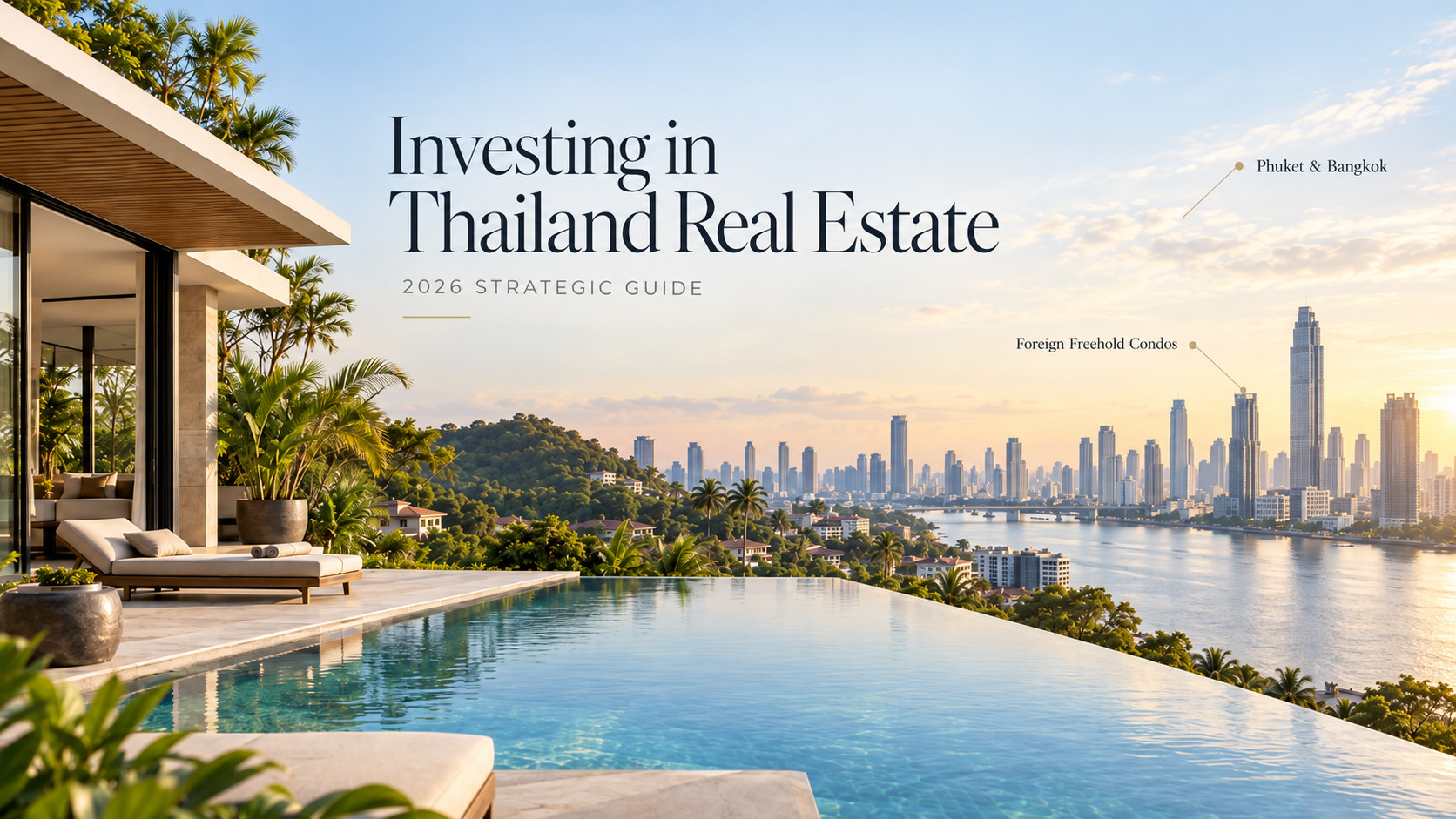
Thailand real estate investment can still offer attractive opportunities for international buyers in 2026, but successful investing increasingly depends on asset selection, legal structure, purchase price, genuine rental demand and resale liquidity.
Thailand is not one single property market. Phuket, Bangkok, Pattaya, Hua Hin and Chiang Mai serve different buyers, tenants and investment strategies.
A strong investment therefore starts with a simple principle: do not buy “Thailand”. Buy the right property, in the right micro-location, at the right price, under a legally sound structure.
JFTB Real Estate Phuket has advised international property buyers and investors in Thailand since 2013. This guide explains the main factors foreign buyers should evaluate before committing capital to Thai real estate.
Thailand Real Estate Investment 2026: Key Facts
| Вопрос | Answer |
|---|---|
| Main foreign ownership route | Qualifying foreign freehold condominium |
| Major markets | Phuket, Bangkok, Pattaya, Hua Hin and Chiang Mai |
| Core investment test | Net return plus resale liquidity |
| Villa issue | Land and building rights must be analysed separately |
| Rental analysis | Property-specific, not based on national averages |
| Off-plan risk | Developer, completion, pricing and future supply |
| Key legal safeguard | Independent due diligence |
| Exit strategy | Identify the likely future buyer before purchasing |
Thailand Property Investment in 2026: Key Takeaways
For foreign investors, several fundamentals matter more than headline market predictions.
- Foreign freehold condominiums remain one of the clearest direct ownership routes for international buyers.
- Foreign ownership in registered condominiums is subject to the statutory foreign ownership quota.
- Foreigners generally cannot own Thai land directly except under limited statutory circumstances.
- Thai nominee shareholder arrangements should never be treated as a workaround for foreign land ownership restrictions.
- Rental yields must be calculated property by property rather than using generic market averages.
- Phuket and Bangkok offer fundamentally different investment profiles.
- New-build properties should be compared against resale alternatives before committing.
- Legal due diligence should be completed independently before significant funds are transferred.
- Exit liquidity is as important as projected rental income.
The best investment is not necessarily the property promising the highest return. It is usually the property where ownership, demand, pricing, operating costs and eventual resale all make sense together.
Thailand Real Estate Market in 2026
Thailand continues to attract international tourists, long-stay residents, expatriates, retirees and foreign second-home buyers.
However, these demand drivers do not affect every property equally.
A strong tourism market does not automatically make every condominium or villa a strong investment. Likewise, a desirable destination does not protect an overpriced property from weak rental performance or difficult resale.
In 2026, successful Thailand real estate investment depends less on broad market direction than on property-level selection.
Prime and Differentiated Property
Properties with strong locations, clear ownership, limited competing supply and genuine lifestyle or rental demand generally have stronger defensive characteristics.
Generic Property
Standardised inventory in areas with significant competing supply may face discounting, weaker occupancy and longer resale periods.
New Supply
New development can create attractive opportunities, but it also increases competition between developers, recently completed projects and existing resale owners.
Legal Compliance
Ownership structures, company arrangements, rental use and building documentation deserve careful scrutiny.
A rising market can hide mistakes. A selective market exposes them.
Investors should also be cautious with headline rental yields. Projection sheets may assume strong occupancy and limited operating costs, while actual returns depend on vacancy, management fees, maintenance and property-specific expenses.
Where possible, ask for historical rental and expense data from comparable properties rather than relying solely on projected returns.
Why International Buyers Invest in Thailand Real Estate
Thailand continues to offer several characteristics that attract international property investors.
Diverse Property Markets
Bangkok, Phuket, Pattaya, Hua Hin and Chiang Mai each serve different tenant and buyer profiles.
Strong Lifestyle Appeal
Thailand attracts holidaymakers, retirees, expatriates, entrepreneurs, families and long-stay residents, creating several layers of property demand beyond conventional tourism.
Broad Property Choice
International buyers can consider:
- Иностранные кондоминиумы в полной собственности
- Resale condominiums
- Роскошные виллы
- Фирменные резиденции
- строящиеся объекты
- Resort properties
- Selected commercial assets
International Buyer Demand
Well-positioned properties in established international markets can attract buyers from several countries rather than depending exclusively on domestic demand.
But international demand is highly selective. Location, ownership clarity, management quality and realistic pricing remain critical.
Choosing the right location is one of the most important decisions in any Thailand real estate investment стратегия.
Best Places for Thailand Real Estate Investment
There is no universal “best place” to invest in Thailand.
The correct market depends on the buyer’s objective.
Пхукет
Phuket is one of Southeast Asia’s most established international resort and lifestyle property markets.
It combines:
- Международный туризм
- Жители, проживающие длительное время
- Роскошные виллы
- Иностранные кондоминиумы в полной собственности
- Фирменные резиденции
- Second homes
- High-end rental demand
The strongest Phuket investments tend to be highly property-specific.
Location alone is not enough. Investors should compare construction quality, ownership, competing supply, view, management, rental restrictions and future resale competition.
Bang Tao, Cherng Talay, Laguna, Layan, Kamala, Rawai and Patong can all serve very different investment strategies.
For a deeper Phuket-specific analysis, see our Investing in Phuket in 2026 гид.
Бангкок
Bangkok provides a deeper urban property market with more year-round residential demand.
Important investment factors include:
- BTS or MRT proximity
- Employment centres
- Building quality
- квота на иностранную собственность
- Unit layout
- Competing condominium supply
- Спрос на аренду
- Управление зданием
- Resale depth
Bangkok may suit investors prioritising urban rental demand and access to a larger domestic resale market.
JFTB also maintains a dedicated Bangkok Real Estate 2026: Condos, Investment and Market Guide. Its JFTB NEXT link should be added once the final staging URL is confirmed.
Pattaya and the Eastern Seaboard
Pattaya offers a large condominium market, international tourism and access to Thailand’s Eastern Seaboard.
Entry prices can be lower than in prime Phuket or central Bangkok.
However, investors should carefully assess:
- Existing condominium supply
- Project quality
- Доступность иностранных квот
- конкуренция в сфере аренды
- Управление зданием
- Ликвидность для перепродажи
The variation between strong and weak projects can be considerable.
Хуа Хин
Hua Hin is primarily a lifestyle and second-home market.
Its appeal includes retirees, Thai second-home buyers and long-stay international residents.
It may suit investors prioritising personal use and longer ownership periods rather than maximum short-term rental performance.
Чиангмай
Chiang Mai offers relatively accessible entry prices and significant long-stay appeal.
Its investment dynamics differ substantially from Phuket and Bangkok, particularly in terms of international resale depth, rental demand and property type.
Investors should not simply apply Phuket or Bangkok assumptions to the Chiang Mai market.
Иностранные кондоминиумы в полной собственности
For many international buyers, a qualifying foreign freehold condominium is the simplest direct ownership structure available in Thailand.
Foreign ownership within a registered condominium is subject to the applicable foreign ownership quota.
Official guidance on foreign condominium ownership is available from the Департамент земель Таиланда.
Before purchasing, buyers should confirm:
- The condominium is legally registered
- Foreign quota remains available
- The unit has an individual condominium title
- The seller is the registered owner
- There are no undisclosed encumbrances
- Common-area fees are current
- The sinking fund position is understood
- Required foreign currency documentation is available
Foreign freehold does not automatically make a property a good investment.
An overpriced condominium with weak management or excessive competing supply can still perform poorly.
Ownership clarity is only one part of the investment analysis.
For a more detailed explanation, see Покупка квартиры в Пхукете иностранцем..
Villas, Land and Foreign Ownership
Villa investment requires greater legal scrutiny because land and building rights must be considered separately.
Foreign individuals generally cannot directly own Thai land except under limited statutory circumstances that are not the normal route for residential investors.
В зависимости от объекта недвижимости покупатели могут столкнуться со следующими проблемами:
- Leasehold structures
- Отдельная собственность на здание
- тайская компания владеет
- Существующие корпоративные структуры
- права пользования
- Поверхности
- Estate management structures
Each arrangement should be reviewed independently.
A Thai company should never be treated as an automatic solution for foreign land ownership.
Any existing company structure should have a legitimate commercial and legal basis and be independently reviewed.
For the broader legal framework, see BПокупка недвижимости в Таиланде для иностранцев: полное руководство на 2026 год..
For villa-specific considerations, see Покупка виллы на Пхукете в 2026 году.
Leasehold Property in Thailand
Registered leasehold can provide a legitimate structure for foreign buyers in certain circumstances.
However, investors should distinguish carefully between the legally registered initial lease term and contractual promises concerning future renewals.
Important issues include:
- Remaining registered lease period
- Registration at the Land Office
- Lease payment structure
- Renewal provisions
- Transferability
- Inheritance
- Early termination clauses
- Landowner obligations
- Sale of the underlying land
- Building ownership
A marketing phrase such as “30 + 30 + 30 years” should never be treated as equivalent to a guaranteed 90-year property right.
The actual contract and registered rights must be reviewed.
For a more detailed comparison, see Право собственности на землю против права аренды в Таиланде.
Thailand Rental Yields in 2026
There is no meaningful single “Thailand rental yield”.
Returns vary considerably between individual properties.
A basic gross yield calculation is:
Annual gross rent ÷ purchase price × 100
But gross yield is only a screening tool.
A realistic net-return calculation should also include:
- Vacancy
- Управление недвижимостью
- Комиссионные за бронирование
- плата за пользование общими зонами
- Repairs
- Замена мебели
- Air-conditioning servicing
- Pool and garden maintenance
- Страхование
- Property taxes where applicable
- Utilities paid by the owner
- Accounting costs where applicable
- Major capital expenditure
A property advertising a high gross return may produce a much less impressive net return once operating costs and realistic occupancy are included.
For a Phuket-specific analysis, see Доходность от сдачи жилья в аренду на Пхукете в 2026 году.
Short-Term Rental Risk
Investors should distinguish between a property being physically rentable and the intended rental activity being legally and operationally viable.
Short-term holiday rental activity can involve hotel licensing, condominium rules, building regulations and local enforcement considerations.
Never assume that because similar properties appear on short-term rental platforms, the intended rental model is automatically compliant.
Before purchasing based on holiday-rental projections, verify the legal structure and operating model independently.
For many buyers, a Thailand real estate investment decision ultimately comes down to whether an off-plan or completed resale property offers better risk-adjusted value.
Off-Plan vs Resale Property
Both strategies can work.
The important question is whether the buyer is receiving fair value for the risks being taken.
Off-Plan Advantages
К потенциальным преимуществам относятся:
- Ценообразование на ранней стадии
- Choice of units
- Modern specifications
- Payment schedules
- Стимулы для разработчиков
- Potential value growth during construction
Off-Plan Risks
Инвесторам следует изучить:
- послужной список разработчика
- Construction delays
- Финансирование
- Environmental approvals
- Разрешения на строительство
- Условия договора
- Specification changes
- Completion risk
- Будущее конкурирующее предложение
One useful test is simple:
What completed resale property could I buy today for the same budget?
If the off-plan property carries a premium, the buyer should understand exactly what justifies that premium.
Resale Advantages
A resale property allows buyers to assess:
- The completed building
- Actual view
- Физическое состояние
- Existing management
- Real operating costs
- Current rental history
- Established surroundings
Resale properties can also sometimes offer stronger negotiating opportunities than heavily marketed new developments.
The correct comparison is not “new versus old”.
Это value versus value.
Гарантированная возвратная стоимость аренды
Guaranteed-return programmes should be analysed as financial obligations rather than marketing benefits.
Просить:
- Who guarantees the payment?
- Как долго?
- Предоставляется ли гарантия?
- What happens if the operator defaults?
- Who pays maintenance and common fees?
- Is furniture included?
- Can the property be used personally?
- What happens after the guarantee expires?
- Is the purchase price higher because of the programme?
A guaranteed yield is only as reliable as the party responsible for paying it.
For this reason, every Thailand real estate investment should be evaluated on realistic net income rather than promotional yield figures.
Property Taxes and Transaction Costs
Transaction costs depend on the property, seller, ownership period and legal structure.
Potential expenses may include:
- Transfer fee
- Специальный налог на бизнес
- Гербовый сбор
- Налог, удерживаемый у источника выплаты
- Legal fees
- Corporate costs where relevant
- Lease registration fees
- плата за пользование общими зонами
- Sinking fund contributions
Do not rely solely on a developer or seller’s summary.
Before signing, buyers should obtain a transaction-cost breakdown for the specific property.
These costs should be included when calculating the true return of any Thailand real estate investment.
Due Diligence Before Investing
Independent due diligence is one of the most important risk controls available to foreign property buyers.
Independent legal and financial checks are particularly important before committing to a Thailand real estate investment
A proper review may include:
Собственность
Confirm the registered owner and legal ability to sell.
Заголовок
Check title documentation, boundaries, mortgages and registered encumbrances.
Foreign Quota
For condominiums, verify foreign freehold availability where relevant.
Building Documentation
Review permits and significant alterations.
Контракты
Review reservation agreements, sale and purchase agreements, leases and other binding documents.
Company Structure
Where a company is involved, investigate corporate records, liabilities and compliance.
Access
For villas and land, confirm enforceable legal road access.
Property Condition
Consider an independent physical inspection, particularly for resale villas.
Rental Assumptions
Verify realistic rental rates, occupancy, management expenses and legal use.
Перепродажа
Compare competing inventory before assuming future appreciation.
Due diligence should answer not only:
“Могу ли я купить эту недвижимость?”
but also:
“Should I buy this property at this price?”
How to Evaluate a Thailand Real Estate Investment
Before committing, an investor should be able to answer five questions clearly.
A successful Thailand real estate investment should be tested against a clear framework before any reservation or purchase agreement is signed.
1. Who Will Rent It?
Identify the actual tenant or guest profile.
Do not rely on vague assumptions such as “tourists will rent it”.
2. Why This Property?
Determine what makes the asset more desirable than competing inventory.
That advantage could be location, view, ownership, price, layout, scarcity, management quality or another genuinely defensible characteristic.
3. Is the Ownership Structure Clean?
Understand exactly what you will legally own and what rights are being transferred.
4. What Is the Real Net Return?
Calculate income after realistic expenses, vacancy and future capital expenditure.
5. Who Will Buy It From You?
Define the probable resale buyer before purchasing.
This fifth question is frequently underestimated.
A property can produce rental income and still be a weak investment if the eventual resale audience is extremely limited.
If there is no convincing answer to “Who will buy it from me?”, the investment deserves additional scrutiny.
Common Mistakes Foreign Investors Make
Several mistakes appear repeatedly in Thailand property transactions:
- Buying primarily from a brochure
- Trusting headline rental returns
- Ignoring resale competition
- Assuming all leaseholds are equivalent
- Treating a Thai company as an automatic ownership solution
- Skipping independent legal advice
- Paying too much because the development is new
- Underestimating maintenance costs
- Assuming tourism automatically creates rental demand
- Failing to investigate the developer
- Ignoring building management quality
- Buying without an exit strategy
A disciplined Thailand real estate investment process should eliminate these risks before significant funds are transferred.
Most expensive mistakes happen before the contract is signed.
Is Thailand Real Estate a Good Investment in 2026?
It can be, but Thailand real estate investment should be assessed property by property rather than through broad claims about the country as a whole.
Thailand offers strong lifestyle appeal, established international destinations and a wide range of property.
But the investment case still needs to be demonstrated at asset level.
A well-located foreign freehold condominium bought at a defensible price may be considerably easier to understand than a spectacular villa with a complicated ownership structure.
Likewise, an exceptional villa with genuine scarcity and strong demand may outperform a large amount of generic condominium inventory.
There is no universal answer.
A strong investment case normally combines:
location + asset quality + legal security + price + income + liquidity
Дисциплинированный Thailand real estate investment strategy should therefore combine legal security, realistic income assumptions, defensible pricing and a credible exit strategy.
Buying Investment Property in Thailand with JFTB
JFTB Real Estate Phuket advises international buyers looking for condominiums, villas and investment property in Thailand, with particular expertise in Phuket.
Наша задача не сводится к простому представлению доступных объектов недвижимости.
We help buyers compare opportunities, challenge projected returns, evaluate pricing, negotiate and coordinate independent legal due diligence before committing capital.
Успешный Thailand real estate investment starts with selecting the right asset rather than following the strongest sales pitch.
Considering an investment property in Thailand? Contact JFTB Real Estate Phuket with your budget, preferred location, investment objective and ownership requirements.
FAQ — Thailand Real Estate Investment
Can Foreigners Buy Real Estate in Thailand?
Yes. Foreigners can legally own qualifying condominium units within the applicable foreign ownership quota.
Land ownership is considerably more restricted and requires separate legal analysis.
What Is the Safest Property Ownership Structure for Foreigners?
For many buyers, foreign freehold ownership of a qualifying condominium provides one of the clearest direct ownership structures.
Villas and land require additional legal structuring and due diligence.
Where Is the Best Place to Invest in Thailand Property?
There is no single best location. The right location for a Thailand real estate investment depends on the buyer’s objective, target tenant, budget and expected holding period.
Phuket is strongly influenced by international tourism, lifestyle demand and second-home buyers, while Bangkok provides deeper year-round urban demand.
Pattaya, Hua Hin and Chiang Mai serve different investment profiles.
What Rental Yield Can I Expect in Thailand?
There is no reliable nationwide figure.
Returns depend on purchase price, location, property type, occupancy, operating costs, management and legal rental use.
Can a Foreigner Buy a Villa in Thailand?
Foreign buyers can acquire interests in villas, but the land and building structure must be analysed separately because foreign ownership of Thai land is restricted.
Is Leasehold Property Safe in Thailand?
A properly structured and registered lease can provide enforceable rights for its registered term.
Buyers should have the lease and any renewal provisions independently reviewed before purchasing.
Are Guaranteed Rental Returns Safe?
Не автоматически.
The value of a guarantee depends on the financial strength and contractual obligations of the party providing it.
Do I Need a Lawyer When Buying Property in Thailand?
Independent legal due diligence is strongly recommended, particularly for villas, land, leasehold structures, off-plan developments and company-owned property.