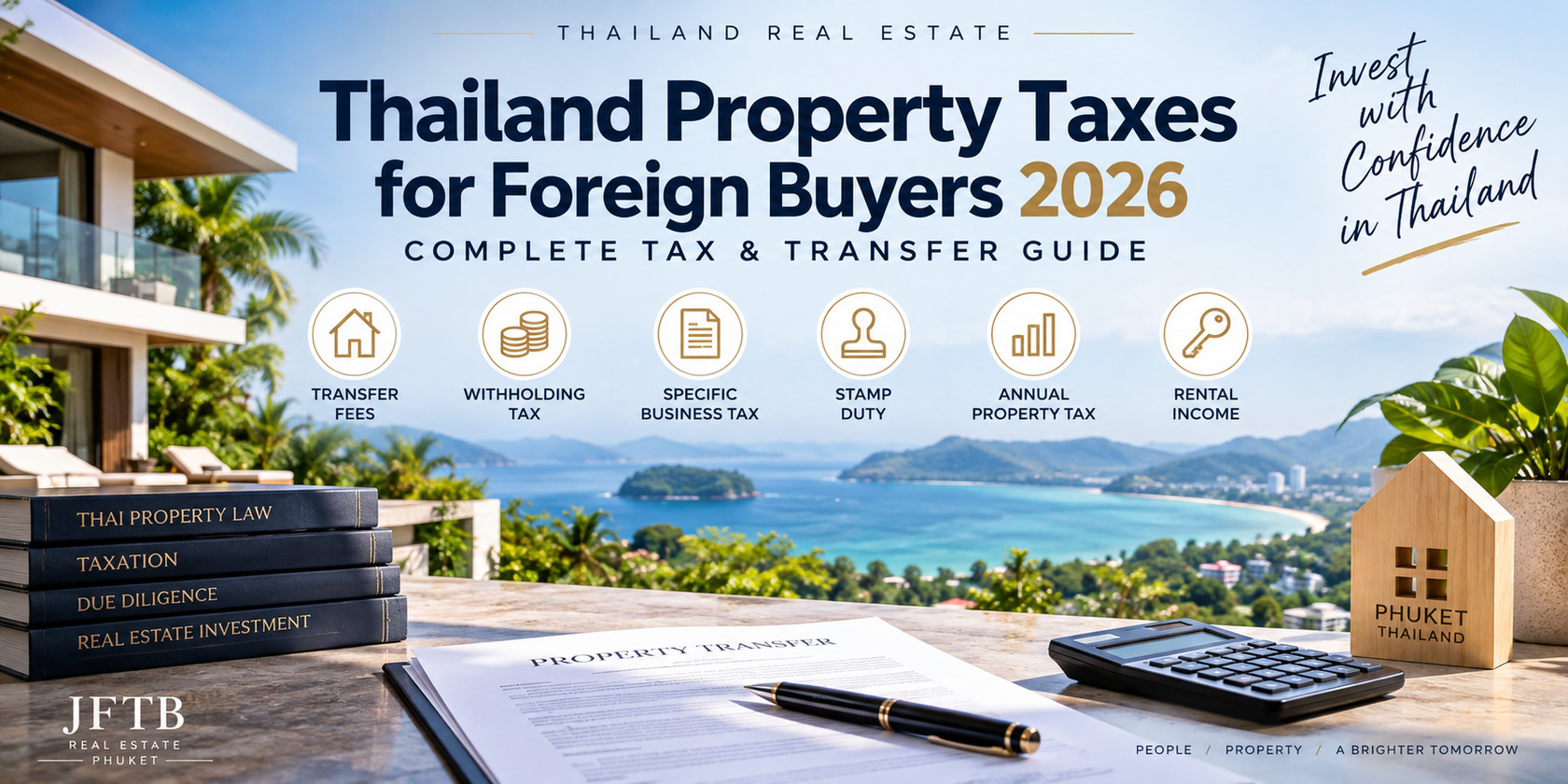
Понимание Налоги на недвижимость в Таиланде для иностранных покупателей is essential before purchasing, holding, renting or eventually selling property in Thailand.
The tax system is not based on one single “property tax”.
Instead, different taxes and government fees can arise at different stages of ownership:
- transfer fee when ownership is registered
- withholding tax when property is sold
- Specific Business Tax in certain sales
- stamp duty when Specific Business Tax does not apply
- annual Land and Building Tax
- income tax on rental income
- corporate tax where property is held through a company
The amount payable can also depend on:
- whether the seller is an individual or company
- how long the property has been held
- the official appraised value
- the actual sale price
- how the property is used
- whether an exemption applies
For this reason, buyers should calculate the likely tax position before signing a Sale and Purchase Agreement rather than treating Land Office expenses as an afterthought.
This 2026 guide explains the main Налоги на недвижимость в Таиланде для иностранных покупателей, how they are calculated and which costs usually arise when property changes hands.
Thailand Does Not Have One Single Property Transfer Tax :
A clear understanding of Thailand property taxes for foreign buyers also makes it easier to compare the true cost of different properties.
Thailand Does Not Have One Single Property Transfer Tax
When a condominium, house or land-linked asset is transferred, several separate charges may appear.
The principal items are:
| Tax or fee | Typical rate or calculation | Usually linked to |
|---|---|---|
| регистрационный сбор за перевод | Normally 2% | Transfer of ownership |
| Withholding tax – individual seller | Formula based on appraised value and holding period | Seller |
| Withholding tax – company seller | 1% | Company seller |
| Специальный налог на бизнес | 3.3% including municipal tax | Certain sales |
| Гербовый сбор | 0.5% | Sales not subject to SBT |
| Land and Building Tax | Annual progressive rate | Property ownership/use |
These charges should not be combined into a single percentage because each uses different rules and sometimes a different tax base.
The Standard Property Transfer Fee Is 2%
The normal registration fee for a transfer of real estate is 2% of the official appraised value used by the Department of Lands.
The Department of Lands confirms the standard 2% registration rate in its official guidance on fees, taxes and duties.
The transfer fee is therefore different from taxes such as Specific Business Tax and withholding tax.
It is a government registration fee associated with recording the transfer of rights.
Для Налоги на недвижимость в Таиланде для иностранных покупателей, this distinction matters because buyers sometimes assume every Land Office cost is calculated from the agreed purchase price.
That is not the case.
This transfer fee is one of the first Thailand property taxes for foreign buyers to include in the acquisition budget.
Who Pays the 2% Transfer Fee?
The commercial allocation of the transfer fee is normally determined by the Sale and Purchase Agreement.
Depending on the transaction, parties may agree that:
- the buyer pays it
- the seller pays it
- it is divided equally
- one party pays all Land Office expenses as part of the negotiated deal
There is no reason to assume automatically that “buyer pays 2%” or “seller pays 2%” without reading the contract.
This is particularly important in Phuket resale transactions where tax allocation is often part of the price negotiation.
The 0.01% Transfer Fee Reduction in 2026 Does Not Generally Apply to Foreign Buyers
Thailand extended a temporary property stimulus measure from 1 July 2026 to 30 June 2027.
For qualifying transactions, the transfer registration fee is reduced from 2% to 0.01%, and qualifying mortgage registration fees are also reduced to 0.01%.
However, the current measure applies only where the buyer is a Thai natural person and the other statutory conditions are met.
The Thai government states that the qualifying property must generally have:
- sale price not exceeding THB 7 million
- official appraised value not exceeding THB 7 million
- qualifying mortgage not exceeding THB 7 million where applicable
The official announcement expressly limits the measure to buyers who are natural persons of Thai nationality. Thai Government – 2026–2027 reduced property transfer fees
Therefore, foreign buyers should normally budget using the standard transfer-fee rules rather than assuming the 0.01% incentive applies to them.
This is an especially important 2026 point because older articles and property advertisements may mention the reduced rate without clearly explaining the nationality restriction.
This distinction is especially important when calculating Thailand property taxes for foreign buyers in 2026.
What Is the Official Appraised Value?
Thailand’s Department of Lands uses an official appraised value for property-registration purposes.
This figure may differ materially from the actual negotiated market price.
Например:
- market sale price: THB 15 million
- official appraised value: THB 10 million
Different taxes may use different bases.
The transfer registration fee is normally calculated from the official appraised value.
Specific Business Tax and stamp duty generally use the higher of the actual sale price or the official appraised value.
Withholding tax has its own calculation rules.
Вот почему Thailand property taxes for foreign buyers cannot accurately be estimated by applying one tax percentage to the asking price.
Thailand’s official appraisal values are scheduled to enter a new valuation cycle from 2027. See our analysis of Thailand Property Valuation Changes 2027.
Official appraisal values therefore play an important role in several Thailand property taxes for foreign buyers.
Withholding Tax When an Individual Sells Property
When the seller is an individual, withholding tax is not simply a fixed percentage of the sale price.
The calculation generally considers:
- the official appraised value
- permitted statutory deductions
- number of years the property has been held
- Thailand’s progressive personal income-tax rates
For tax purposes, the number of years held is calculated using calendar years.
The Revenue Department states that a fraction of a year is treated as a full year and that the calculation is capped at ten years for this purpose.
The result is calculated at the time ownership is transferred.
For an individual foreign owner selling a condominium, this can therefore produce a materially different result from simply calculating “1% withholding tax”.
The 1% rule applies to a company seller, not an individual seller.
For this reason, Thailand property taxes for foreign buyers should also be considered from the future seller’s perspective.
Individual Seller Withholding Tax Is Not the Same as Capital Gains Tax
Foreign owners frequently ask:
“What is the capital gains tax when I sell my condo?”
Thailand does not generally present ordinary private real-estate transfers through a separate standalone tax called “capital gains tax” in the way some countries do.
Instead, income arising from a property disposal is dealt with through the Thai income-tax and withholding-tax framework, together with any applicable Specific Business Tax or stamp duty.
For private sellers, the withholding calculation can depend heavily on:
- acquisition method
- appraised value
- holding period
This is one reason the precise seller calculation should be obtained before agreeing the final net sale proceeds.
Withholding Tax When a Company Sells Property
Where a Thai company or other qualifying juristic entity sells real estate, withholding tax is generally calculated at 1% of the higher of:
- the registered sale price
- the Department of Lands appraised value
The Thai Revenue Department confirms this treatment for corporate sellers.
This withholding is different from the company’s ultimate corporate income-tax liability.
It is a tax withheld at the property transaction stage.
A company-held villa therefore has a different tax profile from a privately owned foreign-freehold condominium.
For buyers considering existing company-held property, see JFTB’s guide to Buying Property Through a Company in Thailand.
What Is Specific Business Tax?
Specific Business Tax, usually abbreviated to SBT, can apply to property transactions considered commercial or profitable sales under the Revenue Code and relevant Royal Decrees.
For relevant real-estate sales, the effective rate is generally:
3% Specific Business Tax
plus
10% municipal tax on the SBT
giving an effective total of:
3.3%
The Revenue Department confirms that the tax base generally uses the higher of the actual sale price and the official appraised value.
Thai Revenue Department – taxation on sales of immovable property
SBT can therefore represent one of the largest transaction costs when property is resold.
Specific Business Tax can become one of the largest Thailand property taxes for foreign buyers to consider when planning a future resale.
The Five-Year Rule for Individual Property Sellers
For an ordinary individual resale, a sale within five years of acquisition can commonly fall within the Specific Business Tax regime.
The holding period for this test is measured from the date of acquisition to the transfer date.
This is different from the calendar-year calculation used for individual withholding tax.
The Revenue Department specifically distinguishes these two methods.
However, several exceptions exist.
For example, an individual seller may fall outside SBT in certain circumstances where the property has genuinely been used as the seller’s principal residence and the seller has been registered in the relevant house registration for the required period.
Inheritance and other statutory situations can also change the treatment.
Therefore, Thailand property taxes for foreign buyers should not be estimated using the simplistic rule “sell before five years = always 3.3%; sell after five years = never 3.3%.”
The actual transaction needs to be checked.
Why the House Registration Exception Matters
One important SBT exception can apply where an individual seller has used the property as a principal residence and has been listed in the house registration for at least the required period.
The Revenue Department refers to a minimum aggregate period of one year for the relevant residential exception.
That can be important for Thai owners.
For foreign property owners, however, eligibility should never be assumed merely because the property was personally occupied.
The precise registration status and factual circumstances need to satisfy the tax requirements.
Stamp Duty
Where Specific Business Tax does нет apply, stamp duty may apply instead.
The standard stamp duty on a qualifying real-estate transfer is:
0.5%
or THB 1 per THB 200 of the relevant tax base.
The tax base is generally the higher of:
- actual sale price
- official appraised value
The Revenue Department confirms that a property sale subject to Specific Business Tax is exempt from this stamp duty.
Therefore, a normal sale is generally not charged both:
3.3% SBT
и
0.5% stamp duty
on the same transaction.
Understanding that distinction prevents a very common overestimation of transfer expenses.
Who Normally Pays SBT, Stamp Duty and Withholding Tax?
These taxes arise primarily from the seller’s tax position.
In ordinary market practice, the seller commonly bears:
- налог у источника
- Specific Business Tax where applicable
- stamp duty where applicable
However, contractual agreements can allocate economic costs between the parties differently.
For example, a purchase agreement may state that all transfer costs are shared 50/50 or that one party bears all Land Office expenses.
Foreign buyers should therefore separate:
who is legally assessed for the tax
от
who has contractually agreed to bear the cost.
Contractual allocation can therefore materially affect the practical burden of Thailand property taxes for foreign buyers.
New Development Purchases Can Have Different Cost Allocations
Purchasing directly from a developer is different from purchasing a resale property from an individual owner.
Developers may structure contracts specifying:
- who pays the transfer fee
- whether the transfer fee is shared
- maintenance deposits
- взносы в резервный фонд
- utility deposits
- плата за пользование общими зонами
- other completion charges
Not all of these items are taxes.
A buyer should distinguish government taxes and registration fees from private contractual charges imposed by the development.
Common Area Fees Are Not Property Taxes
Condominium common-area fees are sometimes included in buyers’ calculations of “annual property tax”.
They are not taxes.
They are charges payable to the condominium juristic person for operation and maintenance of the common property.
Typical expenses funded by common-area fees may include:
- безопасность
- уборка
- бассейны
- ландшафтный дизайн
- lifts
- common electricity
- персонал
- building management
Similarly, a condominium sinking-fund contribution is not a government tax.
Keeping these items separate produces a much more accurate ownership-cost calculation.
Annual Land and Building Tax
Thailand also imposes an annual Land and Building Tax.
The tax depends primarily on:
- property value
- category of use
- ownership circumstances
The principal categories include:
- agricultural
- residential
- other/commercial use
- vacant or unused property
For many foreign residential investors, the residential category is the most relevant.
The annual Land and Building Tax should therefore be included when considering Налоги на недвижимость в Таиланде для иностранных покупателей, even though the amount is often considerably smaller than the taxes involved at purchase or resale.
Annual ownership costs are therefore another component of Thailand property taxes for foreign buyers.
Residential Land and Building Tax
Current residential rates are progressive.
For residential property outside the principal-residence exemption categories, rates begin at approximately:
0.02%
and increase according to the assessed value.
Official local-government tax guidance currently sets residential brackets for relevant “other residential” property at:
- up to THB 50 million: 0.02%
- above THB 50 million to THB 75 million: 0.03%
- above THB 75 million to THB 100 million: 0.05%
- above THB 100 million: 0.10%
The exact tax depends on the statutory category into which the property falls.
Principal Residence Exemptions
Thailand provides certain exemptions for qualifying owner-occupied residential property.
A commonly relevant exemption concerns an individual owner whose name is registered in the house registration for the qualifying principal residence.
Official local-government guidance provides an exemption up to the statutory threshold for qualifying principal residences.
However, foreign investors should not simply assume that they qualify for this exemption.
Eligibility depends on the legal requirements governing ownership and registration.
For a foreign investor who owns a condominium as a second home, investment property or rental unit, annual residential Land and Building Tax should normally be factored into the ownership model unless an exemption has been confirmed.
A Foreign-Owned Condo Can Still Be Subject to Annual Property Tax
Foreign freehold ownership does not exempt a condominium from Land and Building Tax.
The tax treatment depends primarily on use, value and statutory status rather than simply on whether the owner is Thai or foreign.
A foreign-freehold condominium used as an investment property may therefore generate an annual tax assessment.
For buyers considering condominium ownership rules separately, see Покупка квартиры в Пхукете иностранцем..
Vacant Land Can Face Higher Taxation
Vacant or unused land receives less favourable treatment under Thailand’s Land and Building Tax framework.
The tax system is designed partly to discourage long-term non-use of land.
Rates for vacant property can be materially higher than residential rates and may increase if land continues to remain unused.
This is particularly relevant to investors buying development land but intending to leave it undeveloped for several years.
When evaluating such a parcel, annual tax should be included alongside:
- financing cost
- безопасность
- vegetation management
- infrastructure
- development planning
For land-development issues, see Buying Land in Thailand: Titles, Zoning & Building Rules.
Rental Income Is Also Taxable Income
Foreign owners who rent property in Thailand should not consider only Land and Building Tax.
Rental income can create Thai income-tax obligations.
The correct treatment depends on factors such as:
- individual or company ownership
- Thai tax residence
- type of rental income
- allowable deductions
- other income
- applicable double-tax agreements
A foreign landlord should therefore calculate net rental return after tax, not simply headline rent divided by purchase price.
This becomes increasingly important when comparing Phuket investment properties with guaranteed-rental or projected-yield marketing.
Rental taxation should consequently be included in any realistic assessment of Thailand property taxes for foreign buyers.
Gross Yield Is Not Net Yield
Suppose a condominium is marketed at:
6% annual rental yield
That number may be calculated before:
- плата за пользование общими зонами
- управление недвижимостью
- ремонт
- вакансия
- страхование
- Land and Building Tax
- rental income tax
- agency fees
- замена мебели
A serious investor should calculate the return after all recurring expenses.
По этой причине, Thailand property taxes for foreign buyers form part of investment analysis rather than merely a legal compliance issue.
See JFTB’s Руководство по инвестициям в недвижимость на Пхукете в 2026 году for the broader investment framework.
Taxes on a Company-Held Property
Where property is held through a Thai company, the tax analysis changes materially.
Possible issues include:
- corporate income tax
- налог у источника
- Специальный налог на бизнес
- annual accounting
- corporate compliance
- taxes on rental income
- taxes on property disposal
- taxes associated with distributions to shareholders
A company should therefore never be chosen simply because somebody says it is “better for tax”.
The legal, accounting and ownership consequences need to be considered together.
This is particularly important where the company owns land because separate foreign ownership restrictions also arise.
Видеть Иностранная собственность на землю в Таиланде for the land-ownership framework.
Buying Shares in a Property Company Does Not Eliminate Tax Risk
Some villa transactions are structured as share transfers rather than direct transfers of land.
That may mean no new Land Office property transfer occurs at that moment.
But it does нет mean the transaction is “tax free”.
The buyer acquires shares in a legal entity together with its:
- tax history
- бухгалтерские записи
- liabilities
- landholding history
- контракты
- potential compliance issues
Tax due diligence on the company may therefore be more important than the immediate Land Office tax saving.
The transaction structure should never be chosen solely to avoid a transfer fee.
Property Tax Is Part of Due Diligence
Before purchasing, buyers should determine:
- Who is the registered seller?
- Is the seller an individual or company?
- What is the official appraised value?
- What is the agreed sale price?
- How long has the seller owned the property?
- Is SBT likely to apply?
- If SBT does not apply, will stamp duty apply?
- How will withholding tax be calculated?
- Who has agreed to pay the transfer fee?
- Does any temporary fee reduction actually apply?
- What annual Land and Building Tax should be expected?
- Will rental income create Thai tax obligations?
These checks belong within the wider process covered in JFTB’s Комплексная проверка недвижимости в Таиланде.
Example: Foreign Buyer Purchasing a Resale Condo
Consider a foreign buyer purchasing a foreign-freehold resale condominium.
Assume:
- sale price: THB 12 million
- official appraised value: THB 9 million
- seller: individual
- foreign buyer
- no special transfer-fee concession
Potential transaction items include:
Transfer fee
Normally calculated at 2% of the official appraised value:
THB 9,000,000 × 2% = THB 180,000
The contract determines whether buyer, seller or both bear this cost.
Seller withholding tax
Calculated separately under the individual withholding formula using the appraised value and holding period.
SBT or stamp duty
Determined from the seller’s circumstances.
These cannot be calculated accurately without knowing the seller’s history and status.
This example illustrates why quoting a buyer one universal “6.3% transfer tax” is misleading.
Example: Why Seller Holding Period Matters
Two identical condominiums may sell for the same THB 10 million price.
Seller A acquired the unit recently.
Seller B has held the unit for many years.
The properties are economically identical from the buyer’s perspective.
But the seller-side tax position may differ because:
- withholding tax changes with holding period
- Specific Business Tax may apply differently
- stamp duty may replace SBT
That can influence negotiations over who pays which transfer costs.
Is There a Special Foreign Buyer Tax?
Thailand does not generally impose a separate transfer-tax rate simply because the purchaser is foreign.
The standard transfer and tax framework applies according to the transaction.
However, foreign buyers can experience different practical consequences because:
- condominium foreign ownership rules apply
- land ownership is restricted
- certain Thai-only incentives do not apply
- financing options differ
- foreign exchange documentation may be required
- principal-residence exemptions may not apply in the same way
Therefore, Thailand property taxes for foreign buyers are less about a special “foreigner tax” and more about understanding how the normal Thai tax system interacts with foreign ownership structures.
Do Foreigners Pay More Transfer Tax Than Thai Buyers?
Under the standard system, the basic transfer-fee rate is not automatically higher because the buyer is foreign.
However, temporary government incentives may be limited to Thai nationals.
That is exactly the situation in the current 2026–2027 reduced transfer-fee programme.
A Thai natural-person buyer who satisfies the programme requirements may receive the 0.01% rate.
A foreign purchaser cannot simply assume the same concession.
That can create a meaningful difference in closing costs even though the standard statutory transfer rate itself is not nationality-based.
Temporary incentives can create differences in Thailand property taxes for foreign buyers even when the standard tax framework is otherwise the same.
There Is No Universal Percentage for Total Property Taxes
Statements such as:
“Thailand property transfer tax is 6.8%.”
или
“Closing costs are always 3%.”
should be treated cautiously.
The total depends on the transaction.
The calculation can change depending on:
- тип продавца
- holding period
- appraised value
- sale price
- SBT eligibility
- гербовый сбор
- contract allocation
- government incentives
The correct approach is to calculate each item individually.
The practical way to understand Thailand property taxes for foreign buyers is to separate acquisition, holding and exit costs.
JFTB Tax Cost Framework
For international buyers, JFTB separates property tax analysis into three stages.
1. Acquisition Costs
Identify:
- комиссия за перевод
- developer charges
- legal expenses
- ownership-structure costs
2. Holding Costs
Model:
- Land and Building Tax
- общие сборы
- управление
- rental-income taxation
- company accounting where relevant
3. Exit Costs
Estimate:
- налог у источника
- SBT or stamp duty
- transfer-fee allocation
- agency fee
- repatriation considerations
A property should make financial sense across all three stages.
Common Property Tax Mistakes
Common mistakes include:
- assuming the buyer always pays the 2% transfer fee
- assuming the 0.01% incentive applies to foreigners
- calculating every tax from the purchase price
- treating company withholding tax as the rule for individual sellers
- adding SBT and stamp duty together automatically
- ignoring the seller’s holding period
- assuming “no capital gains tax” means a sale has no income tax
- forgetting annual Land and Building Tax
- confusing condominium common fees with taxes
- calculating rental yield before tax
- buying a company-held property without checking historic tax liabilities
These errors can materially change the economics of a transaction.
A complete analysis of Thailand property taxes for foreign buyers should therefore cover the entire ownership cycle rather than the purchase alone.
Часто задаваемые вопросы
What property taxes do foreigners pay in Thailand?
Foreign buyers may encounter transfer fees when purchasing, annual Land and Building Tax during ownership and income tax on rental income. When the property is later sold, withholding tax, Specific Business Tax or stamp duty may also arise depending on the transaction.
What is the property transfer fee in Thailand in 2026?
The standard transfer registration fee is normally 2% of the official appraised value. A temporary 0.01% incentive exists for qualifying transactions through 30 June 2027, but it is restricted to Thai natural-person buyers who satisfy the programme conditions.
Can foreigners get the 0.01% transfer fee in 2026?
The current 2026–2027 government measure specifies Thai natural-person buyers. Foreign buyers should therefore not assume they qualify for the reduced rate.
Who pays the transfer fee in Thailand?
The Sale and Purchase Agreement should specify the allocation. Buyer and seller may agree to split it or allocate it entirely to one party.
What is Specific Business Tax on property?
Specific Business Tax can apply to qualifying commercial or profitable property sales. The effective rate is generally 3.3% including municipal tax.
Is stamp duty paid together with Specific Business Tax?
Normally no. Where SBT applies, the transaction is generally exempt from the 0.5% stamp duty on the property transfer.
What is withholding tax when selling property?
For an individual seller, withholding tax is calculated using the official appraised value, statutory deductions and holding period. For a company seller, the withholding rate is generally 1% of the higher of the sale price or appraised value.
Is there capital gains tax on property in Thailand?
Thailand generally deals with gains from ordinary property sales through its income-tax and withholding-tax system rather than imposing a separate property-specific tax labelled “capital gains tax”.
Do foreigners pay annual property tax in Thailand?
Foreign-owned property can be subject to Thailand’s Land and Building Tax. The rate depends on the property value, use and applicable statutory category.
How much is residential Land and Building Tax?
For residential property falling within the general residential category, current rates can begin at approximately 0.02% and increase progressively according to assessed value.
Is rental income taxable in Thailand?
Thai-source rental income can create Thai tax obligations for a foreign property owner. The precise liability depends on ownership structure, tax residence, deductions and other circumstances.
Are condominium maintenance fees taxes?
No. Common-area fees and sinking-fund contributions are private condominium charges rather than government taxes.
Should taxes be checked before making an offer?
Yes. Transfer and future exit taxes can affect the buyer’s total acquisition cost, net rental yield and eventual resale economics.
Thailand Property Taxes with JFTB
Понимание Налоги на недвижимость в Таиланде для иностранных покупателей is not about memorising one percentage.
It is about knowing:
- which tax applies
- who is liable
- which value is used
- whether an exemption applies
- who has agreed to bear the cost
- how the ownership structure affects future taxation
A property that appears inexpensive based only on purchase price can become materially more expensive once acquisition, holding and exit costs are included.
JFTB Real Estate Phuket assists international buyers with property sourcing, negotiation, investment analysis and coordination of independent legal, accounting and tax advice.
Before committing to a purchase, calculate the entire ownership cycle:
buy, hold, rent and eventually sell.
If you are considering a property in Phuket and want to understand the likely transaction costs before making an offer, contact JFTB Real Estate Phuket before signing or transferring a substantial deposit.