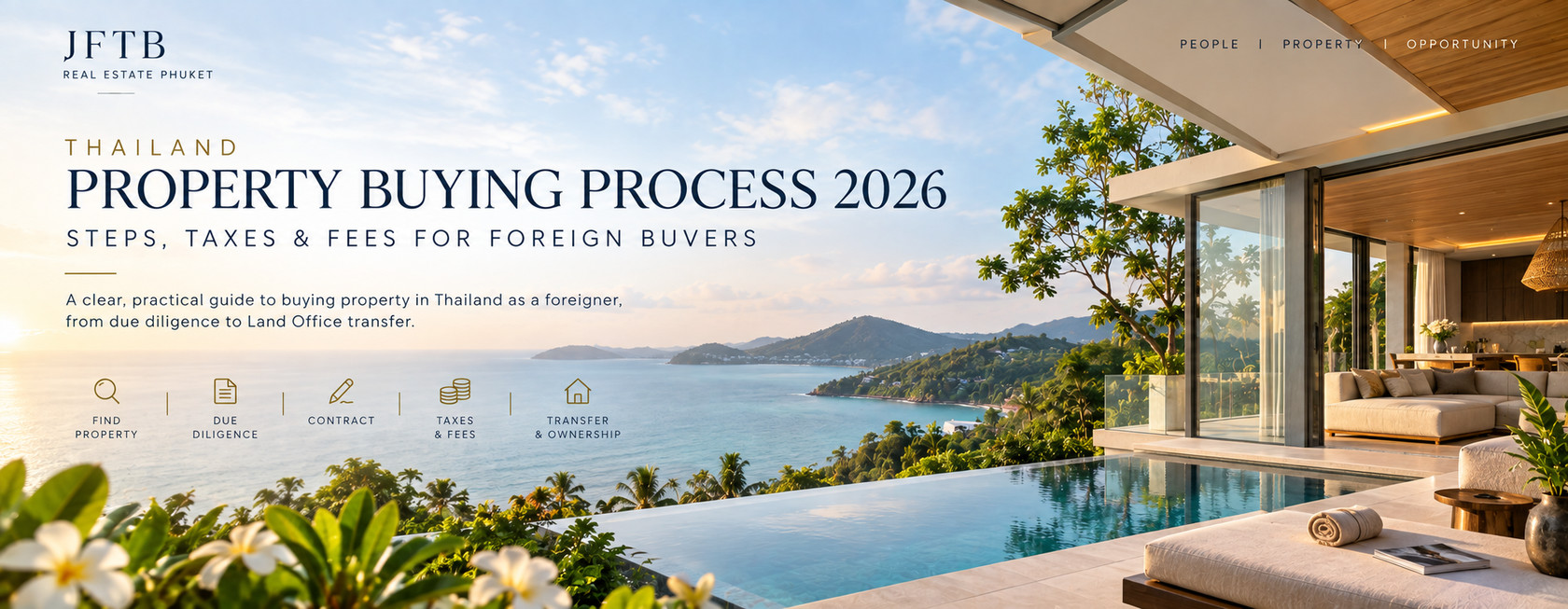
Buying property in Thailand as a foreigner is possible, but the process depends on what you are buying and which legal right you will actually acquire.
A foreign freehold condominium, a leasehold villa, a resale property and an off-plan development do not follow exactly the same path.
The safest Thailand property buying process is therefore not:
Find property → pay deposit → work out the legal structure later
It should be:
Define ownership → verify the asset → negotiate the transaction → complete due diligence → structure the payment → register the transfer
This guide explains the practical buying process for foreign purchasers in 2026, from initial property selection through contracts, funds, Land Office registration, taxes and post-transfer administration.
For a broader overview of ownership and foreign-buyer rules, see Buying Property in Thailand.
Thailand Property Buying Process: Quick Overview
A typical purchase may involve the following stages:
- Define the property, budget and intended ownership
- Compare suitable properties
- Negotiate price and commercial terms
- Review the reservation agreement before paying
- Appoint an independent lawyer
- Complete legal due diligence
- Review and sign the Sale and Purchase Agreement
- Arrange funds and required banking documentation
- Confirm foreign quota where applicable
- Conduct the final inspection
- Confirm taxes, fees and completion balances
- Register the ownership or lease right at the Land Office
- Collect registered documents
- Complete post-transfer administration
The exact sequence changes according to the asset.
A condominium, villa, leasehold property and off-plan project require different checks.
Step 1: Confirm What You Are Actually Buying
Before paying a deposit, establish both the physical property and the legal right being acquired.
These are not always the same thing.
For many foreign buyers, a qualifying foreign-freehold condominium provides the clearest form of direct registered ownership.
Villa transactions can be more complex because the land, building, lease and other registered rights may need to be considered separately.
Leasehold also requires analysis of the registered term, transfer rights, succession provisions and what happens when the lease expires.
For the detailed ownership rules, see:
A good Thailand property buying process starts by resolving the ownership question before negotiating the final contract.
Step 2: Define the Buying Criteria
The buyer should establish a realistic brief before making an offer.
That normally includes:
- total budget
- property type
- location
- intended ownership
- personal use or investment
- financing requirements
- rental objectives
- expected holding period
- resale strategy
Two properties with the same asking price may represent very different legal and financial propositions.
A THB 15 million foreign-freehold condominium and a THB 15 million leasehold villa should not be compared on headline price alone.
The buyer should compare the rights acquired, total cost, practical use and future exit.
If you need help narrowing the market before viewings, see our Phuket Property Finder service.
Step 3: Negotiate More Than the Price
A property negotiation should cover the entire transaction, not only the headline price.
Important terms can include:
- purchase price
- deposit
- payment schedule
- transfer date
- furniture and inventory
- repairs
- vacant possession
- existing tenancy
- due diligence conditions
- refund conditions
- transfer-cost allocation
- outstanding common fees
- seller documentation
For a resale property, anything expected to remain with the property should ideally be recorded rather than assumed.
A strong negotiation reduces uncertainty before money becomes difficult to recover.
Step 4: Review the Reservation Agreement Before Paying
Many property transactions begin with a reservation agreement and deposit.
The important question is not simply how much the deposit is.
It is:
Under what circumstances is it refundable?
Before paying, confirm:
- who receives the money
- whether the deposit is refundable
- what happens if due diligence fails
- what happens if financing fails
- what happens if foreign quota is unavailable
- the deadline for signing the main contract
- what happens if the seller withdraws
- what happens if the buyer withdraws
A small reservation payment may sometimes be commercially necessary to secure a property.
A substantial or non-refundable payment deserves greater caution.
This stage of the Thailand property buying process is where buyers should clarify refund conditions before becoming materially committed.
Step 5: Appoint an Independent Lawyer
The lawyer should represent the buyer’s interests.
A developer’s lawyer or seller’s documentation team may be professional, but they do not automatically perform the same role as an independently appointed buyer’s lawyer.
Depending on the transaction, legal review may cover:
- ownership
- title documentation
- seller authority
- mortgages and encumbrances
- contracts
- access
- building documentation
- lease rights
- foreign quota
- company documents where relevant
- transfer requirements
The level of work should reflect the value and complexity of the acquisition.
Step 6: Complete Property Due Diligence
Due diligence should answer one central question:
Is the buyer receiving the property and legal rights that the seller claims to be selling?
For a condominium, this may involve checking title, ownership, mortgages, foreign quota, common fees, management and restrictions.
For a villa or house, it can also involve land boundaries, road access, servitudes, building permits, utilities and the relationship between land and building rights.
Due diligence is one of the most important safeguards in the Thailand property buying process, especially when ownership, access or contractual rights are complex.
For leasehold property, the registered duration, transferability, inheritance provisions and renewal wording become important.
A beautiful property with defective access, unclear ownership or weak contractual rights can become a poor transaction.
See our full Property Due Diligence in Thailand guide.
Step 7: Apply Additional Checks to Off-Plan Property
Buying off-plan creates a different risk profile because the completed asset may not yet exist.
Before making substantial staged payments, review matters such as:
- developer identity and track record
- ownership of the development land
- existing encumbrances
- construction permits
- required approvals
- unit plans and specifications
- completion timetable
- payment schedule
- delay provisions
- refund rights
- defect obligations
- foreign quota
- common fees and sinking fund
- management arrangements
Marketing material should not replace contractual documentation.
If a feature is essential to the purchase decision, it should ideally appear in the contract or approved specifications.
Step 8: Review the Sale and Purchase Agreement
The Sale and Purchase Agreement should reflect the commercial deal actually agreed between the parties.
Important provisions may include:
- parties
- property identification
- price
- deposits already paid
- payment schedule
- completion date
- due diligence conditions
- ownership structure
- inventory
- seller representations
- outstanding liabilities
- default provisions
- termination and refunds
- taxes and transfer expenses
- possession
A good contract should not only explain what happens when everything goes according to plan.
It should also explain what happens when it does not.
The Sale and Purchase Agreement is one of the most important documents in the Thailand property buying process because it converts the negotiated terms into binding contractual obligations.
Step 9: Arrange the Funds Correctly
For many foreign-freehold condominium purchases, the origin and transfer of funds are important.
Where foreign-currency remittance is used to qualify for foreign condominium ownership, the buyer should obtain the appropriate banking evidence.
Transfer instructions should be confirmed with the receiving Thai bank before sending substantial funds.
Do not wait until completion day to discover that the remittance description or banking documentation is unsuitable.
The Department of Lands publishes official information and answers regarding documentation for foreign condominium transfers through its official website.
Buyers using financing should also establish loan eligibility before making a substantial commitment. See Mortgage in Thailand for Foreigners.
Step 10: Confirm Foreign Quota Before Condo Transfer
A condominium advertised as “foreign freehold” should not automatically be assumed to have foreign quota available at completion.
Foreign ownership in a registered condominium is generally subject to the statutory quota.
The condominium juristic person must provide the documentation required for transfer.
Quota availability should therefore be confirmed before the buyer becomes materially committed.
This is especially important in projects that are already popular with international owners.
Step 11: Conduct a Final Inspection
The final inspection is a practical but important stage of the Thailand property buying process, especially before the last payment is released.
For a completed property, inspect the property again shortly before final payment or transfer.
Depending on the asset, check:
- air-conditioning
- electrical systems
- plumbing
- appliances
- doors and windows
- furniture
- pool equipment
- water systems
- visible defects
- agreed repairs
- inventory
- keys and access devices
For a new property, a formal snagging inspection may be appropriate.
Material defects should ideally be documented before the final balance is released.
Step 12: Confirm the Completion Statement
Before transfer, the parties should know exactly how much must be paid and to whom.
The completion calculation can include:
- balance of purchase price
- transfer fee
- applicable taxes
- common fees
- utility adjustments
- deposits already paid
- outstanding mortgage repayment
- contractual adjustments
This reduces the risk of last-minute disputes at the Land Office.
Thailand Property Taxes and Transfer Fees
Taxes and registration fees depend on the property, seller, holding period, transaction structure and official appraised value.
Common categories include:
| Tax or Fee | Typical Rate | General Principle |
|---|---|---|
| Transfer registration fee | 2% | Generally calculated on the official appraised value |
| Specific Business Tax | 3.3% when applicable | Applied according to the relevant tax rules |
| Stamp duty | 0.5% when applicable | Generally applies when Specific Business Tax is not payable |
| Withholding tax | Variable | Depends on whether the seller is an individual or legal entity |
These rates should not be turned into one universal formula.
For example, Thailand’s Revenue Department confirms a 3.3% effective Specific Business Tax in applicable property transactions and a 0.5% stamp-duty rate where the relevant transfer is not subject to Specific Business Tax.
Official tax information is available from Thailand’s Revenue Department.
For a detailed buyer-focused explanation, see Thailand Property Taxes for Foreign Buyers.
Important 2026 Warning About the 0.01% Transfer Fee
Thailand extended a temporary housing measure reducing certain transfer and mortgage registration fees to 0.01% until 30 June 2027 for qualifying residential transactions with a purchase price and official appraised value not exceeding THB 7 million and, where relevant, a mortgage not exceeding THB 7 million.
However, the current measure applies specifically to qualifying Thai-national individual buyers.
Foreign buyers should therefore not assume that the 0.01% rate applies to their purchase.
The Thai government confirmed this nationality requirement when extending the measure in 2026. See the official Thai Government announcement.
Unless a transaction clearly qualifies for a specific exemption or incentive, foreign buyers should budget using the standard framework and obtain the actual transfer calculation before completion.
Who Pays the Taxes and Transfer Costs?
Do not rely on a simplistic rule such as:
“Buyer pays this and seller pays that.”
Some charges arise from the seller’s tax position.
Other costs may be contractually allocated between buyer and seller.
The Sale and Purchase Agreement should therefore state clearly who is responsible for each cost.
Before signing, request an estimated calculation based on:
- agreed price
- Land Office appraised value
- seller type
- seller holding period
- applicable tax rules
- contractual allocation
The final amount should be confirmed for the actual transaction.
Step 13: Complete the Land Office Transfer
The final registration normally takes place at the competent Land Office.
Depending on the transaction, the process can involve the buyer, seller, authorised representatives, lawyers, bank representatives and Land Office officials.
The Land Office registers the ownership transfer or relevant legal right.
For condominium acquisitions, the required foreign-ownership and banking documents should already be prepared before the appointment.
A well-prepared Thailand property buying process should not depend on finding missing documents on transfer day.
Official Land Office information is available through Thailand’s Department of Lands.
Can the Buyer Use a Power of Attorney?
Often, yes.
A buyer or seller may be able to appoint an authorised representative for certain Land Office procedures.
The correct form and signing requirements should be confirmed for the specific transaction.
Documents executed overseas can also require additional formalities.
A buyer who cannot attend personally should organise the power of attorney well before completion.
Step 14: Keep the Registered Documents
After transfer, retain organised copies of the important transaction records.
Depending on the property, these can include:
- registered title documents
- Land Office documents
- transfer receipts
- tax receipts
- Sale and Purchase Agreement
- banking evidence
- foreign-exchange documentation
- condominium certificates
- registered lease documents
- inventory
- warranties
- building documentation
These records may become important when the property is later sold, leased, refinanced or transferred.
Step 15: Complete Post-Transfer Administration
Transfer at the Land Office is not necessarily the final administrative step.
The buyer may still need to arrange:
- electricity
- water
- condominium or estate registration
- insurance
- property management
- rental management
- internet
- maintenance contracts
- tax advice
Property ownership and immigration status are separate matters.
Buying property in Thailand does not automatically provide the right to live permanently in Thailand.
The Thailand property buying process does not necessarily end when the Land Office transfer is completed.
Common Mistakes Foreign Buyers Should Avoid
The most common problems usually come from moving too quickly rather than from the process being inherently complicated.
Avoid:
- paying a large deposit before understanding refund conditions
- treating the developer or agent as independent legal counsel
- assuming future lease renewal is guaranteed
- ignoring legal road access for villas and land
- sending condominium purchase funds without checking banking requirements
- focusing only on the purchase price rather than total acquisition cost
- assuming bank approval replaces buyer due diligence
The solution is not a more complicated structure.
It is a more disciplined process.
JFTB Buyer View
The deposit is not the finish line.
It is closer to the beginning of the verification process.
A disciplined Thailand property buying process should connect the legal structure, commercial terms and actual property value before the buyer becomes fully committed.
Before becoming substantially committed, a buyer should be able to answer three questions:
What exactly am I buying?
Can I legally acquire and hold it in the intended structure?
Does the transaction still make financial sense after all costs and risks are included?
A good property bought under a weak structure can become a bad transaction.
A legally clean property bought at an excessive price can also become a bad investment.
The objective is to align the property, legal structure and price.
Thailand Property Buying Checklist
Before completion, a foreign buyer should ideally confirm:
Property
- property correctly identified
- price confirmed
- inventory agreed
- condition checked
- final inspection completed
Ownership and Legal
- title verified
- seller verified
- ownership structure confirmed
- foreign quota confirmed where applicable
- lease reviewed where applicable
- due diligence completed
- encumbrances checked
- legal access confirmed where relevant
- contract reviewed
Financial
- deposit documented
- payment schedule understood
- funds prepared
- banking evidence available
- transfer fees calculated
- taxes estimated
- final balance confirmed
Transfer
- completion date agreed
- required documents ready
- power of attorney prepared if needed
- Land Office registration arranged
- post-transfer documents identified
How JFTB Supports Foreign Buyers
JFTB Real Estate Phuket has assisted international property buyers since 2013.
Our role is commercial and buyer-focused.
Depending on the transaction, JFTB can assist with:
- property search
- market comparison
- pricing analysis
- negotiation
- ownership discussions
- coordination with independent lawyers
- due diligence follow-up
- inspection coordination
- communication with sellers and developers
- transfer preparation
JFTB does not replace the buyer’s lawyer, accountant or tax adviser.
The objective is to keep the property selection, negotiation and Thailand property buying process aligned from the first search through completion.
Frequently Asked Questions
How long does the Thailand property buying process take?
There is no fixed timeframe.
A straightforward completed-property resale can move relatively quickly once due diligence and documentation are complete, while off-plan purchases can run through staged payments until construction and final transfer.
Can foreigners buy property in Thailand?
Yes.
Foreigners can directly own qualifying condominium units within the applicable foreign ownership framework.
Land, villas and leasehold structures require separate analysis.
Should I pay a deposit before due diligence?
Sometimes a reservation deposit is commercially required to secure a property.
However, the amount, recipient and refund conditions should be understood before payment.
Does a foreign buyer need a lawyer?
For a material property acquisition, independent legal review is strongly advisable.
The lawyer should represent the buyer rather than relying solely on documentation provided by the seller or developer.
What is the normal transfer fee in Thailand?
The standard transfer registration fee is generally 2% of the official appraised value.
Temporary incentives can apply to specific categories, but the current 0.01% housing measure should not automatically be assumed to apply to foreign buyers.
Can the purchase be completed without the buyer being in Thailand?
In many transactions, appropriately executed powers of attorney can allow authorised representatives to handle relevant procedures.
Requirements should be confirmed in advance.
Buying Property in Phuket? Start With the Right Process
A disciplined Thailand property buying process protects more than the legal transfer.
It helps the buyer avoid unsuitable properties, weak ownership structures, poorly drafted contracts and unnecessary financial risk.
JFTB helps international buyers identify suitable properties, compare alternatives, negotiate commercial terms and coordinate independent due diligence through completion.
View Properties for Sale in Phuket
Official References
Property registration and Land Office guidance are available from Thailand’s Department of Lands.
Tax information relating to property transfers, Specific Business Tax, stamp duty and withholding tax is available from Thailand’s Revenue Department.
The 2026 extension of the temporary 0.01% residential transfer and mortgage registration fee for qualifying Thai-national individual buyers is described in the official Thai Government announcement.
Rules, administrative requirements and tax treatment can change. Buyers should confirm the position applicable to their specific transaction before completion.