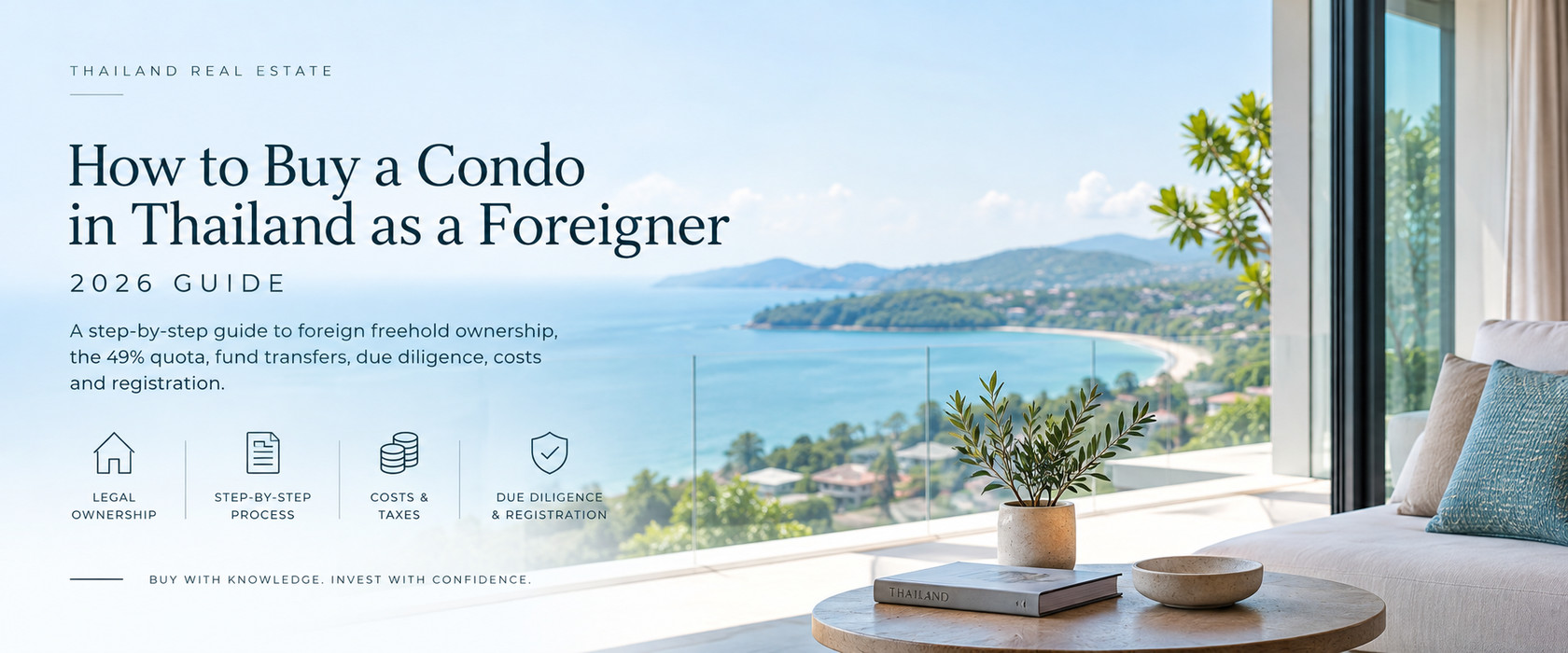
Foreign buyers can legally own qualifying condominium units in Thailand in their own name, provided the legal requirements are satisfied.
Understanding how to buy a condo in Thailand as a foreigner requires more than finding a property and agreeing on a price. The condominium must be legally registered, the buyer must qualify under Thai condominium law, sufficient foreign ownership quota must remain available, the transfer of funds must be documented correctly, and ownership must ultimately be registered at the competent Land Office.
This guide explains the national process step by step, including the 49% foreign ownership quota, foreign-currency transfers, banking evidence, due diligence, contracts, purchase costs and ownership registration.
It focuses specifically on condominiums throughout Thailand. For the broader legal framework covering condominiums, villas, land restrictions and leasehold structures, see our Buying Property in Thailand as a Foreigner: 2026 Complete Guide.
Can Foreigners Own a Condo in Thailand?
Yes, subject to the statutory conditions.
A qualifying foreign buyer may own a unit in a condominium registered under Thai law directly in their own name.
This is fundamentally different from acquiring land.
A condominium unit has its own condominium unit title deed, and ownership is registered at the Land Office. Terms such as foreign freehold are commonly used in the property market to describe this form of direct registered condominium ownership.
Before treating any apartment or residence as eligible for foreign ownership, buyers should verify that:
- the development is legally registered as a condominium
- the exact unit has a condominium unit title deed
- the buyer qualifies to acquire the unit
- sufficient foreign ownership quota remains available
- the seller has the legal authority to transfer the unit
- the required transfer and banking documents can be produced.
Not every apartment, serviced residence or residential development is legally equivalent to a registered condominium.
Understanding the 49% Foreign Ownership Quota
One of the most important rules when learning how to buy a condo in Thailand as a foreigner is the foreign ownership quota.
Foreign ownership is generally limited to 49% of the aggregate unit area of all units in the registered condominium.
The calculation is therefore based on condominium area, not simply on the number of units.
This distinction matters.
A building may still have units available for sale while having insufficient remaining foreign quota to transfer a particular unit into a foreign buyer’s name.
Before paying a substantial deposit, ask the condominium juristic person for current confirmation of the foreign ownership position.
The quota should also be reconfirmed before ownership transfer because availability may change between reservation and completion.
A sales advertisement stating foreign freehold available is not a substitute for current documentary confirmation.
Similarly, a Thai freehold unit, leasehold unit or company-held unit should not automatically be treated as equivalent to a unit that can be directly registered in a foreign individual’s name.
The foreign ownership quota is therefore one of the first legal checks when learning how to buy a condo in Thailand as a foreigner.
How to Buy a Condo in Thailand as a Foreigner: Step by Step
1. Define Your Buying Criteria
Start with the intended use of the property.
Are you buying primarily for:
- personal residence
- a second home
- long-term rental
- investment
- retirement
- future resale?
Set a total acquisition budget rather than looking only at the advertised purchase price.
Allow for legal review, transfer expenses, banking costs, furniture, common-area charges, sinking-fund contributions where applicable and future building maintenance.
Location and investment potential should be analysed separately from legal ownership.
A property can have a valid ownership structure and still be a poor investment.
2. Verify That the Property Is a Registered Condominium
Confirm the exact building and unit.
Do not assume that every property marketed as a condo, residence, serviced apartment or branded residence has the same legal status.
The unit should have a condominium unit title deed capable of being transferred through the Land Office.
This is particularly important for projects marketed to international buyers, where commercial terminology may not always explain the underlying legal structure precisely.
3. Check the Foreign Ownership Quota
Before committing substantial funds, establish whether sufficient foreign quota remains available for the unit.
The condominium juristic person plays an important role in confirming the foreign ownership proportion.
The purchase agreement should also address what happens if the agreed foreign ownership structure cannot legally be completed.
Do not rely exclusively on statements from the seller, developer or sales agent.
4. Carry Out Independent Due Diligence
Independent legal due diligence should take place before a buyer becomes unconditionally committed to the transaction.
For buyers learning how to buy a condo in Thailand as a foreigner, independent due diligence is one of the most important stages before substantial funds are committed.
For a completed condominium, checks may include:
- condominium unit title deed
- registered owner
- mortgages or encumbrances
- seller authority
- foreign quota availability
- outstanding common-area charges
- condominium regulations
- juristic-person documentation
- litigation affecting the unit where relevant
- transfer conditions
- contractual obligations.
The objective is not simply to establish that the condominium physically exists.
The buyer needs to know exactly what can legally be transferred, by whom, under what conditions and with which registered rights.
5. Negotiate the Contract, Not Just the Price
Price is only one element of a condominium transaction.
The agreement should clearly identify:
- the buyer and seller
- the exact unit
- agreed ownership structure
- purchase price
- deposit
- payment milestones
- included furniture
- condition of the unit
- completion date
- transfer expenses
- documents required from each party
- default provisions
- refund conditions
- vacant possession where applicable.
Any representation that materially influences the purchase should ideally appear in the contractual documentation rather than only in advertising, messages or verbal discussions.
There is no universal payment schedule required for every condominium transaction in Thailand.
Resale properties, completed developer units and off-plan developments may all use different reservation amounts, deposits and payment milestones.
6. Organise the Transfer of Funds Correctly
The banking process is one of the areas where foreign buyers most often need transaction-specific guidance.
The statement that every foreign buyer must always transfer every baht from overseas is too broad.
Thai condominium law provides several qualification routes for foreign ownership.
However, many ordinary non-resident foreign buyers purchasing in their own name rely on the route involving qualifying foreign currency brought into Thailand.
Before sending substantial funds, confirm:
- the purchaser’s qualifying route
- sender name
- receiving account
- beneficiary
- currency
- payment purpose
- transaction reference
- banking evidence required at transfer.
Understanding how to buy a condo in Thailand as a foreigner also means establishing the correct banking process before the purchase funds are transferred.
Coordinate the remittance with the receiving Thai bank and the buyer’s independent lawyer before sending the money.
Correcting incorrectly structured transfers after the event can be considerably more complicated than establishing the process beforehand.
For official background on foreign-exchange requirements, buyers can also consult the Bank of Thailand’s exchange-control information.
7. Keep the FET Form or Other Banking Evidence
Depending on the transaction and applicable banking procedure, the buyer may receive a Foreign Exchange Transaction Form, commonly called an FET or FETF, or another form of bank certification.
The exact document depends on the circumstances of the transfer.
Names and transaction references should remain consistent between:
- bank transfer
- sale agreement
- purchaser
- payment documentation
- Land Office registration file.
Keep the complete banking trail.
Bank documentation can also become important later when proceeds from a future sale need to be documented or transferred.
8. Prepare the Transfer Documentation
The transfer file may include documents such as:
- passport and identification documents
- banking evidence
- condominium unit title deed
- seller documentation
- foreign quota certificate
- debt-free certificate from the condominium juristic person
- sale agreement
- powers of attorney where applicable.
Documentation is a critical part of how to buy a condo in Thailand as a foreigner because the Land Office must be able to verify the buyer’s eligibility and transfer evidence.
Exact requirements depend on the buyer and transaction.
Documents signed outside Thailand may also require particular forms, witnesses, notarisation, legalisation or translation.
Confirm requirements before signing abroad.
9. Register Ownership at the Land Office
Signing a private sale contract does not by itself complete the ownership transfer.
Ownership changes when the transfer is registered at the competent Land Office.
At completion, the parties should verify:
- purchaser’s registered name
- title endorsements
- agreed allocation of transfer expenses
- payment completion
- seller documentation
- handover arrangements
- keys
- furniture inventory where relevant.
Transfer timing depends on document readiness, the parties involved and the Land Office process.
It should not be marketed as a guaranteed one-day procedure.
10. Keep the Complete Post-Transfer File
After completion, retain:
- title documentation
- sale contract
- payment receipts
- banking evidence
- transfer records
- juristic-person certificates
- power-of-attorney documents
- inventory
- handover documents.
The condominium management should also be informed of the new ownership so that common fees, access systems, utilities and other administrative matters can be updated.
Foreign Funds and the FET Form
The foreign-currency documentation is often presented as though every transaction follows exactly the same procedure.
It does not.
Section 19 of the Condominium Act provides different categories through which qualifying foreign individuals or entities may acquire condominium ownership.
For many overseas buyers, bringing qualifying foreign currency into Thailand is the relevant route.
Other buyers may qualify differently.
This is why how to buy a condo in Thailand as a foreigner should be analysed according to the individual buyer rather than through a generic online checklist.
Before transferring money, establish which legal route applies and what evidence the receiving bank and Land Office will require.
Do not split, convert or redirect payments without first understanding the documentary consequences.
Banking documentation is another critical part of understanding how to buy a condo in Thailand as a foreigner.
Resale Condo vs Off-Plan Condo
Due diligence differs depending on whether the condominium already exists or is still under development.
| Check | Completed or Resale Condo | Off-Plan Condo |
|---|---|---|
| Ownership | Existing title deed and registered owner can be checked | Developer’s rights and future registration must be reviewed |
| Foreign quota | Current quota can be confirmed | Future foreign allocation needs contractual clarity |
| Physical condition | Actual unit and common areas can be inspected | Buyer relies on plans, specifications and contractual standards |
| Building finances | Existing accounts, fees and management can be reviewed | Future operating costs may still be estimates |
| Main contractual risk | Transfer, condition and existing liabilities | Completion, delay, specification changes and title transfer |
| Developer risk | Usually less relevant on resale | Financial strength and delivery history are important |
Completed and Resale Units
For a resale, buyers should examine the existing unit, title, condominium management and building finances.
A debt-free certificate is important for the transfer but does not replace broader due diligence.
Reviewing meeting minutes, major repair plans, fee collection and condominium management can reveal issues that do not appear on the unit title deed.
Off-Plan Condominiums
Off-plan transactions involve additional risks because the final asset may not yet exist.
Checks should cover the developer, project rights, relevant permits, contractual specifications, payment schedule, completion date, extension provisions, cancellation rights and eventual transfer structure.
A showroom, marketing launch or reservation form is not evidence that every required approval has been completed.
A material non-refundable payment should not be made solely on the basis of marketing material.
Purchase Costs and Taxes
Buyers researching how to buy a condo in Thailand as a foreigner should budget for the full transaction cost, not only the advertised purchase price.
There is no reliable single percentage that represents the total acquisition cost of every condominium purchase.
At or around ownership transfer, costs may include:
- transfer fee
- withholding tax
- specific business tax
- stamp duty
- legal fees
- banking costs
- translation costs
- power-of-attorney expenses
- common-area fees
- sinking-fund contributions
- other transaction-specific expenses.
Which taxes or fees apply and how they are allocated depend on the transaction, seller, ownership period, official appraised value, contract and government measures in force at the time of transfer.
Before completion, request a transaction-specific calculation.
Anyone researching how to buy a condo in Thailand as a foreigner should therefore calculate the complete acquisition cost before signing the final agreement.
The contract should clearly state who is responsible for each expense.
The Condominium Juristic Person Matters
When buying a condominium, you are not buying an isolated box inside a building.
You are also entering a managed co-ownership structure.
The condominium juristic person administers common property, collects common-area fees and implements registered condominium regulations and co-owner resolutions.
Building management is an often-overlooked part of how to buy a condo in Thailand as a foreigner, because ownership quality depends on more than the unit title alone.
A proper understanding of the juristic person is also part of learning how to buy a condo in Thailand as a foreigner, particularly when assessing long-term ownership quality.
Review issues such as:
- maintenance quality
- common-area finances
- outstanding arrears
- sinking fund
- planned major works
- special assessments
- insurance
- building defects
- parking
- pets
- renovations
- use of common facilities
- rental rules.
A well-located unit in a poorly managed condominium can become harder to rent, maintain and resell.
Can a Foreign Condo Owner Rent Out the Unit?
Owning a condominium does not automatically authorise every form of rental activity.
Long-term rental and short-term accommodation may be subject to different legal and regulatory considerations.
The condominium’s own regulations and management policies may also restrict certain activities.
Before buying a property based on projected rental income, verify:
- permitted rental use
- condominium regulations
- management policy
- applicable licensing requirements
- taxes
- management costs
- local enforcement.
In particular, ownership of a condominium unit should not be confused with holding a hotel licence.
For the broader regulatory framework, see our Thailand Rental Law 2026 guide.
Can You Buy a Condo in Thailand Remotely?
In many transactions, a buyer can be represented through an accepted power of attorney.
However, document requirements can vary.
Depending on the circumstances, signatures executed overseas may require notarisation, legalisation, witnesses or certified translations.
Remote completion does not remove the need for independent checks.
The unit, seller, foreign quota, banking trail and final transfer documents still require verification.
Remote completion can simplify how to buy a condo in Thailand as a foreigner, but it does not reduce the need for proper legal, banking and title verification.
Common Mistakes Foreign Condo Buyers Should Avoid
Many problems associated with how to buy a condo in Thailand as a foreigner arise from committing funds before the legal and banking structure has been verified.
Several mistakes repeatedly create unnecessary risk:
- assuming that “foreign freehold available” proves current quota availability
- paying a significant deposit before independent legal review
- sending money before confirming banking instructions
- treating every apartment or residence as a registered condominium
- believing that a specific payment schedule is required by Thai law
- relying exclusively on the seller’s or developer’s advisers
- ignoring condominium finances and management
- accepting projected rental yields as guaranteed returns
- assuming short-term rental is automatically legal
- using outdated tax calculations
- failing to understand future resale conditions.
A legally transferable condominium can still be overpriced, badly managed or difficult to resell.
Legal eligibility and investment quality are separate questions.
Buying a Condo in Phuket
The ownership rules described in this guide apply nationally, including Phuket.
However, the legal framework should not be confused with local market analysis.
Available foreign quota, project quality, pricing, rental demand, management standards and resale liquidity vary significantly between locations and individual developments.
Foreign buyers specifically considering Phuket should therefore also read our Buying a Condo in Phuket as a Foreigner guide, which applies the national ownership rules to the Phuket market.
This distinction keeps the two guides separate:
This guide explains how foreign condominium ownership works across Thailand.
The Phuket guide explains how those rules should be applied when evaluating a condominium purchase specifically in Phuket.
How JFTB Supports Foreign Condo Buyers
JFTB Real Estate Phuket helps international buyers identify suitable properties, compare ownership structures, obtain property information, negotiate with sellers and coordinate transactions with independent legal advisers.
Agency support should not replace independent legal, tax or banking advice.
Our role is to help buyers understand the commercial transaction while ensuring the necessary specialists are involved before substantial funds are committed.
For property structures beyond condominiums, including villas, land restrictions and leasehold, refer to our Buying Property in Thailand as a Foreigner: 2026 Complete Guide.
A proper understanding of the juristic person is also part of learning how to buy a condo in Thailand as a foreigner, particularly when assessing long-term ownership quality.
Final Checklist Before Buying
Before completing a condominium purchase, confirm that:
- the property is a registered condominium
- the exact unit title has been checked
- sufficient foreign quota is available
- seller authority has been verified
- encumbrances have been investigated
- the contract has been independently reviewed
- banking instructions are correct
- the required foreign-currency evidence can be produced
- condominium debts and fees have been checked
- rental assumptions have been independently assessed
- taxes and transfer costs have been calculated
- the Land Office transfer documents are ready.
This disciplined approach is the safest way to understand how to buy a condo in Thailand as a foreigner without confusing a straightforward ownership concept with a risk-free transaction.
Frequently Asked Questions
Can Foreigners Legally Own a Condo in Thailand?
Yes.
A qualifying foreign buyer can directly own a unit in a condominium registered under Thai law when the applicable eligibility requirements are satisfied, sufficient foreign ownership quota remains available and the Land Office accepts the transfer documentation.
What Is the 49% Foreign Condo Quota?
Foreign ownership is generally limited to 49% of the aggregate unit area of all units in the registered condominium.
It is not simply calculated by counting the number of condominium units.
Is Foreign Freehold the Same as Leasehold?
No.
Foreign freehold generally refers to direct registered ownership of a qualifying condominium unit in the foreign buyer’s name.
Leasehold gives contractual rights for a defined period rather than perpetual unit ownership.
Does Every Foreign Buyer Need an FET Form?
Not necessarily in exactly the same form.
Foreign ownership can qualify under different legal routes, and banking evidence can depend on the individual transaction.
Many non-resident buyers using foreign currency brought into Thailand will require an FET Form or other acceptable banking evidence.
The requirements should be confirmed before money is transferred.
Should I Transfer Money Before Choosing a Condo?
Substantial purchase funds should not be transferred until the buyer understands the transaction structure, banking instructions and required evidence.
The sender, beneficiary, currency and payment purpose can all matter.
Is the Foreign Quota Guaranteed Once I Reserve a Unit?
Do not assume so.
Quota availability should be checked when committing to the transaction and reconfirmed when necessary before transfer.
The contract should address what happens if the agreed ownership structure cannot be completed.
Can I Buy an Off-Plan Condo as a Foreigner?
Potentially, yes, but off-plan purchases involve additional due diligence.
The developer, project rights, permits, contract, specifications, payment milestones, completion obligations and eventual foreign ownership structure should all be reviewed.
Can I Rent Out a Foreign-Owned Condo?
Potentially, but ownership does not automatically authorise every rental model.
Applicable rental and hotel rules, condominium regulations, management policy, taxation and local enforcement should be checked before relying on rental income.
Do I Need a Lawyer to Buy a Condo in Thailand?
Independent legal review is strongly recommended.
The lawyer should represent the buyer’s interests and verify the unit title, seller authority, encumbrances, quota, contract, juristic-person documentation and transfer requirements.
Is Buying a Condo in Phuket Different?
The national ownership law is the same, but the local investment decision is different.
Project quality, pricing, foreign quota availability, management, rental demand and resale liquidity vary across Phuket.
Buyers focused on Phuket should read our Buying a Condo in Phuket as a Foreigner guide.
What Is the Broader Rule for Foreign Property Ownership in Thailand?
Condominium ownership is only one property structure available to foreign buyers.
Villas, land-linked property and leasehold require different analysis. Our Buying Property in Thailand as a Foreigner: 2026 Complete Guide explains the wider framework.
Conclusion
Learning how to buy a condo in Thailand as a foreigner is relatively straightforward once the transaction is separated into its essential parts: legal eligibility, foreign quota, due diligence, contract, transfer of funds and Land Office registration.
The biggest mistakes usually occur when one of those stages is assumed rather than verified.
A condominium may look attractive, be located in a strong market and still present legal, financial or resale issues.
The safest approach is therefore to verify the exact unit, ownership structure, foreign quota, banking documentation and contractual terms before committing substantial funds.
For buyers considering Phuket specifically, continue with our Buying a Condo in Phuket as a Foreigner guide. For the complete national property-ownership framework, see Buying Property in Thailand as a Foreigner.