The Phuket property market 2026 remains active, international and highly differentiated, but the environment has become more demanding for both buyers and sellers.
Phuket continues to benefit from a large international visitor economy, established second-home demand, international relocation and foreign property interest. At the same time, visitor volumes have softened, new condominium and villa supply is increasing competition, and buyers are taking more time to compare projects, question ownership structures, test rental assumptions and assess future resale liquidity.
The result is not a uniformly weak market.
It is a more selective market.
Properties with strong locations, understandable ownership, realistic pricing, documented construction and a credible future resale audience can still attract serious demand.
Properties that depend mainly on aggressive yield projections, urgency or difficult-to-explain structures face a harder environment.
This Phuket property market 2026 mid-year review examines tourism, foreign condominium transfers, new residential supply, changing buyer behaviour and what these indicators mean for international property buyers.
Phuket Property Market 2026: Key Takeaways
| Indicator | H1 2026 | What It Means for Buyers |
|---|---|---|
| Phuket visitors | Approx. 6.96 million | Tourism remains a major economic support, but visitor volumes have softened |
| Phuket airport passenger arrivals | 4.39 million, -1.4% YoY | Growth cannot be assumed from headline visitor totals alone |
| Tourism revenue | Approx. THB 263.01 billion | Visitor spending remains economically significant |
| Reported hotel occupancy | Approx. 81.85% average | Accommodation demand remains substantial, with differences by season and property type |
| Foreign condo transfers in Thailand | 6,533 units | Down 8.8% YoY nationally; demand softened but did not collapse |
| Foreign condo transfer value | THB 28.267 billion | Down only 1.5% YoY; higher-value demand remained comparatively resilient |
| Chinese foreign condo buyers | 1,813 units | Still the largest nationality by unit volume |
| Russian foreign condo buyers | 842 units | Up 50.4% YoY, with transfer value up 75.9% |
| New Phuket condo launches | +44.8% vs H2 2025 | More new-project competition and greater choice for buyers |
| New Phuket villa launches | 16 projects / 224 units | Development continues, led by the THB 15M–35M segment |
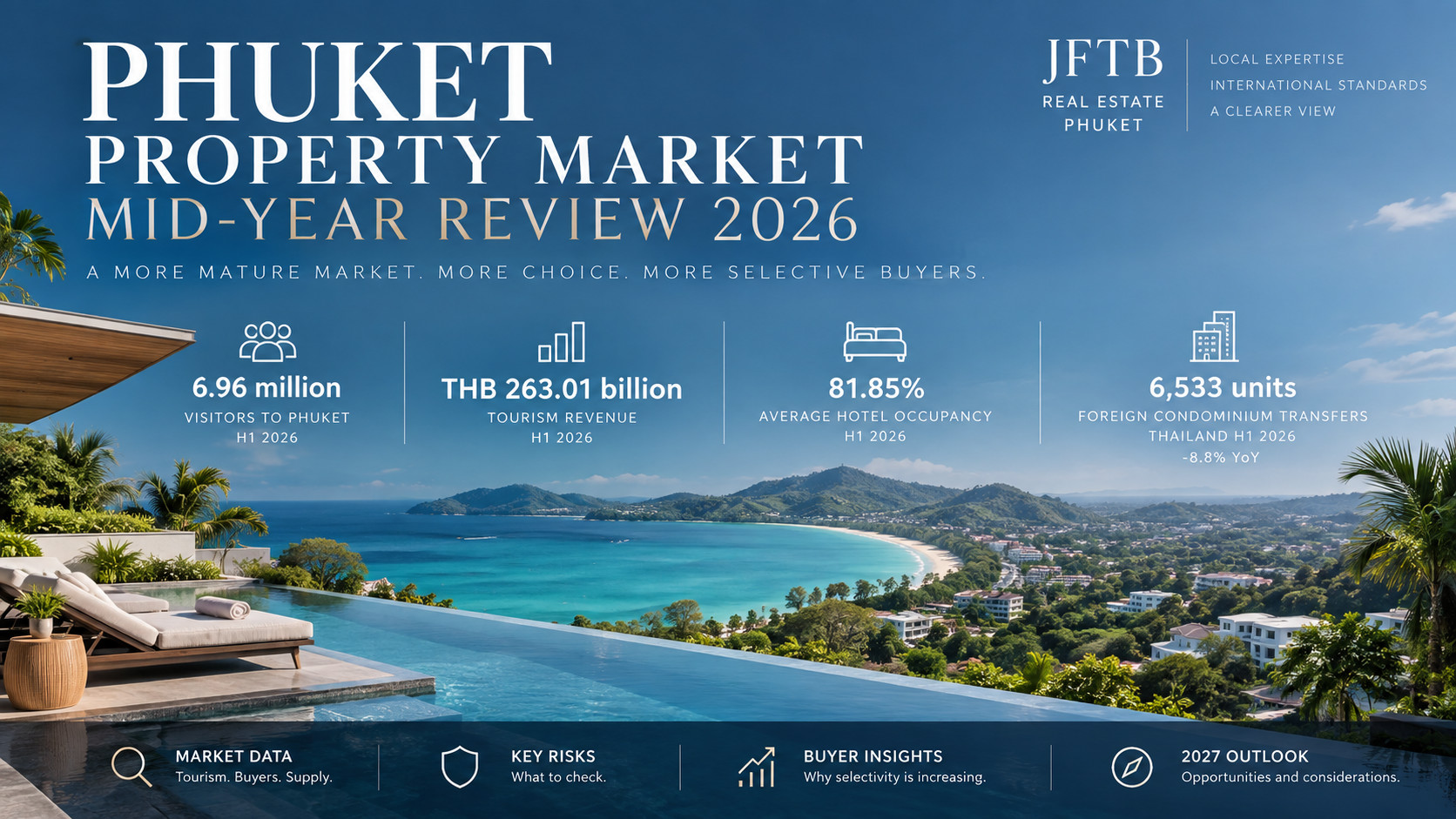
TAT Phuket reported approximately 6.96 million visitors, THB 263.01 billion in tourism revenue and average hotel occupancy of approximately 81.85% during January–June 2026.
However, the direction of travel is important. Phuket International Airport passenger arrivals declined 1.4% year on year during H1 2026, according to CBRE, while TAT Phuket reported visitor numbers down 2.08% during January–April.
Tourism revenue has proved more resilient. TAT data for January–July showed revenue down only 0.72% year on year.
The picture is therefore not one of collapsing tourism demand. It is one of softer visitor volumes combined with comparatively resilient spending.
CBRE’s H1 2026 Phuket data also confirms continued residential development. New condominium launches increased 44.8% compared with H2 2025, while 16 villa projects representing 224 units launched during the first half.
The Phuket Property Market Is Becoming More Selective — Not Uniformly Weak
It is increasingly misleading to talk about the Phuket property market 2026 as though every segment were moving in the same direction.
A foreign-freehold condominium in an established west-coast location, a THB 30 million off-plan pool villa, a leasehold sea-view residence and a hospitality asset respond to different buyers and carry different risks.
Demand can therefore remain active while transaction decisions become slower.
The difference in 2026 is that serious buyers increasingly want to understand why a property deserves its price.
They are more likely to examine ownership structure, compare competing projects, challenge rental projections, calculate realistic running costs and consider the eventual resale market before making an offer.
That is positive for genuinely strong properties.
It is less favourable for interchangeable developments or properties where the investment case depends primarily on marketing.
Phuket Tourism Remains Important — But Visitor Volumes Have Softened
Phuket’s visitor economy remains one of the island’s structural advantages, but the 2026 data requires a more nuanced interpretation than simply describing tourism as “strong”.
During the first half of 2026, Phuket recorded approximately 6.96 million visitors, generating around THB 263.01 billion in tourism revenue.
TAT Phuket also reported average hotel occupancy of approximately 81.85% during the period.
At the same time, Phuket International Airport passenger arrivals declined 1.4% year on year during H1 2026.
TAT Phuket had already reported a 2.08% year-on-year decline in visitor numbers from January through April.
By January–July, tourism revenue was down only 0.72% year on year, showing that spending held up better than visitor volume.
This distinction matters.
Phuket continues to attract substantial visitor expenditure, but growth in tourism should no longer be assumed automatically from visitor numbers.
For property investors, the lesson is even more important:
Tourism activity does not automatically produce a strong return for every villa or condominium.
Actual rental performance depends on the individual asset, including:
- exact location
- management quality
- permitted rental model
- property condition
- seasonality
- competing supply
- maintenance costs
- platform commissions
- owner usage
Two properties can therefore generate very different results even when they operate within the same Phuket tourism economy.
The relevant investment question is not simply whether Phuket tourism is growing.
It is whether a specific property can convert Phuket demand into sustainable net income.
Phuket’s Hotel Market Shows Stability Rather Than Rapid Growth
The hotel market provides additional context.
CBRE described Phuket’s hotel sector as broadly flat in H1 2026, with occupancy down approximately 0.8 percentage points year on year and average daily rates increasing around 0.9%.
This reinforces the distinction between visitor numbers and operating performance.
Volume alone does not determine profitability.
Price, competition, positioning and operating costs matter.
The same principle applies to residential investment.
New Condominium Supply Gives Buyers More Choice
Phuket’s condominium development pipeline continues to expand.
CBRE reported that new condominium project launches increased 44.8% compared with H2 2025.
Only three projects, totalling 1,196 units, were completed during H1 2026, representing a 56.8% decrease compared with H2 2025 because several projects were delayed or were not ready for handover.
For buyers, increased new supply changes the negotiating environment.
A new project should no longer be evaluated only against the developer’s own price list.
Buyers should compare competing developments based on:
- location
- usable area
- foreign ownership availability
- price per square metre
- construction specifications
- common fees
- developer history
- project density
- management
- future resale competition
This becomes particularly important where several projects target the same international buyer profile.
More inventory is not automatically negative. But more similar inventory increases the importance of differentiation.
For international buyers, the Phuket property market 2026 offers more choice than in previous cycles, but that also makes project comparison and entry price increasingly important.
Buyers comparing current stock can explore condos for sale in Phuket before comparing individual projects against competing alternatives.Buyers comparing current stock can explore condos for sale in Phuket before comparing individual projects against competing alternatives.
Phuket’s Villa Pipeline Is Still Expanding
Villa development remains an important part of the Phuket property market 2026.
CBRE recorded 16 new villa projects comprising 224 units during H1 2026.
Approximately 35.3% of those projects were concentrated in Phuket’s West Coast Central area, while the THB 15–35 million segment represented the largest proportion of new launches.
This range is particularly important because it overlaps with one of Phuket’s most competitive international villa-buyer segments.
A modern three- or four-bedroom pool villa may therefore compete against numerous newer developments.
Buyers should look beyond architectural renders and furniture packages and compare fundamentals such as:
- land size
- project density
- road access
- construction specification
- common fees
- ownership structure
- micro-location
- competing future supply
A villa that appears highly differentiated in a developer brochure may look much less unique when compared with twenty competing projects.
Buyers can compare current villas for sale in Phuket and the wider property for sale in Phuket before assessing the value of an individual project.
Foreign Condominium Transfers in Thailand: H1 2026
The latest national foreign-buyer data provides a more balanced picture than the Q1 figures alone suggested.
According to Thailand’s Real Estate Information Center, foreign buyers transferred ownership of 6,533 condominium units nationwide during the first half of 2026.
That was 8.8% lower year on year.
Total foreign condominium transfer value reached THB 28.267 billion, declining by only 1.5% year on year.
Foreign buyers represented 11.7% of condominium transfers by unit volume and 21.7% by value during the period.
This distinction matters.
Unit volume weakened more substantially than transaction value.
Foreign purchasing activity therefore softened, but higher-value transactions remained comparatively resilient.
The second quarter itself was stronger.
A total of 3,292 units were transferred to foreign buyers during Q2, up 1.4% year on year, while transaction value increased 20.2% to THB 14.803 billion.
The H1 picture is therefore not one of foreign demand disappearing.
It is one of lower overall volume combined with more resilient value and a stronger second quarter.
Important: these are nationwide Thailand figures.
They should not be presented as Phuket-only condominium transactions.
For Phuket investors, they are useful as an indicator of broader foreign-buyer behaviour rather than as a direct measurement of Phuket transaction volume.
The Foreign Buyer Mix Is Changing
The nationality mix also changed significantly during H1 2026.
Chinese buyers remained Thailand’s largest foreign condominium buyer group, transferring 1,813 units valued at THB 6.874 billion.
Russian demand moved strongly in the opposite direction to the overall foreign-buyer trend.
Russian buyers transferred 842 condominium units worth THB 3.603 billion.
That represented increases of 50.4% in unit volume and 75.9% in transfer value year on year.
Russia therefore became the second-largest foreign buyer group by both unit volume and value during H1 2026.
Reporting based on REIC data indicates that Russian buying activity was particularly significant in Phuket and Chonburi.
The broader lesson is that Thailand’s foreign property demand is changing rather than disappearing.
For sellers and developers, relying heavily on one nationality creates risk.
For buyers, a property that appeals to several international buyer profiles may have a broader future resale audience.
Confidence Has Become Part of Property Value
A buyer is not purchasing only concrete, land and furniture.
They are also purchasing a legal and commercial story that another buyer may eventually need to understand.
This is why confidence increasingly matters in the Phuket property market 2026.
A property with clear title documentation, understandable ownership rights, documented access, realistic management costs, transparent contracts, verified construction information and a coherent resale structure is easier to analyse today and potentially easier to sell later.
By contrast, uncertainty creates friction.
Legal ambiguity can delay a transaction.
Unclear fees can undermine a rental calculation.
Difficult ownership structures can reduce the future buyer pool.
Missing construction documents can weaken negotiating leverage.
In a more selective market, clarity itself has economic value.
Foreign Freehold Condominiums: Clearer Ownership, But Still a Market Decision
For eligible international buyers, qualifying foreign-freehold condominium ownership remains one of the clearest forms of direct registered real-estate ownership available in Thailand.
That does not automatically make every condominium a strong purchase.
Buyers still need to verify:
- foreign quota availability
- title and encumbrances
- juristic-person accounts
- common fees
- sinking fund
- planned capital expenditure
- rental restrictions
- building condition
- management quality
- competing resale units
Price per square metre also needs context.
A cheaper unit can represent poor value if it has an inferior position, weak management or limited resale demand.
A more expensive unit may justify a premium through scarcity, location, view, layout or building quality.
Legal clarity solves the ownership question. It does not solve the investment question.
Villas Require a Wider Risk Review
Villa purchases generally involve more variables because the building and underlying land rights may need to be analysed separately.
For foreign buyers, transactions may involve registered leases, building ownership arrangements or other rights depending on the property.
The detailed legal framework is covered in Buying Property in Thailand and Property Due Diligence in Thailand.
From an investment perspective, one principle matters:
The harder a structure is to explain today, the more carefully its future resale liquidity should be considered.
A buyer may accept a particular structure after receiving independent legal advice.
But a future purchaser must also be willing to accept it.
Ownership, title, access, permits, documentation and future transferability therefore form part of market analysis, not simply legal compliance.
Price Matters More When Supply Expands
In a rapidly rising market, buyers sometimes tolerate a weak entry price because they expect general appreciation to compensate.
That assumption becomes more dangerous when competing supply expands.
If several comparable properties are available, buyers gain alternatives and resale purchasers become more price-sensitive.
This does not mean prices across Phuket must move uniformly.
Scarce beachfront positions, established projects, completed branded residences and genuinely differentiated villas can behave very differently from high-density or easily substitutable stock.
The better question is therefore not:
“Are Phuket property prices going up or down?”
It is:
“How much direct competition will this specific property face when I eventually want to sell?”
Liquidity Should Be Analysed Before Purchase
Resale liquidity remains one of the most underestimated parts of Phuket property investment.
A property may generate acceptable rental income and still be difficult to sell.
Liquidity depends partly on how many future buyers can realistically:
- understand the asset
- afford it
- acquire it legally
- maintain it
- accept its ownership structure
- justify its price
Properties tend to become harder to resell when pricing is disconnected from alternatives, recurring fees are excessive, ownership is complicated, layouts serve a narrow audience or competing inventory is abundant.
A strong investment case should therefore answer two separate questions:
What can this property realistically earn while I own it?
and
Who is likely to buy it from me later?
The second question becomes increasingly important as Phuket’s inventory expands.
Gross Yield Is Not the Same as Investor Return
Rental projections remain one of the most aggressively marketed parts of Phuket real estate.
A headline gross yield can provide a starting point.
It does not represent the owner’s actual return.
Real performance can be reduced by:
- property management
- common-area fees
- utilities
- cleaning
- maintenance and repairs
- furniture replacement
- booking commissions
- insurance
- vacancy
- seasonal fluctuations
- owner use
Guaranteed-rental programmes deserve additional scrutiny.
The financial strength of the guarantee provider, contractual conditions, operating costs and what happens after the guarantee period may matter more than the advertised percentage.
In the Phuket property market 2026, investors should place greater emphasis on net operating reality rather than headline yield.
Phuket Is Not One Property Market
Location analysis requires more precision than simply comparing districts.
Bang Tao, Cherng Talay and Layan increasingly combine premium residential development, international schools, lifestyle infrastructure and upscale hospitality. Buyers comparing this part of Phuket can also explore our Bang Tao real estate guide for more detail on residential areas, new developments, beach access and local property demand.
Rawai and Nai Harn serve a different mixture of residents, long-stay visitors, retirees, villa buyers and renters. For a closer look at southern Phuket, our Rawai & Naiharn property guide covers residential demand, villas, condominiums, local lifestyle and the differences between individual micro-locations.
Chalong offers practical access and year-round residential demand, you can also read our Chalong property guide for a closer look at local housing, villas and infrastructure.
Kamala remains relevant in the premium segment, particularly for sea-view villas and higher-value residential property. Buyers considering this area can also read our Kamala real estate guide for more detail on hillside locations, residential developments and local pricing dynamics.
Kata and Karon combine tourism demand with residential and holiday-home markets. Buyers looking at Kata can also read our Kata & Karon property guide for more detail on tourism demand, condominiums, sea-view property and the local residential market.
Patong remains one of Phuket’s largest tourism and hospitality centres but has very different residential, commercial and investment dynamics from quieter southern and northwestern villa markets. If you are considering Patong, you can also read our Patong real estate guide for a closer look at local demand, condominium stock, rental dynamics and lifestyle factors.
The district name is only the first filter.
Micro-location, road access, noise, surroundings, construction density, views and the future buyer profile usually matter more.
For an area-by-area comparison, see Best Areas to Live in Phuket
What Buyers Should Watch in H2 2026
The second half of the Phuket property market 2026 should be assessed through practical signals rather than broad predictions.
Buyers should monitor:
- the pace of new condominium launches
- the pace of villa development
- project completion delays
- developer incentives and discounts
- resale inventory
- foreign-buyer nationality mix
- asking-price reductions
- actual rental performance
- recurring ownership costs
- the gap between asking prices and realistic transaction levels
For individual buyers, greater competition can create opportunity.
More inventory can mean:
- more choice
- greater negotiating leverage
- less reason to rush
- better ability to compare projects
But opportunity only exists when buyers actually compare alternatives.
JFTB View: What Matters Most in the Current Market
JFTB’s mid-year view is that Phuket remains structurally attractive to many international property buyers, but selection discipline matters more in 2026 than broad market optimism.
Tourism remains economically significant.
Foreign buyers remain active.
Developers continue to launch new condominium and villa projects.
None of those facts, by themselves, make a particular property worth buying.
The stronger opportunities are properties where location, ownership structure, construction quality, operating costs, purchase price, rental logic and future resale audience remain coherent together.
This also means buyers should be prepared to walk away when documentation, pricing or assumptions do not withstand scrutiny.
The Phuket property market 2026 therefore rewards buyers who compare alternatives carefully rather than relying on broad market narratives or headline returns.
A more selective market is not necessarily bad for buyers.
For disciplined buyers, greater choice and competition can improve negotiating leverage.
How This Review Fits With JFTB’s Phuket Property Market 2026 Analysis
This Mid-Year Review focuses on H1 2026 evidence including tourism performance, foreign condominium transfers and new residential supply.
JFTB’s separate Phuket Property Market 2026 Analysis examines a different dataset: 54,628 property enquiries covering buyer and tenant demand across Phuket.
The two reports therefore answer different questions.
The Mid-Year Review examines wider market conditions and supply.
The Property Market Analysis examines what prospective buyers and tenants are actually searching for.
Together, they provide a more complete picture than either dataset alone.
Frequently Asked Questions
Is the Phuket property market slowing in 2026?
Some indicators show softer tourism volumes and more cautious buyer behaviour while residential supply continues to expand.
However, this should not be interpreted as a uniform island-wide decline.
Different locations, price ranges and property types are behaving differently.
The Phuket property market 2026 is better described as increasingly selective rather than uniformly weak.
Are foreign buyers still buying property in Thailand?
Yes.
REIC recorded 6,533 foreign condominium transfers nationwide during H1 2026, down 8.8% year on year.
Transaction value declined by only 1.5% to THB 28.267 billion, while Q2 itself showed year-on-year growth in both transfer volume and value.
Are Russian buyers becoming more important?
National REIC data shows substantial growth.
Russian buyers transferred 842 condominium units during H1 2026, up 50.4%, while transfer value increased 75.9% to THB 3.603 billion.
Reporting based on REIC data indicates particularly strong Russian activity in Phuket and Chonburi.
Is Phuket tourism still supporting the property market?
Yes, tourism remains one of Phuket’s major economic supports.
However, visitor volumes softened in 2026.
Phuket International Airport passenger arrivals declined 1.4% in H1, while TAT Phuket reported visitor numbers down 2.08% during January–April.
Tourism revenue proved more resilient, declining only 0.72% during January–July.
The important distinction is that substantial visitor spending remains, even though visitor growth has softened.
Is Phuket building too many condominiums?
New condominium launches increased 44.8% compared with H2 2025.
That represents increased competition, but it does not mean every part of Phuket is automatically oversupplied.
Supply needs to be analysed by location, project type, price level and target buyer.
Are Phuket villas oversupplied?
It would be too broad to describe the entire villa market as oversupplied.
CBRE recorded 16 new projects and 224 villa units in H1 2026, with the THB 15–35 million segment representing the largest proportion of new launches.
Competition in this segment therefore deserves careful analysis.
Are condominiums safer than villas for foreign buyers?
Qualifying foreign-freehold condominiums can offer a more straightforward direct ownership structure.
That does not automatically make them better investments.
Building quality, management, price, rental rules, foreign quota and resale liquidity still require review.
What is the biggest risk for Phuket property investors in 2026?
There is no single risk.
Overpaying, weak or difficult ownership structures, unrealistic rental projections, poor construction, excessive competing supply and limited resale liquidity can all materially affect an investment.
Should foreign buyers wait for Phuket prices to fall?
An island-wide price prediction is not a strong purchasing strategy.
Buyers are generally better served by comparing specific properties, identifying competitive projects or motivated sellers and negotiating where the evidence supports it.
Final Decision Framework for Phuket Buyers
Before committing to a property in the Phuket property market 2026, a buyer should be able to answer five questions clearly:
- Is the ownership structure understandable and properly documented?
- Does the price make sense against realistic alternatives?
- Are projected returns based on net operating reality rather than marketing assumptions?
- Does the property have genuine differentiation or scarcity?
- Who is likely to buy this property when I eventually want to sell?
If those answers remain weak, the property requires more investigation regardless of how attractive the brochure, location or headline yield appears.
JFTB Real Estate Phuket has advised international property buyers in Phuket since 2013, helping clients compare condominiums, villas and investment opportunities based on location, pricing, ownership structure, negotiation, independent due diligence and future resale logic.