Buying a beautiful plot of land in Thailand is relatively easy.
Determining whether that land is legally secure, properly accessible and realistically buildable is much harder.
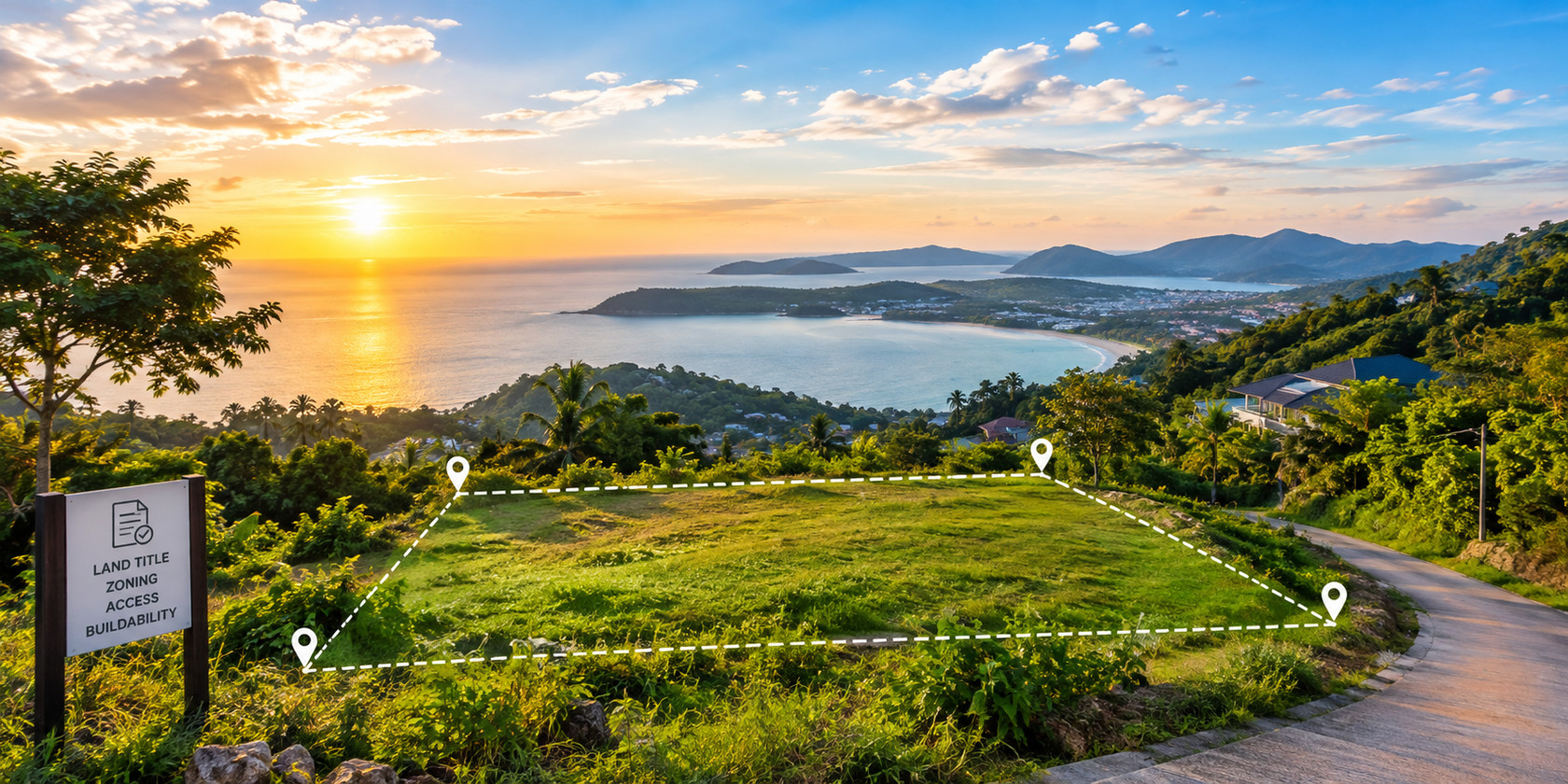
A sea-view plot may look exceptional during a site visit but still present problems involving:
- land title
- boundaries
- road access
- easements
- zoning
- building restrictions
- slope
- drainage
- utilities
- environmental controls
- neighbouring land
- development permits
For this reason, buying land in Thailand should never be based on location and price alone.
The central question is not simply:
“Do I like this land?”
It is:
“Can the intended project legally and practically be built on this specific plot?”
This guide explains how buyers should assess land titles, zoning, access and buildability before acquiring land in Thailand in 2026.
Buying Land in Thailand Starts With the Legal Asset
Before considering views, architecture or future resale value, identify exactly what legal document represents the land.
Thailand uses several forms of land-right documentation.
The Department of Lands identifies three principal forms relevant to private land rights:
- Chanote (Nor Sor 4 / N.S.4)
- Nor Sor 3 Gor
- Nor Sor 3
The Department describes Chanote as the strongest form of land title and notes that Nor Sor 3 documents have less precise boundary demarcation than Chanote. Department of Lands guidance on land title deeds
For most substantial residential or development purchases, buying land in Thailand with a clear Chanote title is generally the preferred starting point.
That does not mean every non-Chanote parcel is unusable.
It means the buyer should understand exactly what rights exist and what additional survey or legal work may be necessary.
What Is a Chanote?
A Chanote is Thailand’s strongest standard land title for private ownership.
It records the land parcel through the Department of Lands and provides the clearest framework for identifying:
- registered owner
- land area
- parcel boundaries
- registered mortgages
- leases
- servitudes
- other registered rights
A Chanote can also be used for registered legal transactions involving the land.
However, the existence of a Chanote does not automatically mean the land is suitable for the buyer’s intended development.
A Chanote answers an ownership question.
It does not automatically answer:
Can I build the project I want here?
That requires additional investigation.
Nor Sor 3 Gor and Nor Sor 3
Nor Sor 3 Gor and Nor Sor 3 are certificates of utilization rather than the same form of title as Chanote.
They can represent legitimate land rights, but the surveying and boundary position require more careful analysis.
The Department of Lands specifically notes that Nor Sor 3 boundaries are less precisely demarcated than Chanote boundaries.
When buying land in Thailand under a non-Chanote document, buyers should therefore pay particular attention to:
- current survey information
- physical boundary markers
- neighbouring owners
- access
- possible discrepancies between occupied and documented land
For high-value development land, uncertainty over boundaries can become expensive very quickly.
Do Not Rely on the Seller’s Land Size Alone
A listing may advertise:
2 rai
3,200 sqm
or
8,000 sqm
But the buyer should not assume that the usable development area equals the advertised land area.
The registered area needs to be checked against the land document and survey.
Even where the total registered area is correct, part of the land may be affected by:
- road access
- servitudes
- drainage channels
- setbacks
- steep slope
- protected areas
- utility corridors
- unusable terrain
The commercial question is therefore not just:
How much land is registered?
It is:
How much of the land can actually support the planned development?
Use LandsMaps as a Preliminary Check, Not Final Due Diligence
The Department of Lands provides its LandsMaps system as a useful preliminary research tool.
It can help identify land plots and review information such as location, approximate parcel area, surrounding geography and other available land information.
The Department of Lands also integrates mapping and land-use information into its digital services.
However, online mapping should not replace a title review or professional survey.
A map displayed on a phone or laptop is not a substitute for establishing the exact registered boundary on the ground.
For initial research, buyers can use the official Department of Lands LandsMaps services.
A Land Survey Can Change the Deal
Land boundaries should be physically understood before the transaction becomes unconditional.
This is especially important for:
- hillside land
- irregular plots
- older titles
- large land parcels
- beachfront or coastal land
- land surrounded by other private plots
- properties where fences do not match title boundaries
A physical wall or fence does not necessarily prove the legal boundary.
The seller may have occupied land differently from the registered parcel for many years.
When the location of a boundary matters to the project, buying land in Thailand without resolving that issue before transfer creates unnecessary risk.
Legal Road Access Is Essential
When buying land in Thailand, legal access can be just as important as the quality or location of the land itself.
One of the most important land checks is also one of the easiest to underestimate:
How does the land legally connect to a public road?
Seeing a road does not automatically mean the plot has permanent legal access.
A road may cross:
- private land
- another owner’s parcel
- estate land
- land controlled through an informal arrangement
A buyer should establish whether access is:
- public
- contained within the parcel
- protected by a registered servitude
- dependent only on private permission
This distinction can materially affect both construction and resale.
Physical Access Is Not the Same as Legal Access
A property may have been reached through the same road for 20 years.
That does not necessarily answer whether the buyer has a registered legal right to continue using it.
For development land, verify:
- ownership of the access road
- width of the road
- whether an easement or servitude exists
- whether the right is registered
- whether construction vehicles can realistically access the property
- whether the access satisfies requirements relevant to the intended development
A spectacular plot without secure access can become commercially very difficult.
Road Width Can Affect Development Potential
The width and status of the access road can influence what can be built.
This becomes particularly important when the intended project moves beyond a single private house into:
- villa estates
- condominiums
- hotels
- commercial property
- larger residential projects
Road requirements can interact with building regulations, emergency access and development approvals.
This is why buying land in Thailand for development requires the road itself to be treated as part of the due diligence, rather than simply as the route used to reach the site.
Zoning Must Be Checked Before the Land Is Purchased
For anyone buying land in Thailand for development, zoning should be verified before the purchase price is treated as justified.
Thailand’s planning rules regulate how land can be used.
The relevant zoning may affect:
- residential development
- commercial use
- hotels
- industrial use
- building density
- building form
- environmental controls
The Department of Public Works and Town & Country Planning provides an official Landuse Plan system allowing users to examine applicable planning information.
It also offers a formal process through which an applicant can request a land-use verification certificate for a specific parcel. Department of Public Works and Town & Country Planning – Landuse Plan
That distinction matters.
An online zoning check is useful during initial research.
For a substantial transaction or development project, the buyer may need formal confirmation.
A Zoning Colour Is Not the Entire Answer
Buyers often hear descriptions such as:
“This is residential zoning.”
or
“It is in a green zone.”
That information may be relevant, but it is not enough by itself.
A zoning designation should be considered together with:
- permitted land use
- project type
- building regulations
- environmental regulations
- local requirements
- road access
- setbacks
- height restrictions
- parcel characteristics
The correct question is therefore not:
“What colour is the land?”
It is:
“Does the complete regulatory framework allow the development I intend to build on this parcel?”
Zoning Rules Can Change
Planning frameworks evolve.
A land use that appears viable based on an old map, an agent’s PDF or a previous owner’s project may no longer reflect the current regulatory position.
Before buying land in Thailand, verify current rules rather than assuming that:
- an old planning approval remains valid
- neighbouring development proves the same project is allowed
- a former proposal can still be built
- an architect’s old concept automatically remains compliant
Current regulations should be checked against the current project.
Building Height Can Be a Critical Issue
This matters particularly in resort markets such as Phuket.
A sea-view site may derive much of its apparent value from what the buyer imagines can be built vertically.
If the permitted building height is materially lower than expected, the economics can change immediately.
Before pricing land for development, determine whether the intended building height and number of floors are realistically permitted.
Never value land based solely on a conceptual rendering prepared before regulatory verification.
Setbacks Reduce the Buildable Footprint
A registered land parcel is not necessarily a fully buildable rectangle.
Setback rules may restrict construction near:
- roads
- neighbouring boundaries
- waterways
- shorelines
- other regulated areas
The effect can be substantial on narrow or irregular plots.
A relatively large parcel can have a surprisingly small practical building envelope.
For that reason, sophisticated buying land in Thailand due diligence should estimate the actual buildable footprint, not just the total land area.
Hillside Land Requires Additional Analysis
Hillside land can create some of the most desirable views in Thailand.
It can also create some of the most difficult development conditions.
Buyers need to examine issues such as:
- slope
- retaining structures
- excavation
- soil stability
- drainage
- construction access
- foundation design
- environmental restrictions
- height calculations
- neighbouring runoff
A lower-priced hillside plot may ultimately cost more to develop than more expensive flatter land.
Slope Can Affect Both Regulation and Construction Cost
The steeper the site, the more important engineering becomes.
Additional costs can arise from:
- retaining walls
- piling
- soil stabilization
- excavation
- drainage systems
- difficult material delivery
- specialist structural design
This does not make hillside development undesirable.
It means the price of the land should reflect the cost of making the site developable.
Drainage Is Part of Land Due Diligence
A site should be inspected in terms of how water enters and leaves the land.
Questions include:
- Where does rainwater flow?
- Does water cross neighbouring land?
- Does neighbouring water enter the parcel?
- Is there an existing drainage channel?
- Is drainage legally protected?
- What happens during heavy monsoon rainfall?
- Could future construction redirect water toward neighbours?
Drainage problems are much cheaper to understand before purchase than after construction.
Flood Risk Should Not Be Judged From One Site Visit
A dry site in February does not establish how it performs during the wet season.
Local knowledge can be particularly valuable.
Ask about:
- historical flooding
- road flooding
- drainage capacity
- water levels
- runoff from hills
- neighbouring development
When buying land in Thailand, seasonal conditions matter.
A site should not be evaluated only on the day it happens to be viewed.
Coastal and Beachfront Land Requires Extra Caution
Beachfront and coastal land carries obvious commercial appeal.
It can also involve more complex regulatory issues.
Potential concerns can include:
- shoreline controls
- public land
- building setbacks
- environmental regulations
- erosion
- access
- marine or coastal restrictions
- boundary uncertainty near natural features
A sea view and a Chanote do not eliminate these questions.
Coastal land should receive enhanced legal, planning and technical review before acquisition.
Verify That the Land Is Not Public or Protected Land
The Department of Lands distinguishes private land from several forms of state or public land.
Land used by the public, reserved for public purposes or protected for natural resources may not be eligible for normal private title issuance.
This is particularly relevant in locations involving:
- forest boundaries
- mountains
- islands
- waterways
- shorelines
- public access areas
The Department of Lands expressly identifies categories of land that cannot simply be issued private title documents.
Historical documents and physical occupation alone should not be treated as proof that private ownership is valid.
Utilities Can Determine Whether the Project Works
Land can be legally buildable yet commercially unattractive because basic infrastructure is difficult or expensive.
Before purchase, investigate:
- electricity
- water
- wastewater
- internet
- drainage
- road access
For large developments, utility capacity matters as much as basic availability.
The presence of a power line near the land does not necessarily mean the project can receive the required electrical capacity without significant additional work.
Water Supply Can Be a Major Development Issue
This is especially important for:
- villa estates
- hotels
- resorts
- hillside projects
- island developments
A buyer should establish:
- available public supply
- private well feasibility where applicable
- storage requirements
- pressure
- seasonal reliability
- project consumption
Water planning should be part of feasibility, not an issue discovered after design.
Electricity Infrastructure Can Add Significant Cost
Large projects may require upgrades, transformers or network extensions.
The cost and timing can materially affect project viability.
A seller may say:
“Electricity is already there.”
That statement should be translated into a more useful question:
“Is the available electrical infrastructure sufficient for the proposed project, and what would expansion cost?”
Existing Buildings Do Not Prove Future Buildability
Sometimes buyers assume that because a house or structure already exists on the land, redevelopment is automatically permitted.
That is unsafe.
The buyer should determine:
- whether the existing building was properly permitted
- what was actually approved
- whether later modifications were authorized
- whether rebuilding would be subject to current rules
- whether the intended new project differs materially from the existing use
An old house can provide useful evidence of historic use.
It does not guarantee permission for a new luxury villa, hotel or multi-unit development.
Neighbouring Projects Are Not Legal Precedent
Another common argument is:
“The property next door built five floors, so we can do the same.”
Not necessarily.
The neighbouring project may:
- have been approved under earlier rules
- sit on different zoning
- have different road access
- have different parcel characteristics
- operate under a different permit
- pre-date later restrictions
Buildability must be checked for the specific plot.
The Seller’s Architectural Plans Are Not Approval
Land sellers frequently present:
- villa renderings
- master plans
- hotel concepts
- subdivision plans
These can help buyers visualize potential.
But unless appropriate approvals have been obtained and remain applicable, a concept drawing is not proof of development rights.
Before buying land in Thailand based on a proposed project, establish what has actually been approved.
Check Encumbrances Before Transfer
The land title should be examined for registered rights affecting the property.
Depending on the parcel, these may include:
- mortgage
- lease
- usufruct
- superficies
- servitude
- other registered obligations
This review belongs within the broader process described in JFTB’s Property Due Diligence in Thailand.
A buyer should understand what will remain registered after transfer and what must be discharged beforehand.
Foreign Buyers Must Separate Land Due Diligence From Ownership Structure
This guide deals primarily with the land itself.
Foreign ownership rules are a different legal question.
A plot can have:
- perfect Chanote
- excellent access
- favourable zoning
- strong development potential
and still not be land that a foreign individual can ordinarily register personally.
For ownership structures, Section 96 bis, Thai spouses, leasehold, superficies, usufruct and company issues, see Foreign Land Ownership in Thailand.
The two questions should never be confused:
Is the land good?
and
How can the buyer legally hold rights over it?
The JFTB Land Buildability Test
For buying land in Thailand, JFTB applies a simple five-part framework before treating a site as genuinely development-ready.
1. Title
What legal land document exists?
Can the registered owner be confirmed?
Are boundaries sufficiently clear?
2. Access
Does the property have permanent legal access?
Is the road adequate for the intended project?
3. Planning
What land use and development rules apply?
Does the intended project fit within them?
4. Physical Buildability
Can the terrain realistically support the project?
Consider slope, soil, drainage, retaining works and construction access.
5. Infrastructure
Can water, electricity, wastewater and communications support the intended development?
If one of these five fails, the economics of the land can change substantially.
The Cheapest Land Is Not Always the Best Value
A cheaper parcel may require:
- extensive retaining walls
- road construction
- easement negotiations
- utility extensions
- drainage works
- title upgrades
- reduced project density
A more expensive plot with clean title, legal access, flatter terrain and confirmed zoning may ultimately produce a better development return.
The correct comparison is therefore not just:
price per rai
or
price per square metre.
It is:
price per usable and commercially developable square metre.
This is why buying land in Thailand requires comparing development potential rather than simply comparing price per square metre.
Land Price Should Reflect Development Reality
When buying land in Thailand for investment, valuation should incorporate what the parcel can realistically produce.
Two neighbouring plots of equal size may have very different values because one allows efficient development while the other loses significant area to constraints.
Theoretical land area is not the same as productive land area.
When Should You Walk Away From a Land Purchase?
A buyer should be prepared to stop the transaction if major issues cannot be resolved.
Examples may include:
- unclear or disputed title
- inaccessible boundaries
- no secure legal road access
- serious zoning incompatibility
- project economics destroyed by building restrictions
- major undisclosed encumbrances
- severe drainage or geotechnical concerns
- public or protected land overlap
- seller unwilling to permit proper due diligence
Sometimes the best result of land due diligence is deciding not to buy.
Buying Land in Phuket Requires Particular Discipline
Phuket land can be extremely valuable because supply in prime locations is naturally limited.
But the island also combines:
- coastline
- steep hills
- dense development
- environmental sensitivity
- narrow roads
- competing land uses
That makes parcel-specific analysis particularly important.
A sea-view or beachfront location can command a premium only if the legal and physical development potential justifies it.
The view should never replace due diligence.
Questions to Ask Before Buying Land
Before committing to land, establish:
- What land document exists?
- Who is the registered owner?
- What is the registered land area?
- Have the boundaries been surveyed?
- Does the physical occupation match the legal parcel?
- Is access public or privately controlled?
- Is a servitude required?
- What is the road width?
- What zoning applies?
- Is the intended use permitted?
- Are there height restrictions?
- What setbacks apply?
- Is the site affected by slope or environmental restrictions?
- Is there flood or drainage risk?
- Can electricity support the proposed project?
- Is reliable water available?
- How will wastewater be handled?
- Are there registered mortgages or encumbrances?
- Are existing buildings properly permitted?
- Can the intended development realistically obtain approval?
If those questions cannot be answered, the buyer does not yet understand the asset.
Frequently Asked Questions
What is the best land title in Thailand?
For standard private ownership, Chanote is generally regarded as the strongest land title because it provides the clearest registered ownership and cadastral framework.
Can Nor Sor 3 land be purchased?
Nor Sor 3 documents can represent legitimate land rights, but boundaries and the precise legal position require more careful review than a Chanote.
Does a Chanote mean I can build anything I want?
No. A Chanote establishes land rights. Development remains subject to zoning, building, environmental and other regulations.
How do I check zoning in Thailand?
The Department of Public Works and Town & Country Planning provides an official Landuse Plan system for preliminary checks and a procedure for requesting formal land-use verification.
Is an online zoning map enough?
It is useful for preliminary screening but should not be the only basis for a substantial land purchase or development decision.
Does road access have to be registered?
The buyer should establish a permanent legal basis for access. If access crosses private land, a registered servitude or other enforceable right may be critical.
Can hillside land be developed?
Potentially, but slope, engineering, environmental rules, access and cost need to be assessed before purchase.
Is beachfront land always buildable?
No. Coastal land may be subject to additional setbacks, environmental restrictions, public-land issues and other controls.
Can I rely on the seller’s building plans?
Not unless the relevant approvals and regulatory position have been independently verified.
Should I survey land before buying?
Where boundaries, access or development layout matter, a proper survey can be an important part of due diligence.
Can foreigners buy land in Thailand?
Foreign ownership is generally restricted, with limited exceptions. See JFTB’s Foreign Land Ownership in Thailand for the ownership rules.
What is the biggest mistake when buying land in Thailand?
Treating registered land area as though every square metre is automatically usable, accessible and buildable.
Buying Land in Thailand with JFTB
The strongest land purchase is not necessarily the plot with the best view.
It is the plot where the legal title, access, planning position, physical characteristics and infrastructure all support the buyer’s intended use.
For buying land in Thailand, the key principle is simple:
verify buildability before valuing development potential.
JFTB Real Estate Phuket assists buyers and investors with land sourcing, commercial assessment, negotiation and coordination of independent legal, planning and technical due diligence.
Before committing to a land purchase, the objective should be clear:
know what you own, know how you reach it, know what you can build, and know what it will realistically cost to develop.
If you are considering land in Phuket or another selected Thailand market, contact JFTB Real Estate Phuket before committing to a deposit or signing an unconditional agreement.