Bangkok is not one property market.
It is a collection of residential markets shaped by business districts, mass transit, international schools, hospitals, shopping, embassies, corporate employment and increasingly sophisticated luxury developments.
A condominium on Wireless Road, a family residence in Phrom Phong, an investment unit near Rama 9 and a riverside branded residence may all be described as Bangkok real estate, but they serve very different buyers, tenants and investment strategies.
That distinction matters in 2026.
The broader Bangkok residential market remains selective, while high-quality luxury and super-luxury condominiums in proven central locations continue to attract both Thai and international buyers.
For foreign purchasers, Bangkok therefore offers substantial choice — but location, building quality, legal ownership, rental demand and future resale liquidity need to be considered together.
This guide explains the major Bangkok property markets, foreign condominium ownership, investment fundamentals, key residential districts and the differences between investing in Bangkok and Phuket.
Bangkok Real Estate in 2026: A Selective Market
The Bangkok property market should not simply be described as booming or declining.
Different segments are performing differently.
According to CBRE Thailand’s H1 2026 luxury condominium market update, completed condominium projects tracked in Downtown Bangkok recorded an average sales rate of 93%, with the completed luxury segment reaching 95%.
Projects still in the pipeline had a lower average sales rate of 52%, while the super-luxury pipeline segment reached 85%.
CBRE also identified Sukhumvit and Central Lumpini as key locations for premium and branded residences, supported by business districts, major retail and mixed-use developments.
These figures should not be interpreted as evidence that every Bangkok condominium is performing strongly.
They show something more useful:
quality, location and product differentiation matter increasingly in a selective market.
That is central to understanding Bangkok real estate in 2026.
Bangkok Is a Collection of Micro-Markets
The phrase “Bangkok property price” has limited meaning without a specific location.
Bangkok contains very different residential environments:
- Central Lumpini and Wireless Road
- Ploenchit and Chidlom
- Phrom Phong
- Thonglor
- Ekkamai
- Asoke
- Sathorn
- Silom
- Riverside
- Ari
- Rama 9 and Ratchada
- wider Midtown and suburban BTS/MRT corridors
Even within the same neighbourhood, two buildings only a few hundred metres apart can have substantially different values because of:
- walking distance to BTS or MRT
- road frontage
- soi accessibility
- building age
- developer reputation
- unit size
- floor level
- view
- management
- foreign ownership availability
- competing supply
This is why Bangkok real estate should ultimately be evaluated building by building rather than simply district by district.
Prime Central Bangkok
At the top of the residential market sits Prime Central Bangkok.
Prestigious locations include parts of:
- Wireless Road
- Langsuan
- Chidlom
- Ploenchit
- Rajadamri
- Lumpini
These locations combine embassies, offices, luxury hotels, flagship retail, Lumpini Park and major commercial districts.
Prime development land is expensive and limited.
New residential projects therefore tend to target luxury and super-luxury buyers rather than the mass market.
The investment case is based on more than prestige.
Within Bangkok real estate, Prime Central locations represent a specialised market where land scarcity and long-term desirability often matter more than headline rental yield.
Prime Central Bangkok can benefit from:
- constrained high-quality development sites
- affluent Thai demand
- international buyers
- corporate and diplomatic demand
- luxury retail
- mixed-use developments
- strong infrastructure
But scarcity can already be reflected in the purchase price.
A prestigious postcode does not automatically mean an attractive investment.
Ploenchit, Wireless Road and Chidlom
Ploenchit, Wireless Road and Chidlom form one of Bangkok’s most established luxury residential corridors.
The area attracts executives, diplomats, wealthy Thai families, international residents and second-home buyers.
High-end projects compete through:
- exceptional location
- privacy
- larger unit sizes
- architecture
- service
- branded management
- park or skyline views
For investors, this part of Bangkok real estate is generally more suited to buyers seeking prime asset quality and long-term desirability than those pursuing the highest possible headline rental yield.
The acquisition price is high.
The future buyer pool can nevertheless remain strong when the property itself is genuinely difficult to replicate.
Sukhumvit Is Not One Market
Sukhumvit is probably Bangkok’s best-known international residential corridor.
But treating all of Sukhumvit as one property market is a serious mistake.
A condominium beside Phrom Phong BTS is not comparable with a project many kilometres farther east simply because both carry a Sukhumvit address.
The most relevant international residential sub-markets include:
- Asoke
- Phrom Phong
- Thonglor
- Ekkamai
Each attracts a different mixture of buyers and tenants.
Phrom Phong
Phrom Phong is one of Bangkok’s strongest established residential locations for affluent Thai and international residents.
Its appeal comes from a combination of:
- BTS access
- major retail
- restaurants
- international schools within the broader area
- hospitals
- established expatriate communities
- high-quality residential buildings
For investors, tenant depth is one of its strongest characteristics.
Larger two- and three-bedroom units can appeal to families and senior executives, while smaller premium units can serve individual professionals.
Within Bangkok real estate, Phrom Phong demonstrates why an older, well-managed building in an exceptional location can sometimes compete successfully with a brand-new development.
Thonglor
Thonglor has developed a strong identity around restaurants, nightlife, cafés, premium services and high-end residential living.
It attracts:
- affluent Thai residents
- Japanese expatriates
- international professionals
- lifestyle buyers
- long-term tenants
Thonglor also demonstrates why neighbourhood reputation alone is not enough.
Some desirable residential buildings sit deep inside Soi Thonglor and rely on private transport or shuttle services.
Before buying, ask:
How far is the property really from BTS?
What is the actual walking route?
What happens to traffic during peak periods?
Does the property have more than one practical access route?
Who is the realistic tenant?
These questions affect both rental demand and eventual resale.
Ekkamai
Ekkamai combines condominium development, houses, restaurants, schools and established residential streets.
It can appeal to buyers seeking the broader Sukhumvit lifestyle without necessarily paying for the most prestigious Thonglor or Phrom Phong address.
But project quality varies considerably.
A strong Ekkamai purchase still depends on:
- exact location
- transport access
- building management
- unit layout
- pricing
- competing supply
Buying an area name is not an investment strategy.
Asoke
Asoke is one of Bangkok’s most connected urban locations.
The BTS Asoke and MRT Sukhumvit interchange provides access to two major rail systems, while the surrounding area contains offices, hotels, shopping, restaurants and established residential towers.
This makes Asoke particularly relevant to buyers prioritising transport and rental convenience.
Its character is more urban and commercial than Thonglor or Phrom Phong.
For Bangkok real estate investors, that can be an advantage when the target tenant prioritises connectivity over a quieter neighbourhood environment.
Sathorn and Silom
Sathorn and Silom form another important business and residential corridor.
The area includes corporate offices, embassies, financial institutions and a broad range of residential buildings.
Sathorn can particularly appeal to:
- corporate executives
- long-term expatriates
- professionals working in the CBD
- buyers seeking larger residences
- investors targeting executive tenants
The precise street remains important.
Some sois provide relatively quiet residential environments despite being close to major commercial districts.
Others experience substantial traffic.
Micro-location can therefore materially influence value.
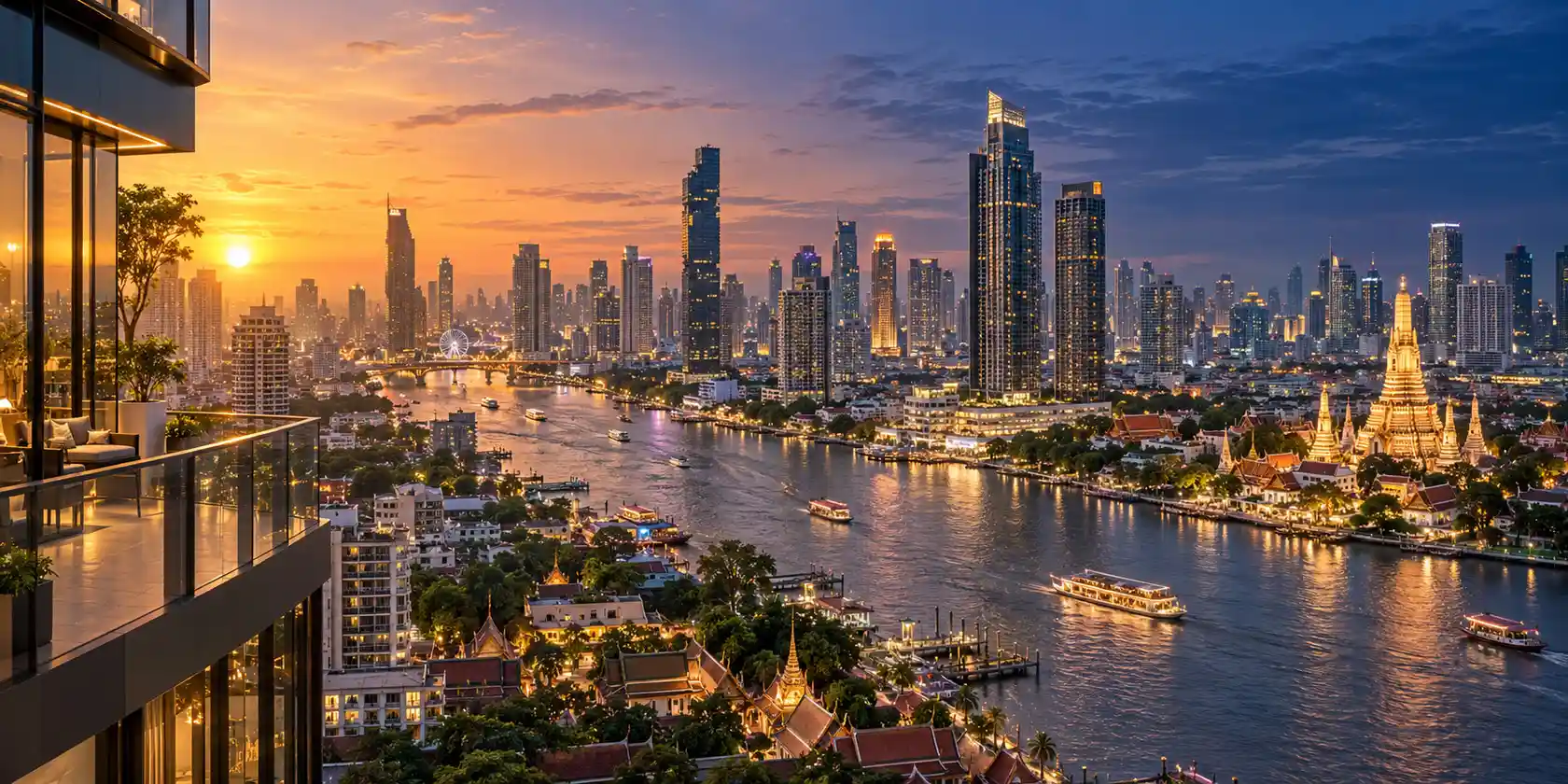
Bangkok Riverside
The Chao Phraya River creates another distinct Bangkok real estate market.
Riverside property includes:
- luxury condominiums
- branded residences
- large family units
- hotel-linked residences
- established waterfront towers
The attraction is obvious.
A genuine direct river view can provide a quality that is difficult to reproduce.
However, buyers should still evaluate:
- road access
- BTS or MRT connectivity
- boat transport
- surrounding neighbourhood
- future construction
- exact view orientation
“Riverfront” should never replace normal property analysis.
A spectacular view combined with inconvenient access can limit both tenant demand and resale.
Ari
Ari has developed into one of Bangkok’s most distinctive urban residential neighbourhoods.
It combines established homes, low-rise streets, cafés, restaurants and condominium development with BTS access.
Ari is less dominated by international luxury branding than Central Lumpini or Prime Sukhumvit.
Its strength is neighbourhood character.
That can appeal to buyers prioritising:
- long-term living
- central location
- local atmosphere
- restaurants and cafés
- BTS access
Ari illustrates an important principle:
a strong neighbourhood can sometimes matter more than a luxury label.
Rama 9 and Ratchada
Rama 9 and Ratchada represent another side of the Bangkok market.
These areas contain substantial condominium, office, retail and infrastructure development.
They can appeal to buyers and tenants looking for:
- modern condominiums
- MRT connectivity
- office employment
- shopping
- more accessible purchase prices than Prime Central Bangkok
However, competing supply needs particular attention.
Where hundreds of similar units exist, rental and resale performance can become highly price-sensitive.
For investors considering Bangkok real estate in high-density corridors, the key question is:
Why will a future buyer or tenant choose this exact unit rather than the alternatives?
BTS and MRT Access
Bangkok is a transport-driven property market.
For many buyers and tenants, Bangkok real estate located within genuinely practical walking distance of mass transit has a clear competitive advantage.
Walking access to BTS or MRT can materially influence residential demand.
But buyers should test marketing claims in real conditions.
“500 metres from BTS” sounds convenient.
The actual journey might involve:
- narrow pavements
- major road crossings
- heavy traffic
- extreme heat
- poor shelter during rain
Real walkability matters more than map distance.
For tenants without cars, genuinely practical mass-transit access can be one of the strongest advantages a condominium possesses.
Branded Residences
Branded residences have become increasingly important in Bangkok’s super-luxury market.
These developments may involve hotel or luxury brands providing:
- management
- concierge
- services
- design standards
- international branding
CBRE’s H1 2026 research specifically highlights Sukhumvit and Central Lumpini as important markets for branded residences.
But the brand itself should never replace analysis of the property.
Buyers need to understand:
- legal ownership
- management fees
- service charges
- operator agreement
- resale conditions
- rental arrangements
- owner-use restrictions
Within premium Bangkok real estate, branded residences should be treated as a specialised product category rather than automatically as a superior investment.
Foreign Freehold Condominiums
For many international buyers, condominiums are the most straightforward segment of Bangkok property.
Thai condominium law allows qualifying foreign buyers to own condominium units under registered foreign freehold, provided the statutory foreign ownership requirements are satisfied.
The foreign ownership limit applies to the aggregate saleable area of the registered condominium, not simply the number of units.
Buyers should therefore confirm foreign quota availability before committing to a transaction.
For the wider Thai ownership framework, see JFTB’s Buying Property in Thailand as a Foreigner.
“Freehold” Does Not Always Mean Foreign Freehold
This distinction is particularly important for international buyers.
A condominium unit may be freehold but currently allocated within the Thai ownership quota.
That does not necessarily mean it can immediately be transferred into a foreign buyer’s name.
Foreign buyers should establish:
- current ownership
- foreign quota availability
- transfer eligibility
- required foreign currency documentation
before paying significant non-refundable deposits.
Within Bangkok real estate, ownership structure can directly affect the size of the future international buyer pool.
Foreign Quota Can Affect Resale
Two otherwise similar units in the same building may have different appeal to foreign purchasers if one can be transferred under foreign freehold and another cannot.
That can affect liquidity.
In projects with strong international demand, foreign quota can therefore carry practical commercial value.
Legal ownership should be established at the beginning of the transaction, not left until transfer day.
Freehold vs Leasehold
Bangkok also contains important leasehold residential projects, particularly in prime locations where underlying land is held by institutions or long-term owners.
Leasehold should not automatically be dismissed.
Some exceptional developments occupy locations that would be extremely difficult to replicate.
But leasehold is fundamentally different from freehold.
Buyers need to understand:
- remaining lease term
- lease registration
- transfer rights
- inheritance
- contractual renewal wording
- resale market
- financing implications
The acquisition price should reflect both the quality of the property and the legal structure.
New Development vs Resale
Bangkok offers enormous choice between new projects and established buildings.
New developments can provide:
- contemporary design
- modern facilities
- newer systems
- staged payments
- new-building appeal
Resale property can offer:
- proven management
- established surroundings
- actual views
- rental history
- immediate inspection
- sometimes substantially larger units
One of the most common mistakes in Bangkok real estate is assuming newer automatically means better.
In established neighbourhoods such as Phrom Phong, Thonglor, Sathorn or Central Lumpini, older buildings can occupy sites that would be prohibitively expensive to reproduce today.
Off-Plan Risk
Buying before completion can provide access to new developments and staged payment structures.
It also introduces additional risk.
Buyers should review:
- developer track record
- contractual terms
- construction progress
- payment schedule
- specifications
- expected completion
- orientation and view
- surrounding future development
- competing supply
The key question is not only whether the development will be completed.
It is whether the completed unit will justify its total acquisition price when competing stock is available.
The Resale Market Matters
Exit strategy should be considered before purchase.
Bangkok has a deep residential market, but liquidity varies enormously between products.
A one-bedroom unit in a project containing hundreds of nearly identical apartments may face significant price competition.
A rare large unit in a proven prime building may have fewer substitutes.
The strongest Bangkok real estate purchases usually have a clear reason why a future buyer would choose them.
That reason could be:
- location
- protected or difficult-to-reproduce view
- large unit size
- exceptional layout
- foreign freehold
- strong building reputation
- limited competing supply
Rental Demand
Bangkok has substantial long-term rental demand.
Potential tenants include:
- Thai professionals
- international executives
- diplomats
- international teachers
- corporate relocations
- entrepreneurs
- expatriate families
But tenant profiles vary substantially by district.
A Japanese executive looking in Phrom Phong or Thonglor may have very different priorities from a professional working around Rama 9.
Identify the intended tenant before selecting the property.
The depth of Bangkok real estate rental demand is one of the city’s main strengths, but tenant profiles vary significantly between districts.
Rental Yield Should Be Net, Not Headline
An attractive advertised gross yield can be misleading.
Actual investment performance needs to account for:
- common-area fees
- management
- vacancy
- repairs
- furnishings
- agent commissions
- insurance
- taxes
- refurbishment
A high-value property in Prime Central Bangkok may provide a relatively modest percentage yield while representing an exceptional asset.
A cheaper condominium farther from the centre may show a higher headline return while carrying greater vacancy or resale risk.
Yield should never be separated from asset quality.
Small Units Are Not Automatically Better Investments
Bangkok has substantial studio and one-bedroom inventory.
Lower purchase prices can make smaller units attractive to investors.
But supply matters.
If a project contains hundreds of near-identical apartments, tenants can often compare units primarily on rent, floor and condition.
Larger or unusually well-designed units may cost more but face less direct competition.
This is particularly relevant in established expatriate markets.
Building Management Matters
The unit is only one part of a condominium investment.
The building itself matters.
For resale condominiums, investigate:
- common areas
- lifts
- swimming pool
- gym
- security
- parking
- sinking fund
- common-area charges
- juristic management
- planned major repairs
A poorly managed building can damage both rental demand and resale value.
For older Bangkok real estate, good management can matter more than cosmetic age.
Bangkok Property Prices Need Context
Price per square metre is useful.
It is not enough.
A proper comparison needs to consider:
- freehold or leasehold
- new or resale
- building age
- floor
- view
- unit size
- furnishings
- developer
- facilities
- exact street
- mass-transit access
Two properties in neighbouring buildings can legitimately trade at substantially different prices.
That is why a single average “Bangkok condo price” is rarely useful for an individual purchase decision.
The 2026 Market Rewards Selectivity
Official market data reinforces this need for selectivity.
The Real Estate Information Center’s Q2 and H1 2026 Bangkok Metropolitan Region market report reported that residential ownership transfers increased 29.6% in unit volume and 15.9% in value year-on-year.
At the same time, the value of newly launched residential projects declined 25.4%, while the number of new units launched increased only 0.8%.
These figures apply to the Bangkok Metropolitan Region, not only Central Bangkok condominiums.
They should therefore be used as macro market context rather than as a pricing indicator for individual districts.
The broader message is nevertheless useful:
transactions continued while supply and development activity remained selective.
That is a healthier way to analyse the 2026 market than assuming a universal Bangkok boom.
International Buyers Remain Important — But the Data Is National
Foreign condominium demand remains relevant to Thailand’s residential market.
According to REIC’s H1 2026 foreign condominium transfer data, foreign buyers received 6,533 condominium units nationwide during January–June 2026, with a total transfer value of THB 28.267 billion.
Compared with the first half of 2025:
- unit transfers declined 8.8%
- transfer value declined 1.5%
The smaller decline in value than in unit volume indicates that higher-value international purchases continued to represent a meaningful part of the market.
However, these are Thailand-wide figures, not Bangkok-only statistics.
They should not be presented as direct evidence of demand in a specific Bangkok building or district.
For Bangkok real estate, building-level foreign demand still needs to be assessed individually.
Bangkok vs Phuket for Property Investment
Bangkok and Phuket are two of Thailand’s most relevant property markets for international buyers, but their demand drivers are very different.
Comparing Phuket with Bangkok real estate therefore requires looking at the underlying source of demand rather than simply comparing purchase prices or advertised yields.
Bangkok
Demand is supported primarily by:
- employment
- corporate activity
- domestic population
- international business
- education
- hospitals
- mass transit
Phuket
Demand has a stronger relationship with:
- international lifestyle migration
- tourism
- second homes
- villas
- resort living
- long-stay residents
This creates very different investment profiles.
Bangkok Generally Has a Deeper Urban Buyer Base
Bangkok benefits from a huge domestic population and employment base.
That can support deeper resale demand for appropriately located and correctly priced residential property.
However, this advantage disappears if the unit is poorly located or surrounded by excessive competing supply.
Phuket has a smaller permanent market but can attract international lifestyle purchasers willing to pay premiums for:
- sea views
- villas
- resort environments
- beach access
- lifestyle
Neither city is automatically more liquid.
Liquidity belongs to the property, not simply the city.
Bangkok Is Primarily a Condo Market for Foreign Buyers
Another major distinction is property type.
International purchasers in Bangkok often focus on condominiums because qualifying foreign-freehold units provide a relatively straightforward ownership structure.
In Phuket, many foreign buyers also consider villas.
That creates additional questions around:
- land
- leasehold
- building ownership
- project structure
Bangkok therefore tends to provide a more standardised foreign-purchaser product.
Phuket offers greater diversity but often requires more property-specific structuring and due diligence.
Rental Demand Is Different
Bangkok tenants frequently rent because they need to live close to:
- employment
- transport
- schools
- business districts
Phuket tenants may rent because they are relocating for lifestyle, spending several months on the island or working within tourism and hospitality.
Bangkok can therefore provide substantial year-round demand in the right locations.
Phuket can command lifestyle and seasonal premiums in selected markets.
For the Phuket investment perspective, see JFTB’s Phuket Property Investment 2026 guide.
Bangkok Is Not Automatically the Safer Investment
A large metropolitan market does not remove risk.
Bangkok buyers can still overpay for:
- oversupplied projects
- weak developers
- inconvenient locations
- poor layouts
- badly managed buildings
- leasehold property priced like freehold
- units with no differentiation
The size of Bangkok increases choice.
It also increases the number of mediocre properties available.
Selection matters.
Due Diligence Before Buying a Bangkok Condo
Before buying, international purchasers should verify at minimum:
- condominium title
- seller ownership
- foreign quota
- encumbrances
- registered unit area
- outstanding common fees
- condominium juristic records where relevant
- building management
- physical condition
- transfer requirements
- contractual obligations
For resale units, inspect the actual property.
For off-plan units, contract and developer due diligence becomes more important.
Visit at the Right Time
A Sunday morning viewing may tell you very little about Bangkok daily life.
Serious buyers should revisit the location:
- during weekday rush hour
- after work
- at night
- after heavy rain
- on foot from BTS or MRT
Listen for traffic.
Walk the actual route.
Observe neighbouring land.
Look at construction sites.
Check whether taxis and ride-hailing vehicles can access the building easily.
Bangkok property is highly sensitive to its immediate urban environment.
Future Construction Can Change a Property
Skyline views are not necessarily permanent.
Before paying a significant premium for an open view, investigate neighbouring land.
A vacant plot or low-rise building may eventually become another high-rise.
This matters particularly in dense areas of Sukhumvit and the central business districts.
A view premium should be supported by an understanding of what may legally and practically be developed nearby.
Who Should Consider Bangkok Real Estate?
Bangkok can be particularly suitable for buyers seeking:
- foreign-freehold condominiums
- year-round rental demand
- urban living
- corporate-city exposure
- substantial resale markets
- international healthcare
- mass-transit access
- luxury or branded residences
- diversification within Thailand
It may be less suitable for buyers whose priorities are:
- private pools
- large land plots
- direct beach lifestyle
- holiday-villa use
- tropical resort living
For those objectives, Phuket may provide a stronger fit.
Frequently Asked Questions
Can foreigners buy property in Bangkok?
Foreigners may own qualifying condominium units under foreign freehold, subject to Thailand’s condominium ownership rules and the statutory foreign ownership quota. Foreigners generally cannot directly own Thai land.
Can foreigners own a Bangkok condo freehold?
Yes. A qualifying foreign purchaser can own a condominium unit under registered foreign freehold if the legal requirements are satisfied and sufficient foreign quota is available within the registered condominium.
What is the best area to buy property in Bangkok?
There is no universal best area. Phrom Phong, Thonglor, Ekkamai, Asoke, Central Lumpini, Sathorn, Riverside, Ari and Rama 9 serve different buyer and tenant profiles. The appropriate area depends on budget, use and investment strategy.
Is Sukhumvit good for property investment?
Sukhumvit contains several of Bangkok’s strongest international residential markets, but performance varies significantly between buildings and micro-locations. BTS access, building quality and competing supply remain critical.
Is Thonglor better than Phrom Phong?
They offer different environments. Phrom Phong has a particularly established international residential and retail ecosystem, while Thonglor has a strong lifestyle, restaurant and nightlife identity. Individual building quality matters more than the neighbourhood name alone.
Is Bangkok property a good investment in 2026?
There are attractive opportunities, but the market is selective. Current 2026 data shows meaningful transaction activity alongside cautious new development, while prime luxury projects have performed strongly. Property-specific analysis remains essential.
Are luxury Bangkok condos still in demand?
CBRE’s H1 2026 research reported high sales rates among completed downtown luxury condominium projects, particularly in established premium locations. That does not mean all luxury projects perform equally.
Is Bangkok good for rental investment?
Bangkok has substantial long-term rental demand generated by employment, business, education and international communities. Performance depends on location, building, unit type, rent and competing supply.
Is freehold better than leasehold in Bangkok?
Foreign freehold generally provides simpler long-term ownership characteristics, but some exceptional Bangkok developments are leasehold. Lease duration, location, price and resale conditions need to be assessed together.
Should I buy new or resale in Bangkok?
Both can work. New developments offer modern specifications, while established resale buildings can offer proven management, larger units and exceptional locations. Buyers should compare total acquisition cost rather than simply building age.
Is Bangkok better than Phuket for property investment?
They serve different strategies. Bangkok is an employment-driven metropolitan market dominated by condominiums, while Phuket has stronger lifestyle, tourism, villa and second-home demand. Neither is universally superior.
Does proximity to BTS increase property value?
Good access to mass transit can materially improve convenience and tenant demand, but the effect depends on the neighbourhood, building quality, competing supply and actual walking conditions.
What is the biggest risk when buying a Bangkok condominium?
One major risk is overpaying for an undifferentiated unit with substantial competing supply. Legal ownership, foreign quota, management, location and future resale demand should all be assessed before purchase.
Buying Bangkok Property with JFTB
The size of Bangkok creates extraordinary choice.
That is both its greatest strength and its greatest danger.
There are thousands of condominium buildings, many significant residential districts and enormous differences in quality, price and future liquidity.
The objective should therefore not simply be to buy “Bangkok”.
It should be to identify a specific property with a defensible reason to own it.
That reason could be an exceptional Central Bangkok location.
It could be genuine walking access to BTS.
It could be a large foreign-freehold unit in an established international residential district.
It could be a rare river view.
It could be an exceptionally well-managed resale building that would be difficult to reproduce at current land and construction costs.
The strongest Bangkok real estate purchases combine location, ownership, building quality, realistic rental demand, acquisition price and future resale appeal.
JFTB Real Estate assists international buyers evaluating property in Thailand with property sourcing, comparative market analysis, negotiation and coordination of independent legal and technical due diligence.
For buyers comparing Bangkok with Phuket, the objective is not to decide which city is universally better.
It is to determine which market — and which specific property — best matches the buyer’s capital, intended use and investment horizon.